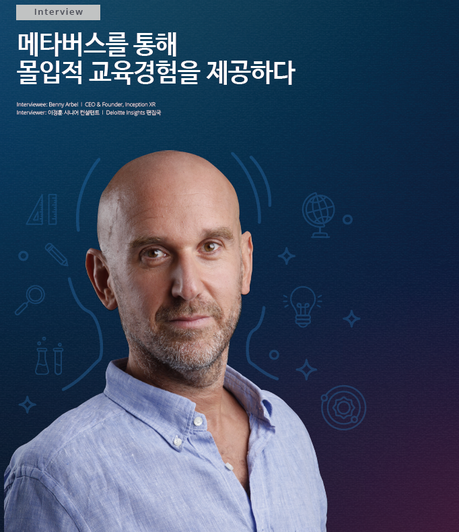
Interviewer: Lee Jung-hoon, Senior Consultant l Deloitte Insights Editorial
| The following is an excerpt from Deloitte Insights 2022 No. 23 'Invitation to the Metaverse: A Land of Opportunity.' The report can be downloaded and accessed at Deloitte Insights (https://www2.deloitte.com/). |
About Inception XR
Q. Could you briefly introduce Inception XR and describe your role as CEO?
A. Inception XR's platform uses interactive, gamified content created with 3D and AR technology to produce highly effective and engaging educational content. In traditional educational environments, content delivered to students is presented in a very dull manner compared to the games and video media they easily encounter in everyday life, creating a problem where students cannot become immersed in educational content.
Inception XR is innovatively transforming the education industry using digital technology to deliver excellent educational content while also, as mentioned, contributing to closing the gap between consumer content and educational content. Although our first product is focused on the K-12 stage (kindergarten through high school), our strategy is to support all learning processes in embracing 3D/XR, immersion, gamification, and interactivity. In fact, we have already begun content development related to job training.
Q. Bookful, Inception XR's flagship product and augmented reality application, has already attracted attention through many media outlets, providing AR experiences. Could you explain Bookful and how it provides value to consumers?
A. Bookful is a 3D/AR learning application targeting children ages 3 to 10. The reason children love the product is that each piece of content has diverse and rich 3D elements. Children can also interact with each piece of content and become immersed in the content's world.
The reason parents love Bookful is that the application not only provides positive content that benefits children but also contributes to improving children's reading comprehension and understanding.
Of course, parents say the biggest reason they love Bookful is that their children become interested in books themselves, whether in virtual reality or in real life.
Q. How much content is in the Bookful application? And do users need actual books to use the application?
A. There are currently over 500 animation-based 3D/AR pieces of content, and within each piece of content you can experience 3 to 5 activities. Users do not need actual books to use the application.
Q. Will the Bookful application be available in other languages? Potentially also in Korean, so readers of this interview can try it?
A. Yes. Regarding Korean, in fact content is already being provided in Korean through our business partner LG U+. Furthermore, there is a lot of content provided not only in the Korean UI but also in English books and Korean, which will contribute to improving not only reading comprehension but also English skills. The service is being provided in the form called 'U+ Kids Vivid Library' (AR Magic Library).
Q. To strengthen immersive educational content, what does Inception XR plan to do going forward?
A. In terms of our future plans, we have three directions.
First is to build stronger partnerships with educational publishers and educational institutions such as Oxford University, Pearson, and Collins to develop applications with a clear target customer base and solid educational purposes. For example, we are already proceeding with collaboration with Oxford University Press targeting parents who have concerns about whether their children can attend school or follow along well in the early years of school.
This collaboration is designed to help children's learning in various aspects using the early years learning framework. Furthermore, we have established partnerships targeting learners of various age groups, including partnerships to address STEM (Science, Technology, Engineering, Mathematics) learning for 12 to 15-year-old adolescents.
The second direction is to continue strengthening the educational platform we currently offer. Through this, specifically, we will support more diverse types of devices going forward while being fully prepared for current and future applications. For example, although we have focused our business on smartphones and tablet PCs, we are also working on applying these to devices such as Chromebooks, which are important in educational environments, as well as AR glasses and VR headsets. This platform will initially support job training and further on, higher education as well.
Also, we are building diverse forms of content delivery methods that allow our platform to provide a more immersive educational environment. Currently in the Bookful application, we have developed core content delivery methods such as picture books, storybooks, coloring, and word matching, and going forward we will support more diverse delivery methods that can be utilized in most educational environments, helping children to explore educational content more and have immersive learning experiences in a 3D environment.
Also, going beyond a single application providing content in one specific field, we will evolve into a comprehensive educational platform providing very diverse types of content, supporting teachers and students in dealing with specific curricula by selecting each different piece of content and then being able to mix and utilize them.
As the last third direction, we will develop, test, and repeat these processes with our technology to ensure that scientifically proven and clear learning effects apply to children of all ages.
Q. It appears that Inception XR has also formed partnerships with numerous intellectual property holders and telecommunications companies. Could you give an example of how Inception XR is providing value to these partners?
A. We provide telecommunications companies with educational 5G content that consumers need. 3D and XR content is representative 5G content that requires high bandwidth and low latency. We are cooperating as a leading partner for 5G educational content with LG U+ in Korea, China Telecom in China, and AT&T in the United States, appealing through this as content that both existing and new 5G users can experience.
By working with us, intellectual property holders can have their educational content transformed into more immersive experiences and delivered and utilized by consumers. Furthermore, intellectual property holders come to understand how XR works and how we can play a key role in their metaverse strategies.
Metaverse Outcomes in the Education Industry
Q. It is very interesting that immersive learning through metaverse technology allows us to understand historical and scientific events in a vivid way. Such learning has traditionally been done through text-based media such as books, pamphlets, and newspapers. Moreover, due to the recent COVID-19 pandemic, some educators took virtual field trips with their students. However, regarding the academic effectiveness of metaverse utilization, have there been notable learning outcomes and improvements for users of Inception XR services?
A. Dr. Gal Ben-Yehudah, a pioneer in cognitive neuroscience, measured the effectiveness of Bookful through experimental research targeting children who use Bookful and those who do not. In conclusion, it was proven that Bookful has clear educational effects in increased vocabulary usage and comprehension, and most importantly, children becoming interested in books and reading them on their own.
Q. During the COVID-19 pandemic, online learning courses showed once again that students can learn remotely. However, the lack of direct interaction in online learning environments made learners feel isolated. Some research says that students' academic achievement fell behind due to online learning during the COVID-19 pandemic. What is different about metaverse learning compared to remote online learning? Can metaverse learning compensate for the negative aspects of online learning?
A. Remote learning exposed the weaknesses of traditional educational methods. Without a teacher standing in front of students, students experienced difficulty becoming immersed in educational content. In other words, the same type of content was simply delivered in a different way.
For education to work effectively in a metaverse environment, educational content needs to be newly structured and optimized. In other words, rich XR animation, gamification, and interactivity must be integrated into educational content.
Q. Different societies have different capabilities for utilizing metaverse technology. For example, marginalized groups may not have sufficient funds to deploy AR/VR devices in their educational environments. Also, certain groups of people may lack the understanding or engagement necessary to utilize metaverse technology compared to other groups. What has been the response of governments utilizing Inception XR's services, and can you share a successful example?
A. We are receiving positive responses from numerous customers, but looking at the overall impact we deliver, even households in economically and socially difficult circumstances that can barely keep books at home can, through our service, provide hundreds of books to their children at very low cost. Also, single-parent households that have almost no time to read books to their children can substitute reading to their children through our service.
Q. Unlike the MZ generation, who feel little difficulty using new technologies like the metaverse, baby boomers may find it difficult to use such technology. Nevertheless, many teachers and professors are still from the baby boomer generation, and while there will be individual differences, the full potential of the metaverse in educational environments may not be realized. Is Inception XR providing technical support to those who experience these difficulties? How will Inception XR respond to these challenges?
A. We believe that great technology should also be simple to adopt. Most of the technology provided by Inception XR is designed to be very easy to use, from infants as young as 3 to the baby boomer generation. By paying sufficient attention to the overall composition and UI/UX, it will be possible to overcome the generational barriers that come with new technology.
Q. As metaverse technology gradually matures and more companies are expected to apply the metaverse to their businesses, what does Inception XR want to achieve within the next 5 years?
A. We are focused on revolutionizing the educational environment by creating educationally sound XR educational content and experiences with gamification and interactivity. We aim to build business partnerships that can strengthen our capabilities and expand our business domain in the K-12 market going forward.
Industry and Market
Q. Currently, metaverse applications are mainly utilizing 2D forms to promote virtual experiences. For example, combining AR technology with a phone to capture virtual images on screen is one such example. However, as AR glasses and HMDs gradually spread to the public within the next few decades, the metaverse market is expected to grow even faster. In terms of the education industry, what are the prerequisites for the metaverse to spread rapidly?
A. In terms of the education industry, we think AR glasses will be a bigger game changer than VR headsets. The reason we think so is that the education industry still prefers use that is connected to reality to some extent rather than XR that is completely independent from reality, and accordingly it is much easier to deliver XR content in the form of AR.
Q. Although the purchase cost of AR glasses and HMDs is falling, there are several questions that need to be answered before they are widely used in schools. For example, questions like these might arise: Are they truly safe for young children? Or have those XR devices dropped to a price level that we can really easily purchase them?
A. I think the biggest difficulty in applying the metaverse in the education industry is the perspective on the metaverse and bureaucracy. For the metaverse to truly be activated and grow in the education industry, we need to provide measurable results that go beyond what current business models provide. At the same time, core elements of the existing traditional form need to be integrated. This means that technology can be implemented gradually, maintaining a progressive approach that moves from the existing way to a better way, rather than a revolutionary approach that changes the existing way.
Q. There are various metaverse contents in the market. Some provide metaverse experiences tailored to educational content, and others provide metaverse experiences tailored to social networking and games. It is welcome that so many metaverse worlds coexist and expand their domains, but experiencing all these metaverse worlds one by one and grasping the trends simultaneously disperses our attention. Do you think integration/cooperation between metaverse worlds will occur in the future? If so, what form will this integration/cooperation take?
A. I think there are cases where integration/cooperation occurs and cases where it does not. Initially, I think there is a possibility that anyone can easily build and create the metaverse. However, as time passes, just as web platforms have been consolidated in the cases of Google, Facebook, Twitter, and LinkedIn, the metaverse of the education industry may also be integrated in that way. However, as experienced in past web environments, we expect there will be enough space for many niche players who will satisfy each individual user.
Q. What is the state of the metaverse market in Israel and the United States? What do you think are the most important points in the development of the metaverse ecosystem? What might those lessons suggest for the development of the metaverse in the Korean market?
A. The metaverse ecosystem is still in early stages, and regarding ecosystem growth it is moving in the right direction, but I still think there is a long way to go. The main lesson we see at this stage of building an early ecosystem is that the people currently in the metaverse are early adopters, but to secure mainstream users it is very important to have the appropriate elements that mainstream users seek. Only then can it become a sustainable metaverse ecosystem.