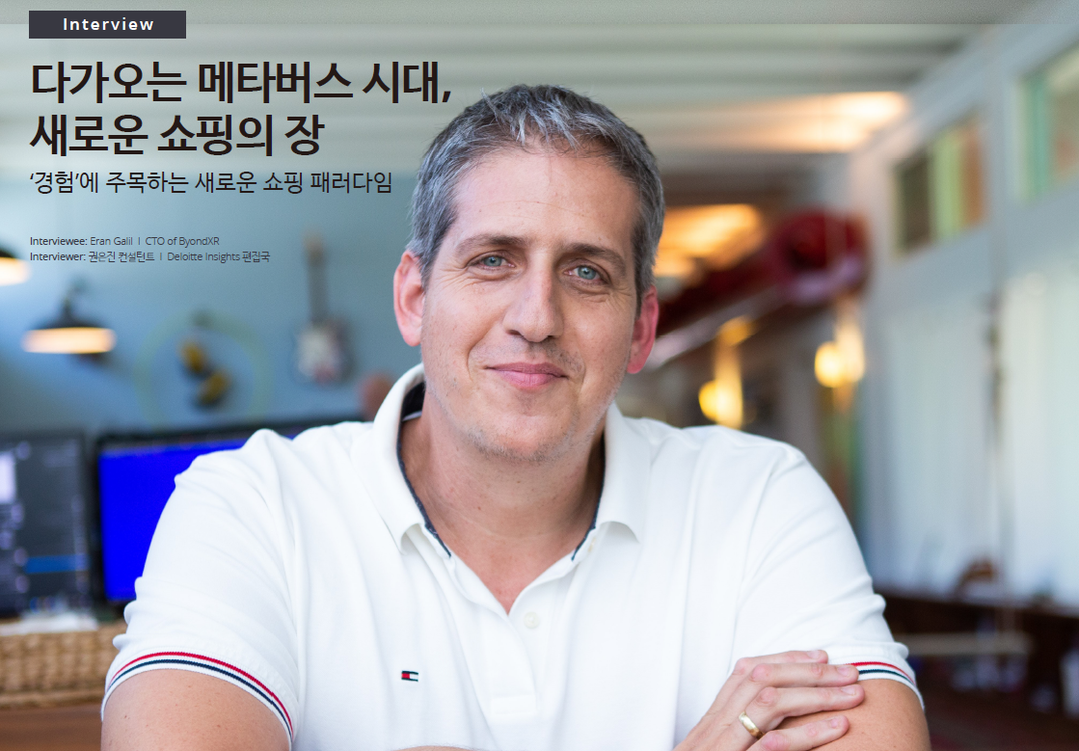
Interviewee: Eran Galil l CTO of ByondXR
Interviewer: Kwon Eun-jin, Consultant l Deloitte Insights Editorial
| The following is an excerpt from Deloitte Insights 2022 No. 23 'Invitation to the Metaverse: A Land of Opportunity.' The report can be downloaded and accessed at Deloitte Insights (https://www2.deloitte.com/). |
Consumers became accustomed to contactless methods such as online shopping, telemedicine, remote work, and remote classes due to social distancing during the COVID-19 pandemic. As part of this change, the venue for online shopping is becoming increasingly active and continues to grow.
Looking only at domestic online shopping transaction volumes, the annual online shopping transaction volume in 2020 recorded approximately 161 trillion won, an increase of 19.1% compared to the previous year, and in 2021 it was approximately 193 trillion won, approaching a 21% increase compared to the previous year. In a situation where consumers had no choice but to choose contactless methods, consumer receptivity to new technologies grew.
In this context, the metaverse is emerging as a new topic in the consumer goods industry. According to a Deloitte survey, 94% of consumers agreed that the degree to which they utilize AR when shopping will be similar to or increase from the current level.
Also, products offering AR experiences were found to show conversion rates 94% higher than those that do not. Among fast-moving companies, cases of using the metaverse to enhance customer experience and target the MZ generation emerging as the main consumer demographic are already appearing frequently. Looking at these trends, the metaverse is no longer an option for consumer goods companies.
However, for consumer goods companies to build the metaverse themselves and develop the technological capabilities to attract consumer interest requires enormous manpower and costs over a long period. ByondXR, an Israeli company headquartered in New York, USA, uses technologies such as AR and VR to realize the offline stores and showrooms of consumer goods brands in the metaverse, enabling new communication methods between consumers and brands and creating innovative consumer experiences. The company paid attention to the unique 'experience' that consumers can gain in showrooms and stores in the metaverse.
In this interview, we explore how ByondXR's CTO Eran Galil is resolving the consumer need to experience new shopping and the consumer goods companies' need to respond to this need.
Q. Please introduce ByondXR and the business domain you are in.
A. ByondXR, established in 2016 by professionals with more than 25 years of experience in the technology field, is ahead of its time by predicting upcoming trends and creating the environment where these trends are realized in reality. Various brands, retailers, and wholesalers can create new consumer experiences through ByondXR, which helps the retail sector adopt the metaverse while also creating consumer experiences that improve consumer satisfaction, loyalty, and engagement.
We have launched virtual stores in France, Germany, Japan, Australia, Thailand, Hong Kong, South Korea, Malaysia, the United States, and other places, and looking at KPIs after launch, user dwell time increased by more than 4 times, and most importantly, e-commerce sales increased by more than 25%. Also, membership registrations increased by more than 180%, and the average age of shoppers decreased by about 9 years.
ByondXR creates virtual stores that are entirely new worlds made by mimicking physical spaces. Virtual stores can be an immersive experience on the web or can be realized as augmented reality in an actual physical space. Through gamified activities and VR headsets, we can drive customer engagement and increase customer retention rates. We are a global company operating 24 hours a day with offices in the United States, Israel, and Europe, striving to provide seamless solutions.
Q. You are providing services that allow retail and wholesale brand companies to build virtual spaces and showrooms through the metaverse. Please introduce the solutions you offer.
A. We offer three solutions: Virtual Stores, Virtual Showroom, and XR Visualizer. Consumers can access these platforms anytime, anywhere, on any device.
All three solutions are basically used to show a brand's products to users, but each has a different purpose. The Virtual Store is a B2C solution used by general consumers.
The Virtual Store, a realistic 3D shopping environment, is a consumer-friendly platform focused on entertainment and information delivery for consumers. For this, elements such as games and avatars are included. Consumers experience an interactive shopping journey, capturing consumers' hearts by expanding their imagination through engaging activities and immersive experiences. Accordingly, shopping time noticeably increases, and the conversion rate from simple visitors to actual buyers also increases.
The Virtual Showroom is a B2B solution focused on showing new product collections in the best way to buyers, not the final users of the products. Brands then don't need to fly to wherever the buyer is to show them samples.
This solution grew very strongly due to the pandemic, and it had already been helping to resolve sustainability issues before that. Sample production is one of the issues that undermines sustainability from an environmental protection standpoint, but using this solution eliminates the need to make samples. In the Virtual Showroom, the company's product collection is vividly shown in realistic 3D. Interaction with products is also possible in the Virtual Showroom, and comprehensive yet detailed information is provided to buyers at every stage. We use multi-layered data to show new product collections at a very realistic level, making our clients' business interactive, innovative, and sustainable.
The XR Visualizer is mainly used in the home decor field and is a solution for envisioning how to design interiors. In the case of virtual stores and showrooms, we create 'spaces' for consumers so they can try various experiences within them, while in the case of the XR Visualizer, users can directly mix and match furniture, kitchen counters, walls, tiles, flooring, and other products to change the space itself as desired. Through this, we provide consumers with the best experience to aid their decision-making and create memorable brand experiences.
Q. Which types of companies mainly use these solutions, and for what purposes?
A. We are currently mainly providing custom metaverse virtual stores to leading consumer goods, beauty, and luxury brands. These brands use virtual stores to enter the metaverse and showcase bestselling products. They also introduce new social initiatives and connect offline stores with virtual stores.
Virtual stores are also being used to increase consumer engagement, introduce new products, and highlight existing products. They are also used to boost customer loyalty and sales. Virtual Showrooms are used by leading wholesalers in the retail field to introduce and manage new collections.
XR Visualizers are mainly used by tile manufacturers, furniture makers, and home accessories retailers.
Business Environment
Q. After the pandemic, digital transformation has accelerated as consumer goods industries responded to the contactless consumption pattern, and with rising expectations for the metaverse, distribution and consumer goods companies are turning their eyes to the metaverse. How large is the current market of companies seeking to utilize virtual stores and showrooms in the metaverse?
A. We see this market as huge. More and more users want a new shopping experience that departs from conventional shopping methods. And they want to have these experiences online. Building a virtual store in the metaverse can directly meet these needs. We currently estimate the virtual showroom apparel market at approximately $380 billion, the virtual store fast-moving consumer goods (FMCG) market at $1 trillion, and the XR Visualizer home decor market at $220 billion.
Given the current state of the e-commerce market in our business domain, we think the number of metaverse shoppers could reach the level of regular shoppers within a few years, and may even surpass them. This is because more and more activities will move to virtual.
Q. What has been the trend in the number of users over the past 2-3 years? What is the user forecast for the next 5 years?
A. Three years ago, the number of users was only in the hundreds of thousands. Now, two and a half years into the pandemic that accelerated digital transformation, we estimate the number of virtual store and showroom users to be in the hundreds of millions and still growing. If we include virtual stores built in existing metaverse environments or new metaverse environments such as Roblox, Horizon, Decentraland, and Zepeto, the total number of virtual store users reaches billions.
Technology
Q. What technologies are utilized in ByondXR's solutions?
A. Our software platform is fully built on the cloud, so it can be accessed through a regular web page without a separate download. The backend engine includes cutting-edge rendering techniques along with automatic real-time content processing, creating vivid, dynamic, immersive, and realistic scenes.
Through our publisher engine and toolset, we can change consumer behavior and interactions in near real-time, create stores quickly, and respond to our clients' requirements.
Q. I understand you also provide real-time behavioral analytics services. What technologies are applied here? What insights do you derive from this?
A. Through the internal data collection engine, all aspects of customer interactions on the virtual store, showroom, and visualizer are measured. For example, there are cases where customers don't understand what to click to proceed to the next stage, or the structure is too complex for the products to be seen properly. There might also be technical issues with certain devices. Through this real-time behavioral analytics, we can immediately grasp whether the store is functioning normally, whether there are user experience issues or technical problems that interfere with guiding consumer behavior as we want.
Q. Are there technologies you are investing in to strengthen realistic/immersive stores and customer experiences?
A. Yes there are. There is the best real-time rendering applied to the backend for rendering optimization, and technology that progressively delivers the store in parts. This is applied to the web front end to achieve the best results even in environments with slow network speeds.
Q. What do you think are the limitations of technology (XR devices, networks, etc.) in the current metaverse industry?
A. The key is how visually excellent and realistic the user experience appears on the web and general mobile devices. Currently, it is nearly impossible to create high-quality 3D gamified movement in a web environment with multiple avatars, but we are working to overcome these limitations.
Q. Do you intend to pursue partnerships or mergers and acquisitions with hardware, software, and application (platform) companies? If so, what synergy effects do you expect?
A. Yes, we are always interested. Especially so for partners we believe we can grow with through partnership.
We are looking for partners such as creative agencies and studios, and retail consulting firms related to performance management with which we can jointly build go-to-market strategies.
Consumers
Q. Among the various domains of cosmetics, clothing, interior, and others that you serve, which domain is currently getting the best response from consumers? What do you think is the reason?
A. The beauty industry is showing strength, but consumer packaged goods (CPG) is catching up quickly. Among CPG brands, there are many cases where the D2C (Direct-to-Customer) sales channel is very weak. For example, in the case of soap brands, they often always sell products through resellers like supermarkets or drug stores. Also, people buy cosmetics at places like iHerb or Sephora rather than the brand's official website. Therefore, these brands can build virtual stores to drive consumers to their own websites and strengthen the D2C channel. It becomes a new window for approaching customers.
Q. In the case of cosmetics, the reason consumers go to offline stores is to physically test them — applying them to skin, smelling them, checking the texture. There will be similar consumer needs in other industries as well. The metaverse seems to have difficulty satisfying these consumer needs at present. Nevertheless, what do you think is the reason consumers use metaverse showrooms or stores?
A. Consumers want to try, learn, and above all have an experience. There are many AI solutions that augment the sensory experience of feeling products on the body. It won't be exactly the same as actually using the product, but it produces amazing effects and is quite attractive. As consumers become more familiar with a brand, trust in that brand grows, leading to purchases.
Q. How are you overcoming the limitations of virtual stores and virtual showrooms where you can't physically see, feel, and test products?
A. We encourage consumers to request samples. Or we show them via AR how makeup or hair color would look on the consumer's skin. Ultimately, consumers' trust in the brand grows even without them actually using the product.
Also, we are utilizing gamification as part of the experience to help customers learn more about products and gain confidence in purchasing.
Q. Among virtual store and showroom users, it seems that younger age groups who are relatively familiar with the metaverse but have lower purchasing power would be the main users. For older consumers who have actual purchasing power, the metaverse may seem like a new and unfamiliar technology with a high barrier to entry. If so, how are you compensating for this?
A. Virtual stores are attracting younger generations. Virtual stores sometimes have a direct impact on purchases and sometimes lead to brand strengthening. Also, virtual stores are built to discover new customer segments. This is very important for beauty brands. For brands, brand exposure is important, not just conversion rates where visitors become buyers. Therefore, entering the attention span of all age groups is part of the goal. Millennials, Gen X, and baby boomers also want to shop where Gen Z shops.
Q. How do you communicate with consumers to further advance the customer experience?
A. We conduct user testing and small-scale limited beta launches, analyze them carefully, and improve based on the results. We also incorporate accumulated experience into stores and include them as part of the customer journey.
Outlook
Q. Is there a business domain beyond your current business that you could potentially diversify into?
A. We think our solutions such as virtual stores and showrooms can be utilized in almost any domain. Amazon also started with books and then expanded. Virtual stores started in the beauty domain but can expand to all domains. The potential is unlimited.
Q. When do you think the perfect realization and commercialization and popularization of realistic immersive content will occur?
A. I think it's possible within 2-3 years. It's going to be amazing.
Q. For the continued development of the metaverse industry, what investment/support is needed from governments or financial/venture investment industries in each country?
A. Governments can invest in giving those with constraints access to virtual spaces where they can have better, more inclusive and comprehensive experiences when handling everyday government-related matters. Communities can be formed in the metaverse, and political parties can campaign or form much stronger bonds with voters.
If governments create a metaverse version when proceeding with urban redevelopment projects, allowing citizens to have enjoyable time there before completion, urban redevelopment projects can become much more attractive to citizens. The possibilities are unlimited, as I say again.
Governments are watching the metaverse closely. Governments will play a pivotal role in the development and activation of the metaverse, from infrastructure such as 5G and 6G that will open up the possibility of better user experiences to related regulations. Just like other advanced technologies, the metaverse also seems to need a dedicated department such as a cyber department. Because the risks to be managed are large. It sounds like science fiction, but it's actually starting to happen.
Q. According to a recent Deloitte report, companies appear to be considering three scenarios for the metaverse. The first scenario is 'full immersion,' where most of the population embraces the metaverse, conducting business and enjoying leisure time in the metaverse with most of their time immersed in the metaverse. The second is the 'isolated generation' scenario, where only groups such as early adopters spend a lot of time in the metaverse within the limits that technology allows, while the rest of the population uses it only occasionally. Third, there is the 'augmented life' scenario, where the metaverse develops with more advanced technology to augment the physical world, facilitating and supplementing people's everyday activities — such as telemedicine and voice assistants. The report forecasts that due to investment flowing into this field, the metaverse will develop in the direction of the 'isolated generation' and 'augmented life' scenarios. As a professional working in the metaverse industry, in which direction do you think the metaverse will develop?
A. I completely agree with the report's view. The 'full immersion' scenario seems distant. I agree that it will lean toward the 'isolated generation' and 'augmented life' scenarios. In fact, these scenarios are happening. Particularly regarding 'isolated generation,' more and more use cases are emerging in areas such as shopping, video conferencing, education, and training, and they are developing very well. What we are developing is also called an 'eCommerce island' in the metaverse. That's very consistent.
For the 'augmented life' scenario to come to fruition, technology must be practical and easy to use. For example, always-on smart glasses and contact lenses could be a breakthrough.
ByondXR can be said to be investing in the 'isolated generation' scenario. Since we are also involved in AR, we can say we have also invested in the 'augmented life' scenario, but as a platform we are focused on creating new metaverse e-commerce islands.
Q. How do you plan to develop realistic and immersive stores and services? Please tell us about your future business vision.
A. New and exciting things are in progress. What I can tell you at this point is that we aim to become the gateway to the metaverse. We want to become a 'metaverse gateway' that can access different metaverses and is available to all brands and retail companies. We also aim to show this to users with the best possible visual quality and richness of appeal. We have plans to expand to other domains, from automobiles to F&B. All domains can benefit through our showrooms and stores. ByondXR wants to grow in each of these domains. We also want to grow together by cooperating with numerous types of channel and solution partners.