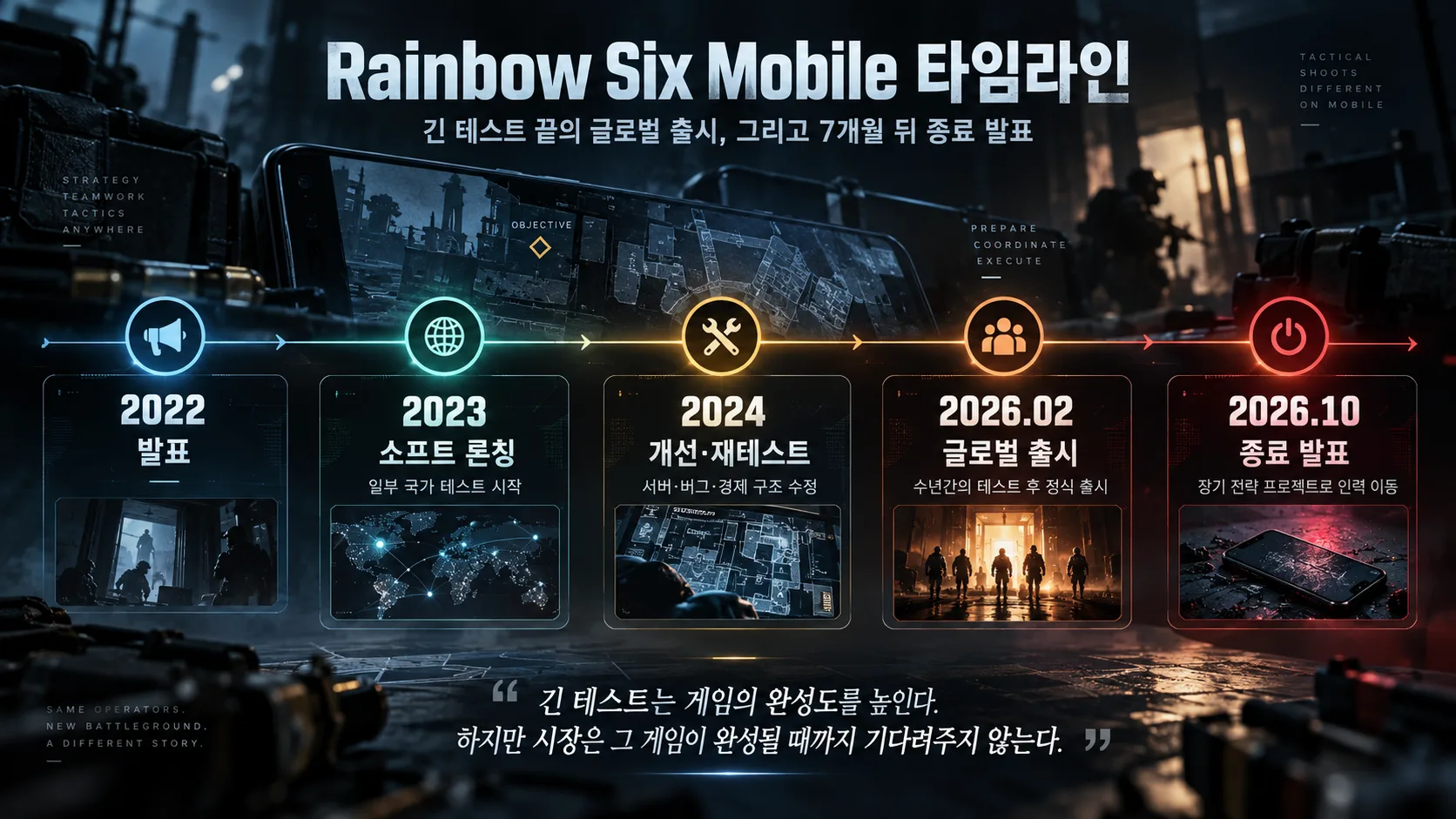
Rainbow Six Mobile launched worldwide in February 2026. At the time, Ubisoft emphasized just how long the game had been in preparation. The company said it had spent years refining the game through closed alpha tests, multiple beta phases, a soft launch, and final testing, continuously incorporating player feedback along the way. The soft launch alone had been running since 2023, with 15 seasons released during that period.

Then, on October 8, roughly seven months after the global launch, Ubisoft announced plans to wind down the game. Rainbow Six Mobile will end service on January 15, 2027, and the development team will move on to other long-term strategic projects. The company also said it would still release the next planned season even after announcing the shutdown, suggesting that this was not simply a case of servers becoming impossible to maintain or content suddenly running out. Ubisoft did not cite specific player metrics or technical problems as the reason for the decision, instead stating that the development team would move on to other long-term strategic projects.
The game’s initial market response was not particularly weak either. According to Sensor Tower, Rainbow Six Mobile ranked second among mobile games worldwide in download growth in February 2026, with especially rapid increases in the United States, the United Kingdom, and India. PocketGamer.biz, citing AppMagic estimates, reported that the game generated around $1.6 million in player spending across the Apple App Store and Google Play during its first 14 days after global launch.
Those figures alone are not enough to determine whether the game was commercially successful. Still, this was not a title that completely failed to attract players at launch, which makes the decision to shut it down stand out. Including its alpha and beta phases, the game had been tested for years, while the soft launch itself lasted more than two years. Ubisoft spent all that time refining the game before taking it worldwide, yet it took less than a year after global release for the company to decide to end the service.
So what, exactly, was the soft launch meant to verify?
It Found Problems — and Actually Fixed Them
A soft launch is somewhat different from early access. Early access generally focuses on releasing a game still in development to a broader audience and improving it alongside players. A mobile soft launch, by contrast, is commonly used to operate the game in selected markets and gather real-world data before a full release. Rainbow Six Mobile made extensive use of that process.
In March 2024, Ubisoft temporarily paused the expansion of its soft launch into additional regions, as well as the rollout of new content. The reasons were specific. The company said it wanted to improve server performance, resolve bugs and connectivity issues, and optimize compatibility so that the game could run at higher frame rates and graphical settings across a wider range of mobile devices.
The game later returned to testing, and Ubisoft also followed through with changes to its in-game economy. The existing Ticket Pack system was replaced with a new currency called Renown, allowing players to unlock the operators they wanted directly. Ubisoft described the Ice Storm season as a new Technical Test phase, using it to evaluate the revised systems and player response once again.
Testing continued right up to the global release, with Ubisoft repeatedly adjusting the game’s mechanics, systems, and interface along the way. In other words, Rainbow Six Mobile was far from a game rushed to market without sufficient validation. Problems were identified, changes were made, and those changes were tested again before the game finally entered the global market.
Even so, Ubisoft decided to end the service roughly seven months after launch.
That outcome alone is not enough to judge the effectiveness of the soft launch or determine exactly why the game was shut down. What it does show, however, is that a long period of pre-launch testing and a successful global release do not necessarily translate into a long-running service. And Rainbow Six Mobile was not the only game to follow that pattern.
It Wasn’t Just Rainbow Six
Apex Legends Mobile went through a Limited Regional Launch in 10 countries before its worldwide release. EA said it used the period to test not only matchmaking and progression systems, but also backend infrastructure, the in-game store, monetization, and regional live operations. In other words, many of the systems required to operate a mobile live-service game were tested with real players before launch.
The game launched globally in May 2022, but EA announced its shutdown in January 2023. The company said that despite the game’s strong start, the quality, quantity, and cadence of its content pipeline had fallen short of expectations. The level of polish that could be tested before launch and the challenge of sustaining a long-term content operation proved to be separate issues.
Call of Duty: Warzone Mobile went through a similar process. Its Limited Release began in Australia in November 2022 before expanding to additional regions. Activision said it used the period to stress-test matchmaking and progression systems, fix bugs, and gather player feedback. Ahead of the global launch, the company also said it had delivered dozens of major updates and fixed thousands of bugs.
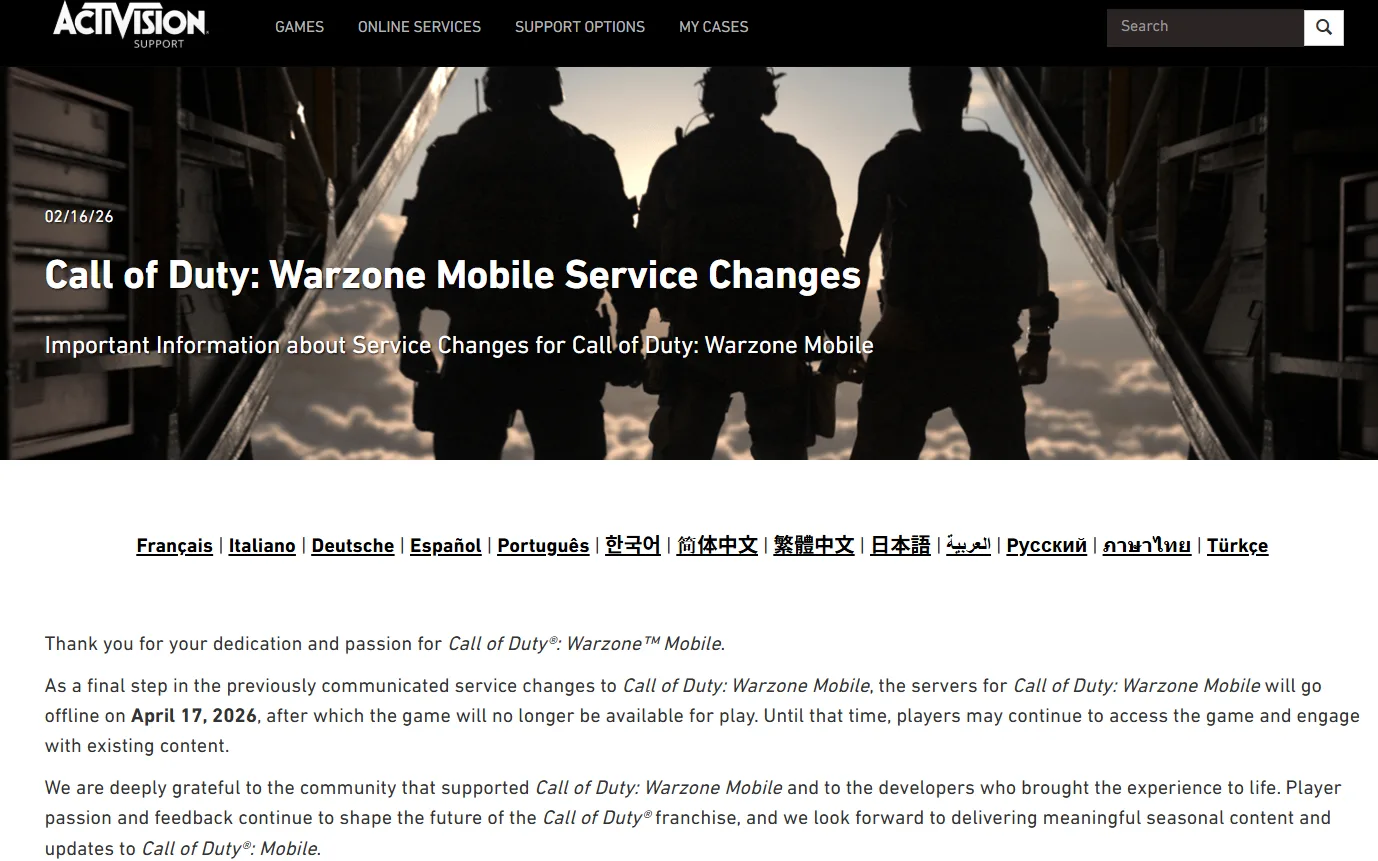
But the game’s run after its March 2024 global launch was also relatively short. In 2025, new seasonal content and real-money purchases were discontinued, and the servers were shut down in April 2026. Activision explained that the Warzone experience, which had been successful on PC and consoles, had not resonated with mobile-first players to the extent the company had expected.
The circumstances and reasons behind the three games’ closures cannot be treated as identical. Apex Legends Mobile pointed to difficulties in maintaining a sufficient content pipeline, while Warzone Mobile raised the issue of fit with mobile-first players. In the case of Rainbow Six Mobile, Ubisoft did not cite specific player metrics or profitability figures, instead saying that the development team would move on to other long-term strategic projects.
Still, viewed together, the three cases share one clear pattern. Each underwent substantial testing and revision with real players before global release and ultimately advanced to a worldwide launch. Yet in none of these cases did global launch amount to a guarantee of long-term service.
That distinction makes it useful to think about soft launches and global launches as two different stages. A soft launch is a process of validating and refining a game before full release. A global launch is the decision to take that game into a much broader market. But in a live-service business, that decision does not end the evaluation. Publishers must continue deciding whether the game is still worth the people, money, and resources required to sustain it.
Reaching global launch may mean that a game has passed an important milestone, but it does not guarantee that the service will continue for years to come.
Does Longer Testing Really Make a Game Safer?
There are clear reasons to run a long soft launch. Real players make it possible to repeatedly test server stability, device compatibility, tutorials, the in-game economy, monetization, retention, and other systems. By exposing problems that short internal tests may never reveal, a soft launch can reduce some of the risks associated with a global release.
But a longer testing period does not mean that every form of uncertainty disappears with it.
Problems inside the game can be identified and fixed one by one, while the environment outside the game continues to move. New competitors emerge. The way people spend their time on mobile devices can change. Monetization models and live-service practices evolve, as do the expectations players bring to a genre. The market in which a game begins its soft launch is not necessarily the same market it will face when it finally launches worldwide.
That difference matters even more for live-service games. Developers can make a game more stable through repeated testing, but player attention and the competitive landscape continue to change during the same period. A long testing process may reduce uncertainty inside the game, but it cannot freeze the market around it.
Apex Legends Mobile and Warzone Mobile can also be viewed through this lens. Both went through pre-launch testing before reaching a global audience, only to encounter different challenges later — content supply in one case and compatibility with mobile-first players in the other. That does not mean their lengthy testing periods were pointless. Rather, it suggests that there are limits to what can be refined through testing, while other questions can only be confronted once the game is operating in the broader market.
What matters, then, is not simply how long a game has been tested, but how both the game and the market have changed during that time.
The exact reasons behind the decision to shut down Rainbow Six Mobile cannot be reduced to a single factor based on the information currently available. But one point from the case is clear.
A game can become more polished through testing, but the market ultimately judges something else: whether that game still gives players a reason to choose it.