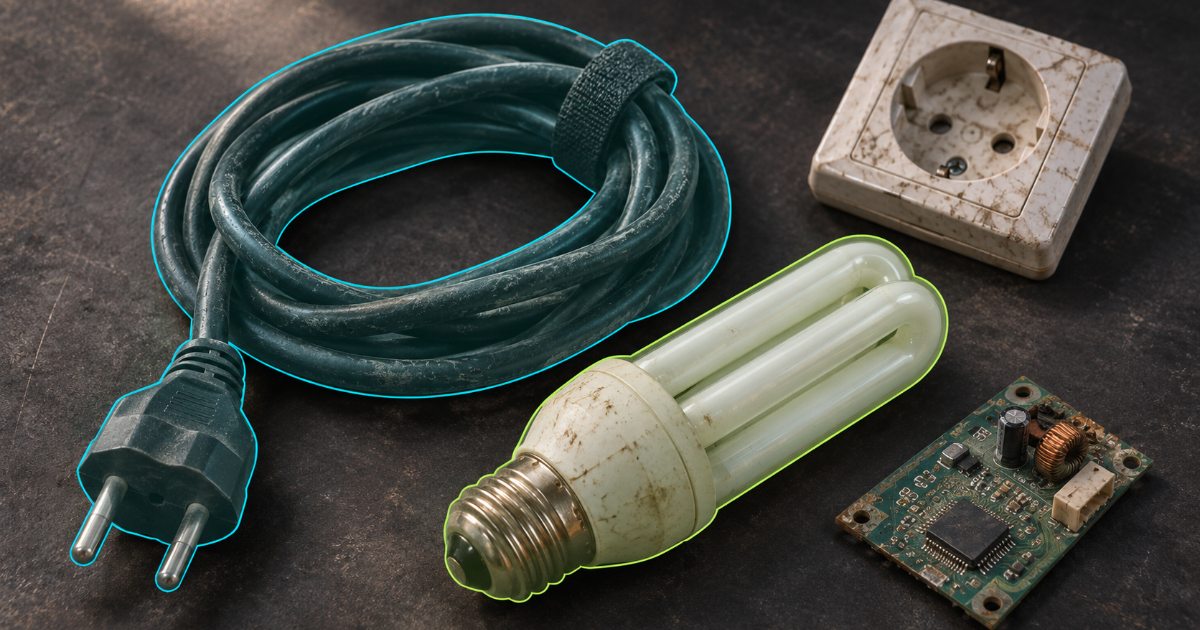
A segmentation method selects examples to adjust to each new image. Its reported sixfold time saving includes the cost of preparing the comparison model.
Discarded electronics contain resources that can be recovered, but a recycling system first needs to identify what it is handling. Cables, lamps and electrical outlets can overlap in the same image. Before a machine can grasp or dismantle an item, it needs to distinguish that item's boundaries from everything around it.
The Global E-waste Monitor 2024, published by ITU and UNITAR, estimated that the world generated 62 million tonnes of electronic waste in 2022. Only 22.3% was documented as properly collected and recycled. These international figures describe the scale of the waste problem. They are separate from the results of the AI study discussed here.
Researchers led by Aseni Senanayake at Monash University in Australia have proposed a method that adjusts an image segmentation model to each image it analyzes. Their paper, released by Scientific Reports on October 26, 2026, after acceptance for publication, examines how an existing model can be adapted to electronic-waste recognition.
Finding the boundaries of an object
Recognizing a cable in a photograph is different from identifying exactly which pixels belong to it. Segmentation marks an object's region within the image, including where it meets the background or overlaps with another item.
The researchers used SAM2, Meta's segmentation model. Users can select objects with points, boxes or masks. Although SAM2 can work across many kinds of images, applying it to an industrial task requires checking its accuracy and processing requirements under the conditions of that task.
For recycling, the selected region must match the item to be separated or dismantled. Its boundaries also need to be precise enough for the intended operation. Producing a mask is therefore one step in a longer workflow, and the study focuses on adapting the model for that recognition step.
Choosing 25 examples for each image
When a new image arrives, the proposed method retrieves 25 relevant examples with labeled object regions. It selects examples that avoid repeating the same information, then uses them to adjust the model. The researchers call this test-time fine-tuning.
Choosing those references matters as much as deciding how to use them. Near-identical examples may add little information, while unrelated ones may provide little guidance about the target. The reference set needs to be relevant without being repetitive.
The team divided 900 images into a pool of 750 reference candidates and 150 evaluation images. Each adjustment uses a small set of examples, but the reference collection still has to be prepared. People must label the object regions that guide the model.
Adapting to individual images also changes when computation takes place. A model adjusted once before use incurs a preparation cost, then processes subsequent images without repeating that adjustment. The proposed method performs adaptation for each image. Comparing the two requires counting both preparation and analysis time.
What the sixfold time saving measures
The proposed method took about 1.3 hours to process all 150 evaluation images. That was roughly one-sixth of the comparison method's combined offline fine-tuning and inference time.
On a per-image basis, the proposed method was slower. Retrieving references, adjusting the model and running inference took an average of 31.10 seconds. The comparison method required about 7.5 hours of offline fine-tuning, but inference afterward took just 0.96 seconds per image.
Those numbers describe different costs. Including initial preparation gives a different result from measuring only the repeated use of an already prepared model. As the number of images or the frequency of readaptation changes, the relationship between total processing times could change as well. The experiment does not establish a sixfold speed improvement under every operating condition.
For a recycling operator, the useful comparison depends on the delay that needs reducing. Preparing a model for unfamiliar waste and processing a continuous stream of familiar items pose different problems. A time saving in one setting may have less value in the other.
Testing the method in a recycling facility
The experiments were conducted offline. The authors identify high-speed conveyor deployment as requiring further validation. Performance also needs testing on unfamiliar components and under conditions involving dust, reflections and obstructed views.
A facility would need to evaluate more than individual masks. How many items can the system process in a given period? How will mistakes be checked and corrected? What information must reach the separation equipment? The connection between an image region and a machine's physical action needs testing too.
The study does not demonstrate higher recycling rates or greater material recovery. Model processing time and facility performance are separate measures. A deployment assessment would need to consider recognition accuracy, throughput, retraining frequency and equipment integration costs together.
The method offers a way to adapt AI by choosing examples for the image being analyzed. Whether that saves useful time depends on the operator's workload. Small batches of unfamiliar items and high-volume processing of familiar ones should be evaluated separately to establish where the approach offers a practical advantage.