At first, competition among coding tools appeared to be a competition over code generation ability. What seemed to matter was who could write more accurate functions, suggest the next line more naturally, and produce complex code in a single pass.
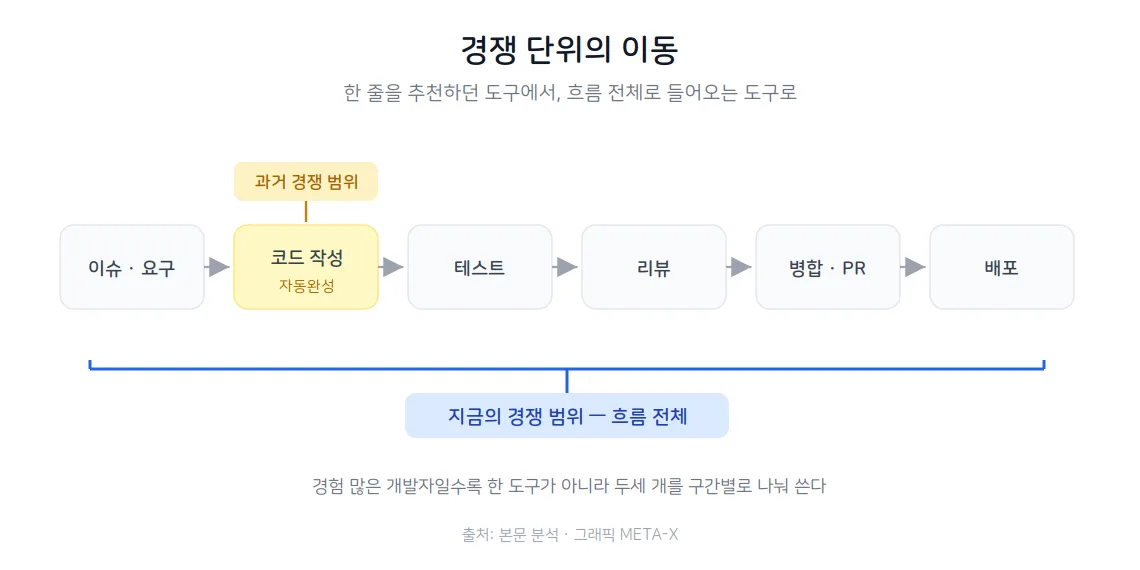
But the unit of competition has already moved. AI coding tools are no longer simply writing code on behalf of developers. They are entering the actual flow in which developers work. They read issues, explore codebases, create proposed changes, and connect those changes to tests, reviews, and pull requests. That is why the question now is not “Who writes code better?” but “Who controls the flow in which developers work?”
This flow is actually divided into two layers. One is the layer that creates code. This is the question of which tools developers use to write and modify code. The other is the layer that controls the code that has been created. This is the organizational question of whether the code has been reviewed, whether it has passed policy checks, whether it can be deployed, and whether audit records remain. This article looks at the former layer: the competition among tools that create code. The latter layer — governance and deployment control — is a different battle fought by separate platforms. One example of that control layer is the strategy discussed in MetaX’s article “GitLab Is Being Reorganized as a ‘Software Production Line’ for the AI Agent Era” (Eden, 2026-06-09). This article looks at the layer beneath it.
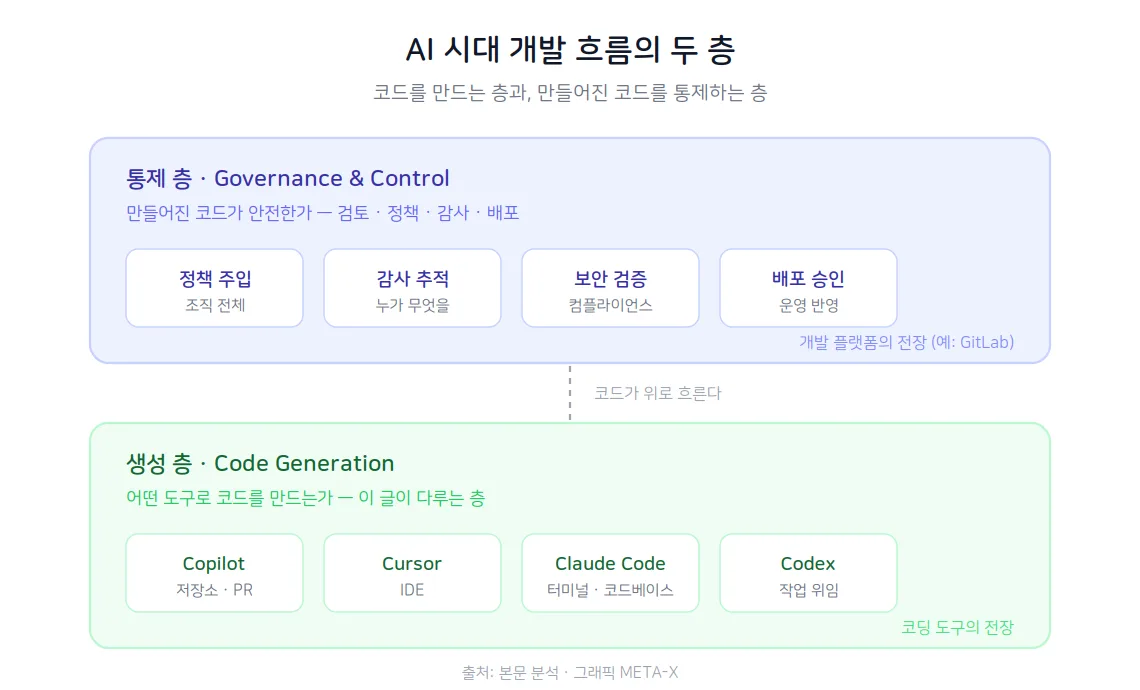
Here, once we narrow the focus to the tool layer, an interesting point emerges. If the unit of competition is not a single line of code but the entire development workflow, then the side that controls the place where that flow gathers most often should have an advantage. For a long time, that place belonged to GitHub. It was the platform where repositories, issues, pull requests, reviews, and Actions gathered in one place. If the competition was about workflow, it was natural to expect GitHub Copilot to be ahead.
But the data in 2026 does not fully support that expectation. Copilot remains the most widely used tool, but its growth has slowed, and in satisfaction and trust-related indicators, later entrants have begun to show stronger signals. The advantage held by the player with the strongest cards did not simply harden into dominance.
Then why was GitHub in such an advantageous position for so long? Why did that advantage not continue in the same way? And what will ultimately decide the competition?
From Autocomplete to Workflow
Early AI coding tools were close to autocomplete. They suggested the next line while developers were writing code, completed repetitive code, and generated simple functions. At this stage, AI was a support tool sitting beside the developer’s hands, and the criteria for competition were simple: faster, more accurate, supporting more languages, and following the developer’s flow without interrupting it.
But autocomplete is only one part of the development process. Real development does not consist only of the moment when code is typed. It includes understanding requirements, grasping the existing structure, deciding the scope of changes, testing, receiving reviews, and merging. As AI enters this process, the unit of competition naturally becomes larger.
This shift is also visible in recent developer surveys. The Stack Overflow 2025 Developer Survey clearly shows this gap. Eighty-four percent of respondents said they are using or plan to use AI tools, but only 29 percent said they trust AI results. Meanwhile, 46 percent said they distrust the accuracy of AI outputs, higher than the 33 percent who said they trust them. Nor is this a flow built around a single tool. In enterprise settings, the use of multiple AI coding tools is becoming more common. According to GitLab’s AI Accountability Report, more than 90 percent of surveyed organizations use two or more AI coding tools, and 54 percent said they use three or more. In practice, teams may use one tool for autocomplete and another agentic tool for handing off more complex tasks. This is the clearest evidence that the unit of competition has moved from “one line” to “the flow.”
The Position Where the Flow Converges Is Advantageous
This is where tools such as Copilot, Cursor, Claude Code, and Codex begin to diverge. They are all grouped under the name of AI coding tools, but in practice they target different points along the development path.
GitHub Copilot has its strength inside the GitHub ecosystem because it can connect directly to collaborative flows such as repositories, issues, pull requests, code reviews, and Actions. Cursor reconfigures the IDE itself around AI. It emphasizes the experience of talking with AI inside the editor, exploring the codebase, and making changes. Claude Code is closer to terminal and codebase-centered work. It puts weight on agentic tasks such as reading existing projects, modifying files, and running commands. Codex shows the direction of a delegation-based interface, where developers assign work and then review the results.
The competition among these four tools is not about “which AI writes code better.” It is a competition to occupy different positions where developers work. One targets the flow of repositories and pull requests, another the IDE, another the terminal and codebase, and another the interface for delegating work.
And to enter the workflow, knowing code alone is not enough. A tool must also capture context. An AI that sees only a single file is entirely different from one that can see the whole repository, issues, pull requests, review comments, test failure logs, and team rules. Developers do not write code on a blank screen. They work inside structures that already exist. Some functions are tangled with other modules, some changes break tests, and some code conflicts with the team’s rules.
Under this hypothesis, GitHub was in a favorable position. GitHub is not just a place where code is stored. It is a space where issues, pull requests, reviews, Actions, and deployment flows gather. It already held the place where flow and context accumulated. That advantage still exists in part. GitHub’s structural distribution power remains large. According to GitHub’s official Newsroom, GitHub is used by more than 180 million developers, more than 90 percent of the Fortune 100, and over 4 million organizations. Copilot also has 4.7 million paid subscribers and has been adopted by more than 77,000 organizations.
The Flow Did Not Converge on a Single Platform
The data in 2026 points in a different direction from that hypothesis. Copilot remains the most widely known AI coding tool and the one most used at work. However, the JetBrains AI Pulse 2026 survey also diagnoses that Copilot’s growth in awareness and workplace adoption has stagnated year over year. By contrast, Claude Code has grown rapidly and has shown strong signals in satisfaction and recommendation intent. The status of being the “default Microsoft option” created an early advantage, but it may now be becoming a ceiling. Across the industry, meanwhile, AI tools are being used more widely, while trust in their accuracy is declining. The Stack Overflow 2025 Developer Survey clearly illustrates this gap. Eighty-four percent of respondents said they are using or plan to use AI tools, but only 29 percent said they trust AI results. Forty-six percent said they distrust the accuracy of AI outputs, higher than the 33 percent who said they trust them. The fact that a tool is widely used does not mean that trust in the tool has been firmly established.
There are three signals that the flow has not converged on a single platform.
First, platform dependency has become a double-edged sword. Being inside GitHub is a strength because it creates a reason not to leave GitHub. But developers have moved according to satisfaction and task fit, and in agentic work, more cases have emerged where they choose terminal- or IDE-centered tools.
Second, GitHub itself opened its boundaries. On February 4, 2026, GitHub began offering Anthropic’s Claude and OpenAI Codex in public preview through Agent HQ. This signals that GitHub chose not to close the development flow around Copilot alone, but instead to allow agents from multiple providers to run together inside GitHub and VS Code. In effect, Microsoft’s own platform accepted that editor- and platform-centered models are not the only architecture for AI development. The biggest question raised against the premise that “one platform will monopolize the flow” did not come from a competitor, but from GitHub itself.

Third, developers use stacks, not single tools. As seen earlier, experienced developers use two or more tools in parallel on average. If so, the image of one place controlling the entire flow becomes difficult to sustain. The flow is being divided, with each segment assigned to the tool that fits it best.
Still, a decline in share does not mean the advantage has disappeared. It would be premature to declare Copilot a product in crisis. Its massive installed base and distribution power remain intact. The core change is not scale, but trajectory. The picture shown in 2026 is that the player with the most favorable position can no longer widen the gap through that position alone.
What Will Decide the Competition?
If the flow does not converge on a single platform, the competition will be decided elsewhere. Three variables remain unresolved. No tool has yet mastered all three.
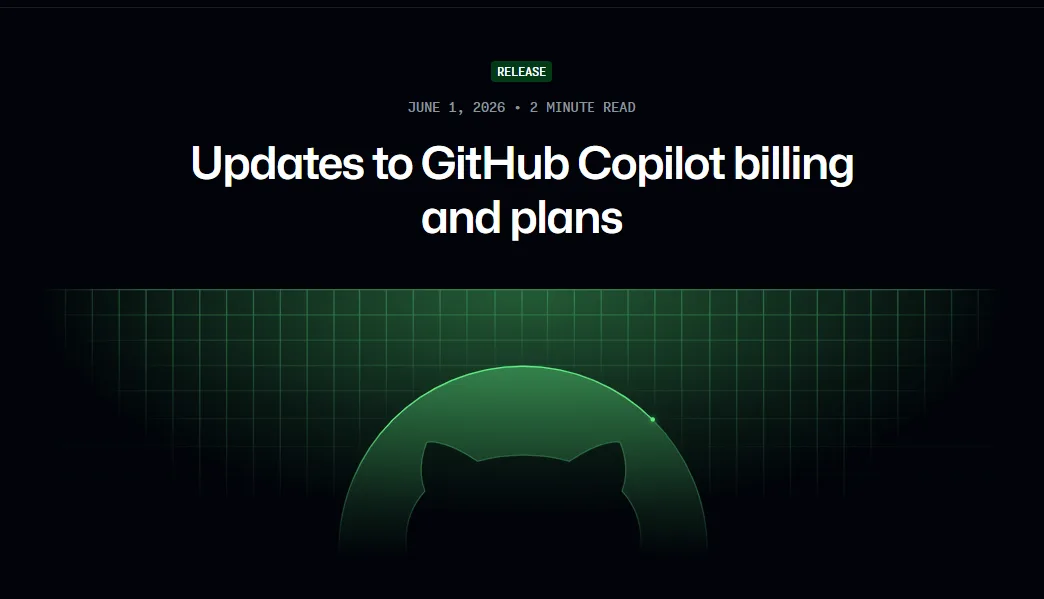
First is the pricing structure. As AI goes deeper into the workflow, cost becomes less like a simple feature and more like infrastructure. AI reads more files, processes longer contexts, and runs multiple tasks in parallel. Token usage, model selection, execution time, and automation costs all follow. This shift has already become reality. Starting June 1, 2026, GitHub transitioned Copilot usage to usage-based billing through GitHub AI Credits. Usage is calculated based on input, output, and cached token consumption, and GitHub explained that Copilot has evolved into a platform that performs long, multi-step agentic sessions, making the previous pricing model unsustainable. As a result, some users have begun facing costs that are harder to predict depending on workload. GitHub cited the increased compute and inference costs of long, multi-step agentic sessions as the reason the old flat-rate model could no longer be sustained. This is a signal that the judgment that autonomous agent reasoning costs are difficult to absorb under flat-rate pricing is spreading across the industry. For companies, “Can AI write code well?” is becoming as important as “Can the cost be predicted and controlled?” No one has yet clearly answered who can make these costs transparent and predictable.
Second is model choice. Within a workflow, it is difficult for a single model to handle every task. Some tasks require a powerful model, while others only need a faster and cheaper one. Some companies also want to use models under their own contracts or local models because of security and data policies. This makes it important to attach and combine multiple models naturally within the flow. The side that can do this moves beyond simple coding assistance and comes closer to becoming a development AI hub. This variable is quickly becoming normalized. Even Copilot, which was once tied to a single supplier model, now supports models from multiple providers. The axis of competition has shifted from model performance itself to when and where models can be deployed, and no side yet holds a decisive advantage on this axis.
Third is review and responsibility. The more code AI produces, the more the developer’s work shifts rather than disappears. The time spent typing may decrease, but the work of judging whether the code is correct becomes more important. Whether it is maintainable, whether it fits the architecture, whether it is secure, and whether it can enter production still require human judgment. The trust gap discussed earlier becomes a problem again here. Developers are using AI tools more than ever, but trust in the accuracy of AI outputs has declined noticeably over the course of a year. In the same survey, the share of respondents who actively distrust accuracy was higher than the share who trust it. The next stage may be won not by the tool that produces autocomplete faster, but by the one that closes this trust gap.
There is one point that needs to be clarified. When developers review results at their own fingertips, that is a problem of the tool layer. When an organization injects policies across the whole process, audits what each agent did, and controls deployment, that is a problem one layer above. The latter has already become a separate battlefield, and the players targeting that position are not coding tools, but development platforms. GitLab’s governance strategy, discussed in MetaX’s “GitLab Is Being Reorganized as a ‘Software Production Line’ for the AI Agent Era” by Eden, is an example of that control layer. The competition in the tool layer discussed here and the competition in the control layer above it are unfolding at the same time, but on different stages.
The Contest Is Not About Code, but the Flow
The unit of competition among AI coding tools has clearly changed. If the early competition was about autocomplete and code generation, the current competition has shifted to the entire flow in which developers work. The data consistently points in that direction.
What remains unsettled is who will control that flow. If the competition is about workflow, the hypothesis that GitHub would lead because it holds the place where the flow converges was natural. But the market in 2026 has not simply confirmed that hypothesis. The advantage of the platform holder has hit a ceiling, GitHub has brought competitors into its own platform, and developers have chosen stacks instead of a single tool. That does not mean latecomers have already won. The structural advantages of distribution and installed base remain.
Ultimately, the competition in the tool layer will be decided not by a single line of code, but on the flow that stretches from the start of development to merging and deployment. And the variables that will decide that competition — pricing that makes costs predictable, flexibility that attaches multiple models naturally, and review support that closes the trust gap — have not yet been fully captured by any side.
Taking one step back, the picture becomes larger. Just as the competition among tools that create code has not yet been decided, the competition among platforms that control the code produced above them is also underway. In the age of AI, leadership in software development is being decided simultaneously across these two layers: generation and control.
The era of asking who can write more code is over.
The real question begins now.
Who will control that flow — and the flow above it?