AI is beginning to play a more direct role in enterprise work, and the conditions required to use it are changing as well. To search corporate data, connect multiple applications, select the right tools, and carry out tasks, generating accurate answers is no longer enough. AI also needs an execution environment that allows it to access the systems required for work and manage the progress and results of each task.
At the same time, as AI takes on more responsibilities, the areas that need to be managed are expanding. The data, external services, and computing resources used by AI each come with their own access permissions and usage conditions. If those permissions are not properly managed, corporate AI resources can be abused by outsiders or generate unexpected costs. Expanding the scope of AI use and operating it securely are becoming increasingly difficult to treat as separate challenges.
Recent announcements from Microsoft and Google illustrate this shift from two different angles. Microsoft introduced “Copilot Harness,” designed to help AI agents connect different tools and carry out work. Google, meanwhile, disclosed cases of “LLMJacking,” in which attackers used stolen credentials to gain unauthorized access to corporate AI services and computing resources. The two cases are not directly related, but viewed side by side, they point to the same broader trend. One shows that the environment in which AI can work is expanding, while the other shows that the resources and permissions within that environment are becoming increasingly important to protect.
An Environment Where AI Can Work: Copilot Harness
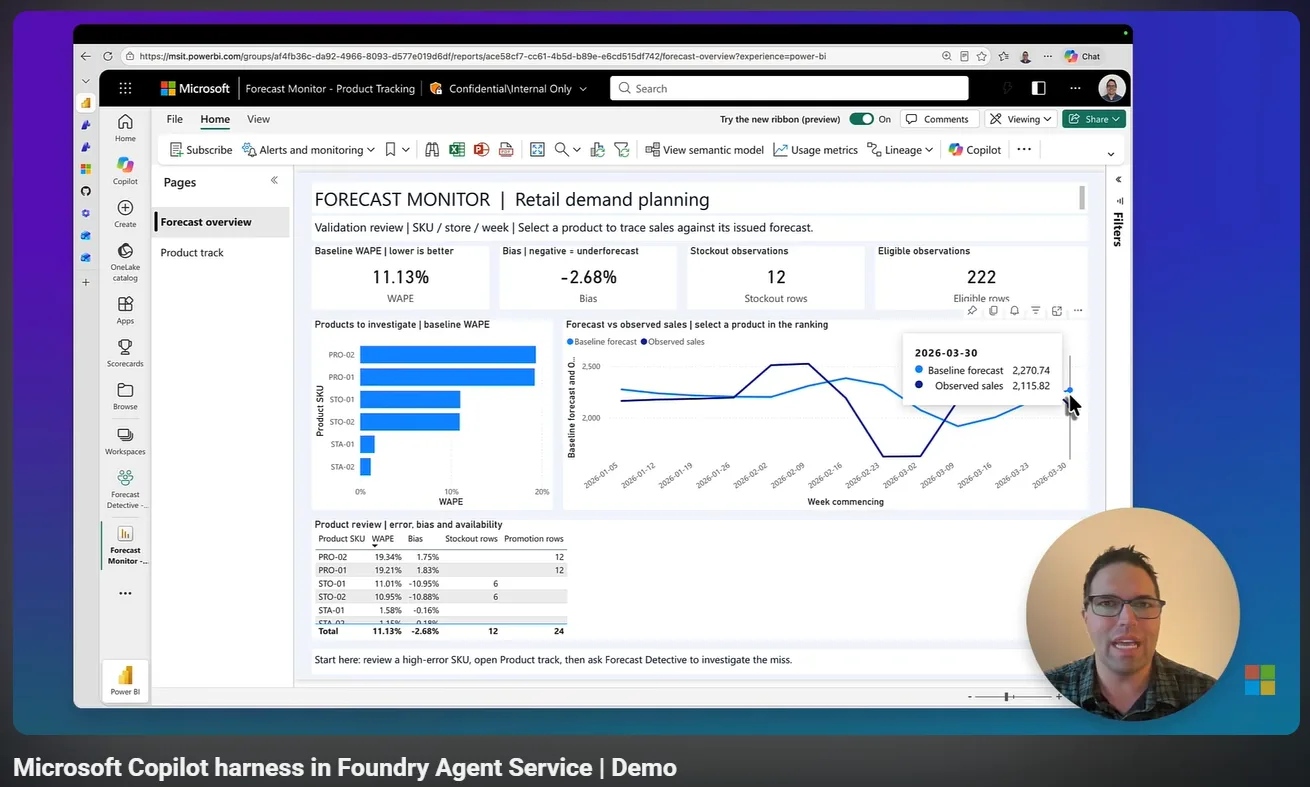
On October 28, Microsoft announced that Microsoft Copilot Harness would be available in public preview within Microsoft Foundry Agent Service. A “harness” refers to the surrounding system that enables an AI model to actually get work done. Copilot Harness is a managed execution environment that allows AI agents to use multiple tools and data sources to perform complex tasks. It opens to developers the execution framework that has been used across Microsoft Copilot products such as GitHub Copilot and Copilot Studio.
Copilot Harness can be broadly divided into four main capabilities: Skills, which package recurring workflows for reuse; Tools, which connect agents to external services; execution and delegation capabilities that allow agents to work with files and code and assign tasks to sub-agents; and configuration management, which keeps agent settings alongside application code. Developers define what the AI is expected to do, while the actual execution takes place within an environment operated by Microsoft.
Consider, for example, an AI agent designed to produce a market research report. The AI could collect designated materials, analyze relevant data, and organize the findings into a report. Developers would define which sources and tools the agent could use and what procedures it should follow, then configure the AI to operate within those boundaries. Microsoft itself has cited research and analysis workflows as representative use cases.
Of course, this does not mean that AI can freely access every system within a company. Tool connections and execution permissions are restricted according to authentication and approval conditions configured by developers. Copilot Harness is also still in public preview, which means there are limitations to applying it immediately in production environments.
Even so, the announcement points to where competition in enterprise AI is moving. It is no longer only about how accurately an AI model can answer a question. What increasingly matters is whether it can use multiple tools and reliably complete real-world tasks from beginning to end. That is why the execution environments and operational systems supporting enterprise AI are drawing more attention.
When the Permission to Run AI Becomes a Target
As AI becomes part of enterprise infrastructure, attackers are beginning to target the resources that make it work.
On November 2, Google Threat Intelligence Group (GTIG) and Mandiant disclosed cases of “LLMJacking”, in which attackers stole access to large language model services. According to the investigation, related compromises were identified in 2026 across companies in North America, South America, and the Asia-Pacific region.
LLMJacking refers to attacks in which an outsider gains unauthorized access to another organization’s AI service credentials and uses its AI models or cloud resources. In effect, the attacker uses AI services paid for by someone else: the victim organization receives the bill, while the attacker receives the benefit.
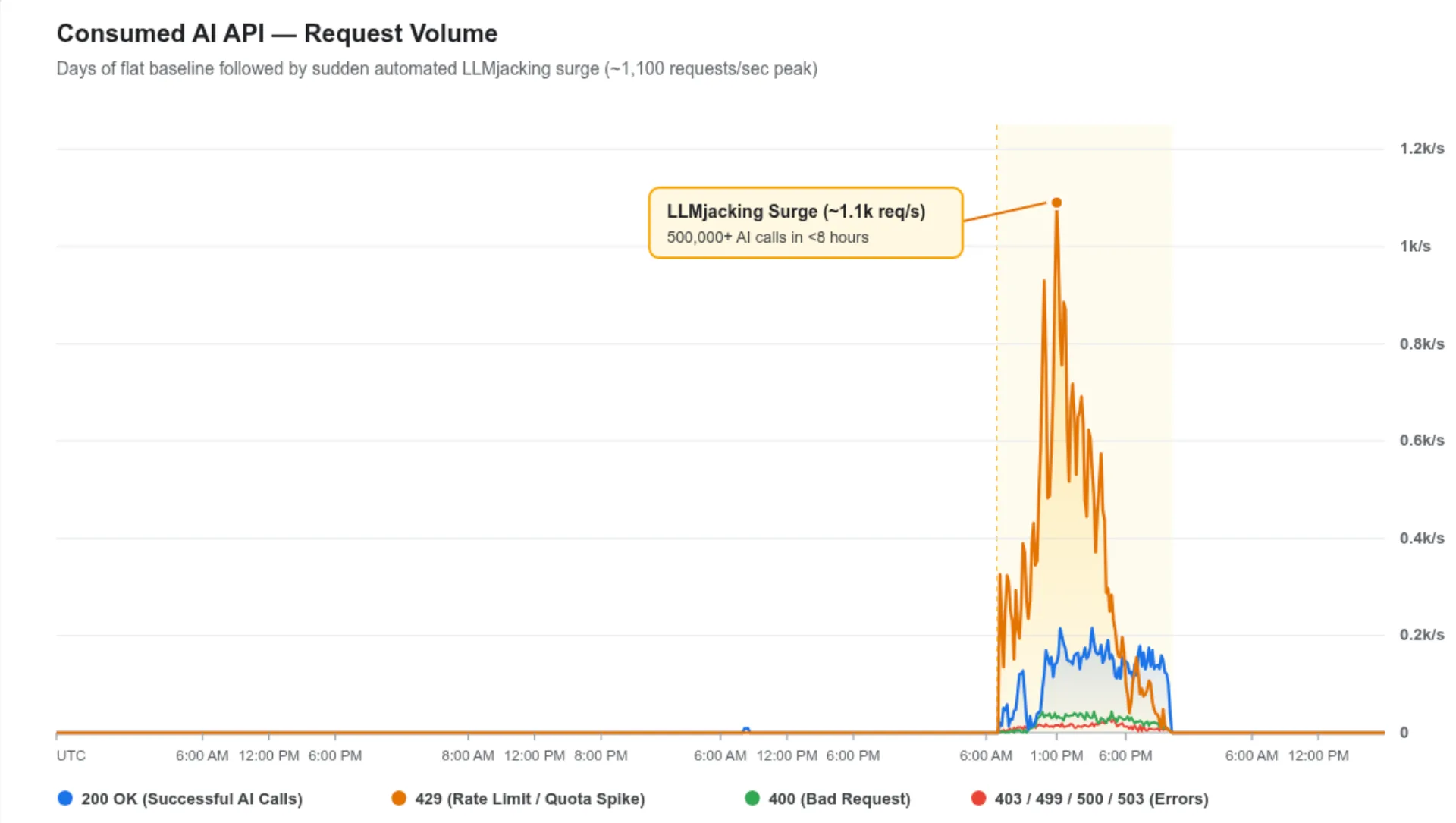
Attackers can reach enterprise AI services through several routes. They may identify publicly exposed AI service endpoints or use leaked API keys and cloud credentials to gain access. In some cases, attackers created additional service accounts and API keys or even activated previously disabled AI services in order to increase usage.
The financial impact can be substantial. Google reported cases in which fraudulent usage charges exceeded $100,000 in a single day, as well as cases where cumulative charges reached $1 million before access was blocked. These figures illustrate how quickly attackers can consume an organization’s AI resources.
Even more notable is that stolen access can itself be resold. Google identified “LLM Mixer” services that aggregate API keys and access permissions stolen from multiple organizations and resell them to third parties. These services act as intermediaries, routing user requests through compromised accounts. The victim organization pays the usage fees, while the attacker collects the revenue.
This model resembles earlier forms of cloud resource theft, but it is not the same. The key difference is that access to AI model calls and inference services can be monetized directly. In the past, compromised server computing power was often used for cryptocurrency mining. With LLMJacking, however, AI service access and inference capacity themselves become tradable assets. The speed at which losses can accumulate is therefore very different. Cryptocurrency mining may gradually consume resources, while LLMJacking can generate massive charges within just a few hours. Corporate AI accounts and API keys are no longer merely access mechanisms; they have become assets with economic value in their own right.
How Far Does the Boundary of AI Security Extend?
Microsoft’s Copilot Harness and Google’s LLMJacking cases are not directly connected. Yet when the two announcements are viewed together, they reveal what organizations need to manage as enterprise AI infrastructure expands.
Copilot Harness illustrates a broader trend in which AI is connected to tools and execution environments so that it can take on more work. To make this possible, organizations must define which materials and external services the AI can access, which commands it is allowed to execute, and which credentials it can use. The more work AI performs, the more permissions it may need.
LLMJacking shows that those permissions can themselves become a target. Attackers can obtain access granted to an organization and use it to call models and consume computing resources. In such cases, the AI service may appear to be operating normally, making it difficult to detect who is actually using it or whether the level of activity is legitimate without additional monitoring.
These threats are not entirely new. Account theft, credential leaks, privilege escalation, and unauthorized resource use have long been familiar cybersecurity problems. What has changed is how the damage appears. As AI services become connected to external tools and adopt usage-based pricing models, familiar security failures can now turn into enormous costs in a very short period of time.
For that reason, enterprise AI security can no longer stop at protecting models and data. Organizations also need to monitor which systems AI can access, which actions it can perform, and whether usage and costs remain within expected ranges. Established security practices—granting only the minimum permissions required, securing API keys, and quickly detecting abnormal usage—need to be applied just as carefully to AI operating environments.
As agents take on more complex work, the permissions they require increase and their execution processes become more fragmented. Giving AI the ability to work and ensuring that this ability is used only within defined boundaries are becoming two sides of the same challenge.
Operations and Control Matter as Much as AI’s Capabilities
Companies are not adopting AI simply to obtain better answers. They want to reduce repetitive work, automate complex tasks, and use existing systems more efficiently. Microsoft Copilot Harness is an attempt to provide the environment needed for AI to perform that kind of real work.
But assigning work to AI also means assigning permissions. As more data, tools, external services, execution privileges, and computing resources are opened to AI, the same pathways can also become attractive targets for attackers. Google’s LLMJacking report shows that these pathways are already being exploited in practice—and that the consequences can appear as bills amounting to tens of thousands of dollars in a single day.
The problem is the difference in speed. Companies are rapidly expanding what AI is allowed to do, while discussions about what AI should be allowed to access, how far it should be able to act, who should monitor its use, and who should bear the resulting costs and responsibility are struggling to keep pace. These questions become even more complicated when execution environments are outsourced to managed services. Even if a platform operates the runtime on a company’s behalf, the decision about which permissions to grant—and responsibility for the consequences—ultimately remains with the organization using it.
What AI can do remains an important question. But now there is another question that is just as important, perhaps even one that needs to be asked first: What have we allowed AI to access, and do we know whether those permissions are being used only as intended?
Any company planning to entrust AI with more work needs to be able to answer that question first.