AI Regulation: From Technology-Centered Liberalism to Outcome-Centered Accountability...
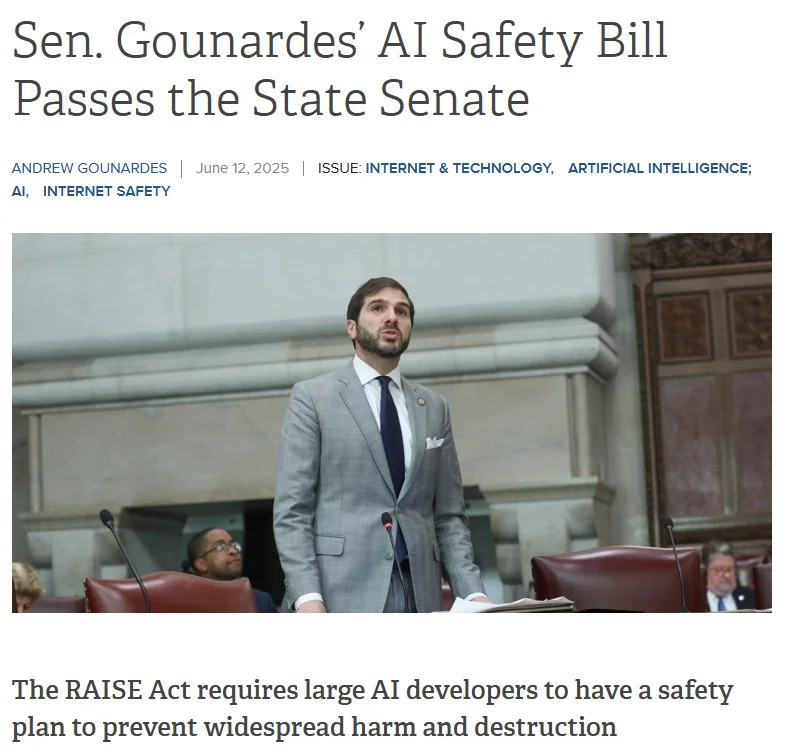
On June 12, 2025, the RAISE Act (Responsible AI Safety and Education Act), introduced by New York State Senator Andrew Gounardes, passed the state senate — America's first high-risk AI safety legislation, mandating that cutting-edge AI models maintain safety plans preventing 100+ casualties or $1B+ property damage. Requirements: covered entities must implement safety plans; mandatory incident reporting and system transparency obligations; New York Attorney General can impose civil penalties up to $30 million for violations. "High-risk" AI definition focuses on frontier models with sufficient capability to cause large-scale harm — not all AI systems. The act shifts regulatory philosophy from "innovation-first, regulate-later" to "accountability-first" for the highest-capability systems. Comparison with other AI governance approaches: EU AI Act (risk classification with pre-licensing for high-risk systems); California SB 1047 (vetoed by Governor Newsom in 2024, similar scope); federal RAISE Act analog pending in US Congress. RAISE Act significance: (1) First state law specifically targeting "frontier AI" safety rather than specific application domains (healthcare, employment, education); (2) Establishes precedent that private AI development carries public safety obligations even before deployment; (3) Creates enforcement mechanism through civil penalties rather than criminal liability; (4) New York's enactment creates regulatory pressure on other states and federal level. Industry reaction: concerns about compliance uncertainty for rapidly evolving capabilities; questions about who constitutes a "covered developer"; the 100+ casualty threshold is seen as both setting a high bar and creating a perverse incentive to ensure model capabilities stay just below triggers.