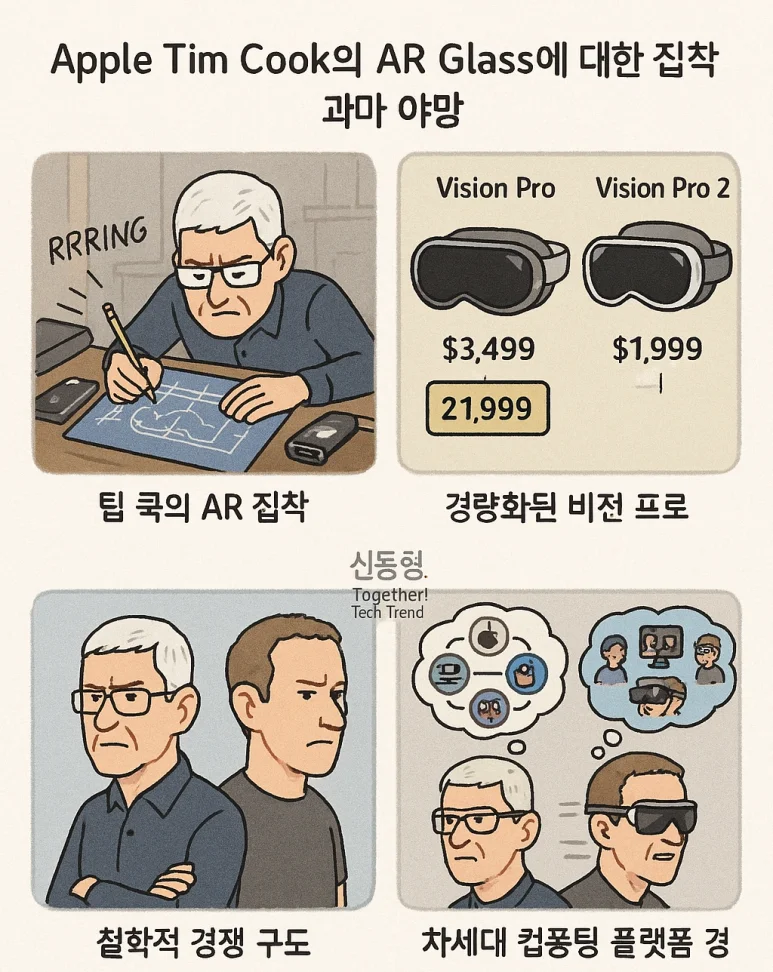
Apple Tim Cook Obsession and Ambition for AR Smart Glasses
Study with Donghyung Shin: Apple Tim Cook AR Smart Glasses Obsession and Ambition Report (April 16, 2025). Section 1 Tim Cook AR Obsession: "No Interest in Anything Else." 1.1 Cook personal conviction: Tim Cook has publicly stated since 2016 that AR is "as profound as the smartphone" -- a rare prediction from a CEO known for caution; his conviction that AR glasses are the next major computing platform has not wavered despite Apple Vision Pro mixed commercial reception. 1.2 The iPhone parallel: Cook draws explicit comparison to how iPhone transformed mobile computing; AR glasses that overlay digital information on the physical world represent the same category of platform shift; the question is not whether but when and who gets there first. Section 2 Apple AR Hardware Strategy. 2.1 Apple Vision Pro position: launched February 2024 at 3,499 USD; sold approximately 500,000 units in year one (below targets); positioned as "spatial computing" rather than AR glasses; the high price and tethered computing model are acknowledged limitations rather than the final product form; Vision Pro is the technology proving ground, not the mass market product. 2.2 The lightweight glasses roadmap: Apple is developing a form factor closer to normal glasses (not ski-goggle design) targeting 2026-2027 launch; the technical challenge is fitting sufficient computing power, battery, and display into a glasses-sized device; Apple custom silicon (M-series descendants) and optical waveguide display technology are the key enablers. 2.3 Meta Ray-Ban competition: Meta Ray-Ban smart glasses (camera, speakers, Meta AI -- no display) have sold 2M+ units at 299 USD; they prove consumer willingness to wear AI-equipped glasses daily; Apple response needs to match the form factor while adding display capability. Section 3 Software and Ecosystem. 3.1 visionOS development: Apple has published visionOS developer tools attracting serious enterprise application development; spatial computing applications for surgery planning, architecture visualization, and training are proving the platform value proposition; the enterprise use cases build the ecosystem that consumer applications will later leverage. 3.2 App Store spatial dimension: Apple will apply its App Store model to spatial computing apps; the developer ecosystem revenue sharing creates the economic incentive for AR app development that has been missing from competing platforms. Section 4 Competitive Landscape. 4.1 Meta advantage: distribution (Facebook and Instagram social graph creates communication use cases for AR); price point (Ray-Ban 299 vs Apple expected 1,000+); current market presence. 4.2 Google reentry: Google Lens AI capabilities and Android distribution give Google a pathway back into AR after Glass failure; Android AR glasses from Samsung partnership are expected. 4.3 China competition: Huawei, OPPO, and Xiaomi are developing AR glasses targeting Asian markets; price pressure from Chinese competitors will constrain Apple pricing flexibility in non-premium segments. Section 5 The 2027 Vision: Cook believes Apple AR glasses will eventually replace the iPhone as the primary personal computing device; this is a 10-15 year transition, not a 3-year one; the strategic priority is establishing platform leadership before the transition accelerates; losing the AR platform to Meta or Google would be as consequential as if Apple had lost the smartphone platform to Android -- which nearly happened and fundamentally reshaped the competitive landscape.