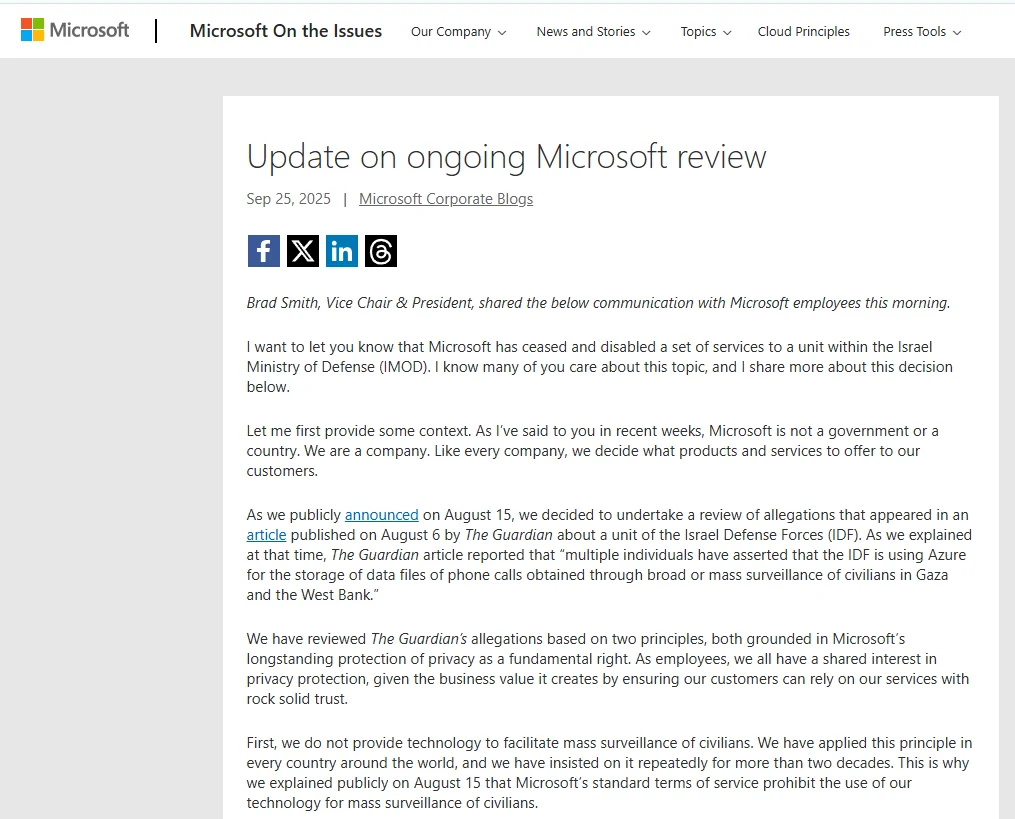
Microsoft has suspended provision of some of its cloud services and AI technology to a specific unit of Israel''s Ministry of National Defense (IMOD). This action came after allegations emerged that the company''s technology was being used for large-scale civilian surveillance in the Gaza Strip and West Bank. VP and President Brad Smith disclosed this in internal communications to employees on September 25, emphasizing "we are a company, not a nation-state, and determine services according to principles and ethics."
The incident originated from an August 6 Guardian report that the Israel Defense Forces (IDF) was using Microsoft''s Azure cloud to store large-scale data files including civilian call content. Microsoft officially announced an internal investigation on August 15, stating two principles: it does not provide technology for mass civilian surveillance; and it does not violate customer privacy. The investigation proceeded centered on Microsoft''s own business records — financial materials, internal documents, communication records — without accessing IMOD customer content.
Smith disclosed that evidence supporting some Guardian reporting was found — particularly materials related to use of Azure storage based on a Netherlands data center and certain AI services. Accordingly, Microsoft decided to suspend specific IMOD subscriptions and services, particularly cloud storage and AI service access. Smith explained: "This constitutes a violation of terms of use, and this is a measure to ensure our services are not used for civilian surveillance."
Notably, the decision does not affect Microsoft''s other activities in Israel. Smith clarified: "Activities protecting the cybersecurity of Israel and Middle Eastern nations will continue" — reflecting the importance of cooperation relationships Microsoft has established with Israel and Gulf countries under the Abraham Accords. Microsoft is attempting to separate "large-scale civilian surveillance" as a universal ethical principle from "national security support" as a realistic role. However, this raises boundary questions: "Where does surveillance end and security begin?" The incident reveals how vulnerable the balance is between ethical responsibility and international political interests that global big tech stands on, and how far corporate principles can be maintained between political pressure and commercial interests.