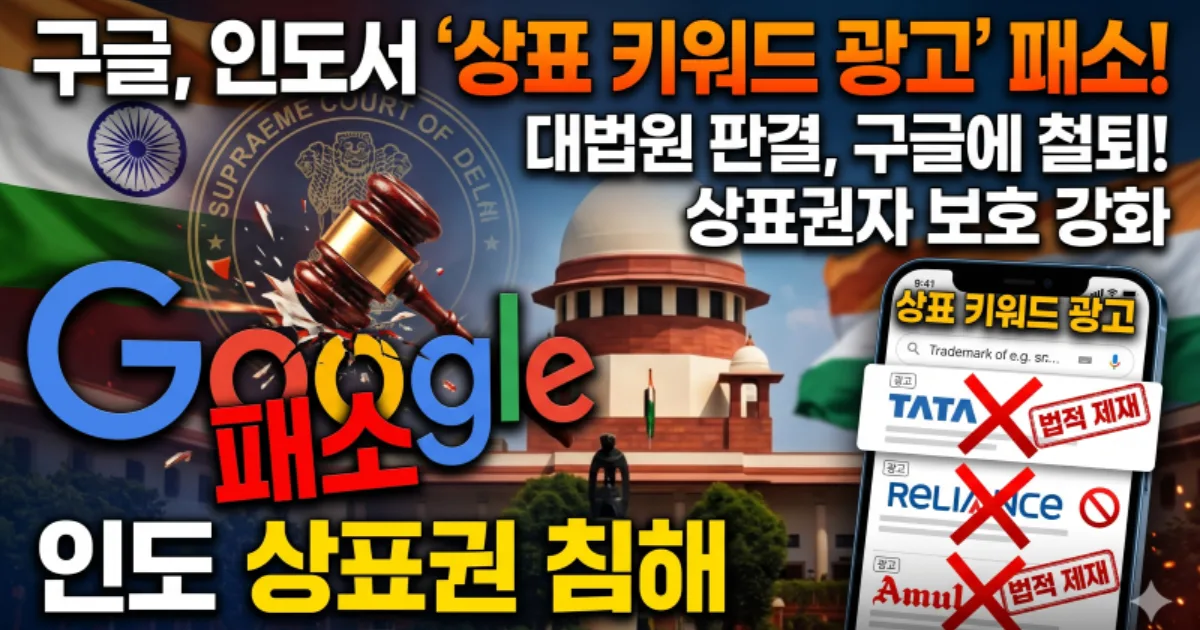
Google has suffered a major legal defeat in India over trademark keyword advertising, in a ruling that could reshape the responsibilities of search advertising platforms.
In a judgment delivered on May 22, 2026, the Delhi High Court restrained Google LLC and Google India from using the registered trademark “HINDWARE” as an advertising keyword or AdWord. The court also barred Google from using combinations such as “HINDWARE SANITARYWARE,” “HINDWARE SANITARY” and “HINDWARE SANITARYWARE INDIA” as keywords, AdWords or in any other manner.
The court ordered Google LLC and Google India to jointly pay 30 million rupees in nominal damages, along with actual litigation costs.
The case is not merely a dispute over one company’s trademark. It goes to the heart of the search advertising industry: whether a platform may allow advertisers to buy a competitor’s trademark as an invisible keyword in order to appear at the top of search results. The court held that even if a trademark does not appear directly in the text of an advertisement, its use as a keyword that triggers the advertisement can still amount to “use” under trademark law.
The more significant part of the ruling concerns Google’s role. Google argued that it was only an intermediary providing advertising space and technical tools, while advertisers selected the keywords. The court rejected that characterization. It found that Google recommends keywords through its keyword planner, operates real-time bidding and auction systems, and earns revenue when users click on ads.
In doing so, the court treated Google not as a passive platform, but as an active advertising business. The ruling may therefore redraw the boundary of responsibility in search advertising.
The Dispute Began When Competitors Appeared Above HINDWARE
The dispute dates back to 2013 and 2014. Hindware alleged that when users searched for its registered trademark “HINDWARE,” advertising links for competitors such as Cera and Grohe appeared at the top of Google search results.
According to the judgment, Cera and Grohe used Google’s AdWords program to purchase Hindware’s registered trademark, or combinations of that mark, as advertising keywords. As a result, when consumers searched for terms such as “HINDWARE,” “HINDWARE SANITARY” or “HINDWARE SANITARYWARE,” competing websites appeared in sponsored search results.
Hindware sued, alleging trademark infringement, passing off, unfair competition and dilution. Grohe, Cera and Omkara Infoweb were originally among the defendants, but they settled with Hindware during the course of the proceedings. The core question that remained was whether Google India and Google LLC could be held liable.
Google argued that advertisers choose the keywords and that it merely operates a neutral advertising platform. It also argued that keywords are invisible backend triggers that users do not see, and therefore do not constitute trademark use. The court did not accept that defense.
Issue One: Can Invisible Keywords Be Trademark Use?
The first major issue in the ruling was the legal meaning of invisible use. Google argued that because the keyword did not appear in the advertisement and was not visible to consumers, it could not be considered trademark use. If the word “HINDWARE” did not appear directly in the ad copy, Google argued, the risk of consumer confusion was limited.
The Delhi High Court took a different view. It held that the meaning of “use” under Indian trademark law is not limited to physical or visual display. In particular, the use of a trademark in relation to goods can be interpreted broadly. If a trademark functions as a keyword that triggers an advertisement, the court said, it may constitute use of the mark.
The court also refused to read the phrase “in advertising” narrowly. Google argued that this should mean only cases where the trademark appears inside the advertisement itself. But the court distinguished “in advertising” from “in an advertisement.” In other words, even if the mark is not visible in the ad text, it can still be used in the advertising process if it causes the advertisement to appear.
This reasoning is important in the digital advertising era. Online advertising is often shaped less by visible words than by invisible matching systems, algorithms, keywords and data signals. The court recognized that these hidden layers can also fall within the scope of trademark law.
Issue Two: Is Google Merely an Intermediary or an Advertising Business?
The second major issue was Google’s legal position. Google argued that AdWords operates based on keywords and ad copy entered by advertisers, and that Google merely provides the platform and tools. It also argued that advertisers’ websites are third-party sites that Google does not own or control.
The court disagreed. It described Google’s advertising system as a structure built around the keyword planner, real-time bidding, quality scores, ad ranking and cost-per-click pricing. Google’s algorithm determines which ads appear on the search results page, and Google earns money when users click on those ads.
The court found that Google actively suggests, sells and auctions trademark keywords, and profits from that process. In other words, Google is not simply renting out advertising space. It is monetizing the economic value of trademarked search demand.
This finding carries major implications for platform liability. If a platform designs the distribution structure of advertising, controls the revenue model and encourages certain forms of commercial conduct, it becomes harder to describe that platform as a neutral channel.
Issue Three: Competition or Free Riding on Trademark Value?
Google argued that allowing competitors to bid on trademarks as keywords promotes competition and gives consumers more choices. The company compared the practice to placing competing products next to each other in an offline store or putting up a billboard near a rival’s shop.
The court did not reject the value of competition itself. Consumers should be able to compare alternatives, and competitors have the right to advertise their products. But the court said the issue was not whether competition is allowed. The issue was the method used to compete.
A competitor may advertise its own products. But buying another company’s registered trademark through Google’s advertising system in order to intercept consumer search intent is different. The court found that such conduct cannot be justified merely by invoking competition.
The court also emphasized that “HINDWARE” is not a generic word. It is a coined and registered trademark that had already been recognized as well known. A distinctive and well-known trademark deserves stronger protection. By offering that mark as a keyword to competitors and profiting from resulting clicks, Google was found to have benefited from the reputation and advertising investment built by Hindware over many years.
Section 29(8) and the Advertising Function of Trademarks
A key legal point in the ruling was the interpretation of Section 29(8) of India’s Trade Marks Act. This provision states that use of a registered trademark in advertising may amount to infringement if it takes unfair advantage of the mark, is contrary to honest practices in industrial or commercial matters, or is detrimental to the mark’s distinctive character or reputation.
The court held that Google’s use of the HINDWARE mark as a keyword, and its treatment of the mark as an object of bidding and auction, took advantage of the distinctiveness and reputation of Hindware’s trademark.
The court also emphasized that Section 29(8), unlike Section 29(4), does not require a separate condition of use “without due cause.” In the advertising context, if unfair advantage or conduct contrary to honest commercial practices is established, infringement may be found.
This is a broader interpretation of trademark protection. Traditionally, trademark infringement focused mainly on whether consumers were confused about the origin of goods. Modern trademark law also recognizes the advertising function, investment function and reputation function of trademarks. The court found that search advertising can interfere with these functions.
Google’s Safe Harbor Defense Fails
Google also relied on intermediary immunity under Section 79 of India’s Information Technology Act. It argued that ads and keywords were third-party information created by advertisers, and that Google merely hosted or transmitted them neutrally.
The court rejected this safe harbor defense. Google was not simply a communication system transmitting third-party information. It designed and operated the advertising program, suggested keywords, managed the bidding structure and earned revenue through a cost-per-click model. The court found that Google exercised broad control over the advertising business.
This reasoning aligns with a broader trend in online platform regulation. A platform is not automatically immune simply because it calls itself an intermediary. When a platform designs the transaction structure, determines visibility through algorithms and directly profits from the process, its responsibility may expand.
This is especially relevant in advertising, where platforms are not merely conduits but market operators.
Why the Damages Were “Nominal” but Significant
Hindware sought damages, but the court found that sufficient evidence had not been submitted to precisely prove actual losses. Still, because trademark infringement had been established, the court held that nominal damages could be awarded.
The court ordered Google LLC and Google India to jointly pay 15 million rupees in each of the two suits, totaling 30 million rupees.
The symbolic value of the award is larger than the amount itself. The court recognized that even where actual damages are not precisely quantified, clear trademark infringement can justify compensation and legal recognition of the right. The court also ordered Google to pay actual litigation costs. Given that the litigation began in 2013 and 2014, the cost order carries additional significance.
Industry Impact: Structural Risk for the Search Advertising Model
The ruling matters because it targets one of the oldest revenue structures in search advertising. Search advertising captures user intent and attaches ads to that intent. When a user searches for a specific brand, that search indicates interest in the brand. Advertisers want to display competing products at that precise moment. Platforms auction off that moment of attention.
The legal problem arises when the search term is not a generic word but a registered trademark. A search for a brand name may mean that the consumer is specifically looking for that brand. If a competitor’s ad appears at the top, the consumer may be confused or at least diverted before reaching the brand owner’s website. The platform earns revenue from that click.
The court did not view this merely as competitive advertising. Where the mark is distinctive, well known and built through years of investment in advertising and consumer trust, the platform’s sale of that mark as a keyword can interfere with the trademark owner’s exclusive commercial value.
From Search Keywords to AI Prompts
Although the case concerns Google AdWords and trademark keyword advertising, its implications may extend into AI search and generative advertising.
In an AI search environment, users do not only type simple keywords. They may enter natural language prompts such as “recommend products similar to Hindware” or “show cheaper alternatives to Hindware.” A platform may then combine brand names, user intent, competing products and recommendation algorithms in more complex ways.
The next set of disputes may be even harder. Even if an AI platform does not directly sell a brand name as an advertising keyword, it may analyze prompts containing brand names and recommend rival products. It may rely on the reputation of a specific brand to suggest alternatives. In such cases, trademark use becomes more invisible, more contextual and more algorithmic.
The Delhi High Court’s reasoning may therefore have precedent-like importance. The court found that invisible backend use can still be legally relevant when it exploits trademark value in the advertising process. That logic could influence future disputes involving AI recommendation ads, conversational commerce and generative search advertising.
Implications for Korean Companies and Platforms
The ruling also carries important implications for Korean companies. In Korea, the purchase of competitors’ trademarks as keywords has long been a sensitive issue across search advertising, shopping search, app store advertising and portal keyword ads. Companies with strong brand recognition may find competitor ads appearing above their own websites when users search for their brand names.
Platform companies should examine three issues.
First, they need to review whether policies that recommend or auction registered trademarks as keywords are compatible with trademark laws in each jurisdiction. Second, they should consider whether simple notice-and-takedown procedures are sufficient, especially in cases involving coined marks, well-known trademarks or direct competitors. Third, they should manage transparently how brand-name prompts are processed in AI search and advertising recommendation systems.
Brand owners also need to adjust their strategy. Registering a trademark is no longer enough. They must monitor how their marks are used in search advertising, keyword advertising and AI recommendation environments. They may also need systematic procedures for requesting restrictions, filing platform reports, monitoring competitor ads, preserving evidence and managing licensing policies.
Conclusion: Can Platforms Auction the Value of Another Company’s Trademark?
The essence of the ruling can be reduced to one question: can a platform turn another company’s trademark-driven search demand and brand trust into advertising auction inventory?
The Delhi High Court’s answer is limited. Competitive advertising is allowed. Showing alternatives to consumers is allowed. But using another company’s registered trademark, especially a coined and distinctive mark, as an unauthorized keyword and selling it to competitors for platform profit cannot be treated as ordinary competition.
The power of digital advertising operates in invisible places. Keywords, algorithms, bids, quality scores and cost-per-click systems shape user choice. The court held that trademark rights must still be protected within that hidden structure.
Search advertising is a core engine of the internet economy. But if that engine runs on the brand value and consumer trust created by others, courts may demand a new answer.
This ruling makes one point clear: advertising platforms can no longer rely only on the claim that they merely connect advertisers and users.