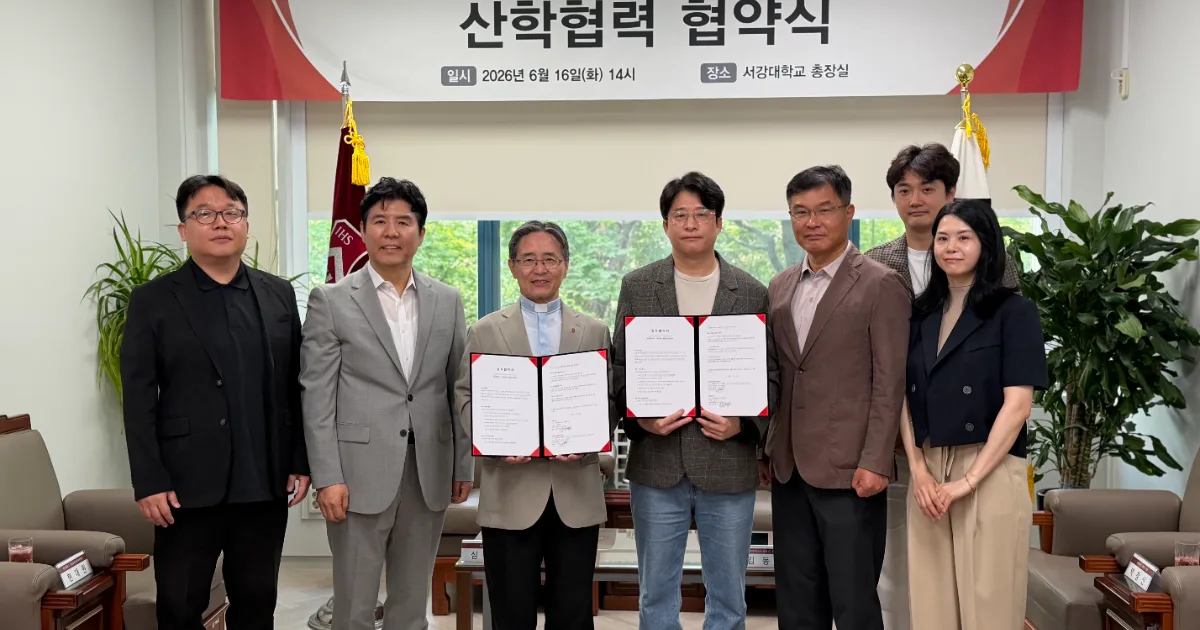
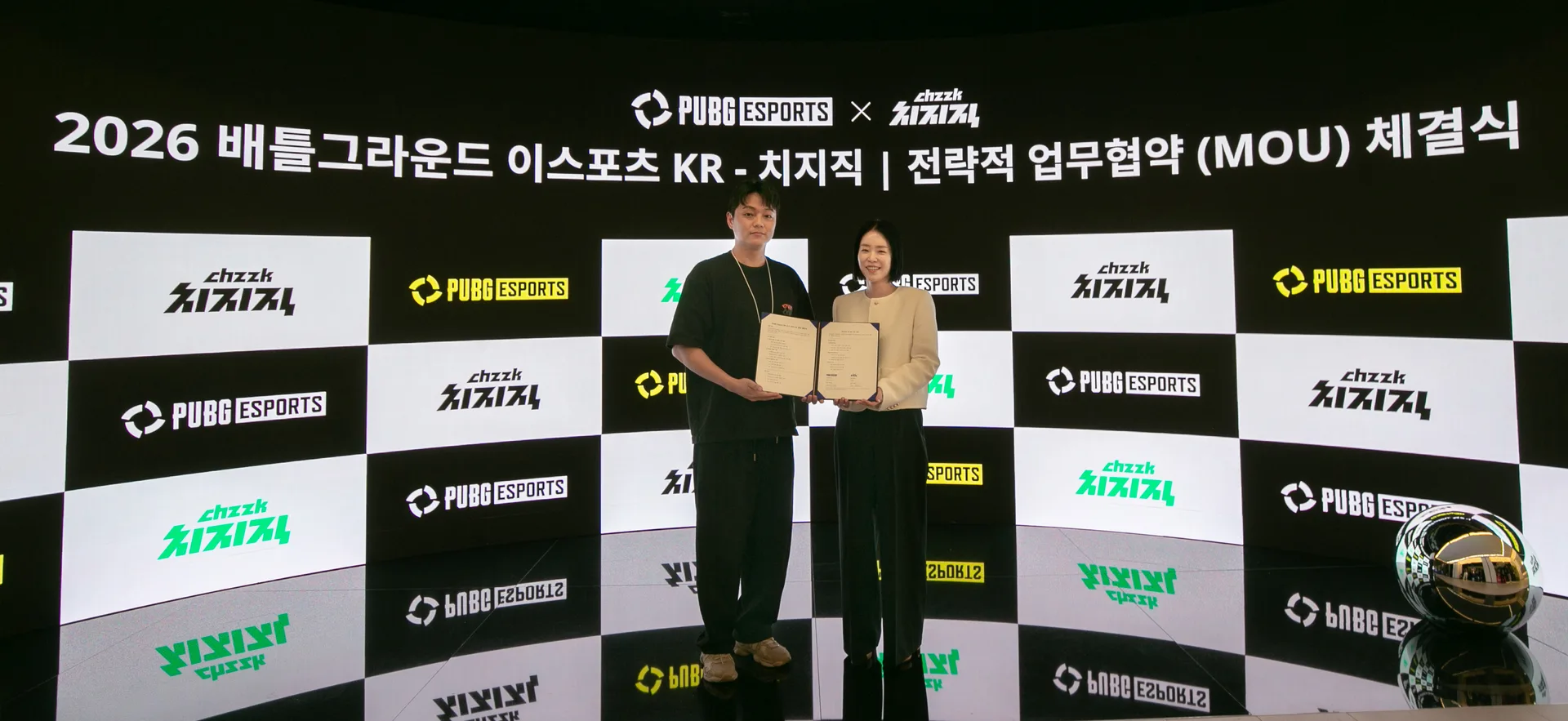
Naver and Krafton have joined hands around PUBG: Battlegrounds esports. In June 2026, the two companies signed a strategic business agreement to expand the content ecosystem of PUBG: Battlegrounds esports. The plan is to connect Naver’s streaming platform CHZZK with Krafton’s PUBG: Battlegrounds esports IP, combining the strengths of a platform, a game IP, and a community.
At first glance, this looks like a familiar kind of broadcasting partnership. The game company gains wider exposure for its esports content, while the platform secures a popular game IP. The game company creates the tournament, and the platform shows it. But this partnership is not simply about “where the match will be watched.”
The core of this partnership lies in where the time fans spend around PUBG esports is created, and who takes the lead in shaping that time. Pre-event content before the tournament, live chat and co-viewing during matches, clips and streamer content after the games, and offline venue events are all becoming part of the esports experience. The match is still at the center, but fandom now lingers much longer in the time before and after the match.
This is where the relationship between game companies and platforms also begins to change. Krafton wants to extend the life of the PUBG IP, while CHZZK wants to bring the time fans gather, react, and remain into its platform. In that sense, this partnership is less about competition over esports broadcasting rights and more about how the initiative in shaping fandom time around a game IP is being redistributed between game companies and platforms.
The Shifting Center of Gravity in Esports
Esports has long been understood as content centered on the match itself. Who is playing, which teams are facing each other, what strategies appear, and who wins have been the core questions. The competitiveness of a broadcasting platform was also judged by how reliably it could deliver the match, and how strong its commentary and viewing environment were.
But today’s esports consumption no longer stays within the match alone. Before the game, fans consume player interviews, teasers, and prediction content. During the match, they react together through chat and co-viewing. After the game, they return to highlights, clips, and review content. The match itself remains the central event, but the fandom experience now extends into the time before and after it.
In this shift, broadcasting rights alone are no longer enough. The right to transmit the match is still important, but it is becoming just as important to shape the time surrounding that match. How pre-event content is placed, where fans are encouraged to react, and how post-match consumption continues are now part of the competitiveness of esports.
Ultimately, esports is expanding from an industry of matches into an industry of time. It still matters how many people watched a match. But it is becoming increasingly important how long the anticipation, reactions, and interpretations surrounding that match continue. The partnership between Naver and Krafton sits directly on top of this transition.
CHZZK’s Goal: Fandom That Stays on the Platform
For CHZZK, PUBG esports is not just another piece of broadcast content. What CHZZK wants is not merely to attract viewers who come to watch a tournament, but to turn those viewers into a fandom that stays within the platform. The tournament brings viewers in. Chat, co-viewing, and streamer content turn that time into an internal platform experience.
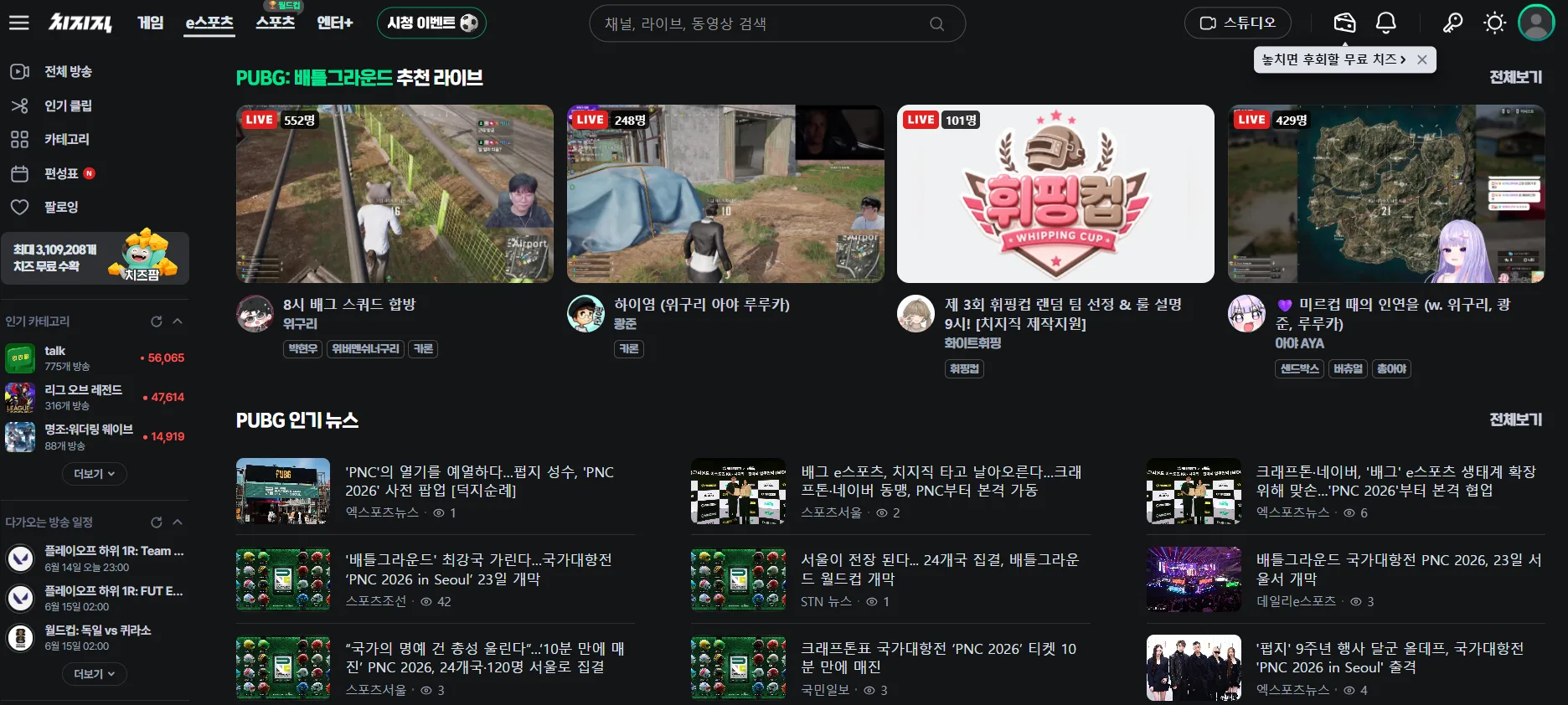
CHZZK’s strength lies not in simple viewing, but in a community-based viewing experience. Users do not watch matches alone. They watch them in the rooms of familiar streamers, together with other fans. Even when watching the same match, the experience changes depending on the atmosphere of the chat, the streamer’s reactions, and the interpretations shared by the fan community. At that point, viewing moves beyond the official broadcast and becomes an experience of belonging to a fandom community.
PUBG esports fits this structure well. Battle royale games generate countless variables throughout a match. Drop locations, rotation routes, engagement decisions, survival calls, and zone shifts constantly create moments that can be interpreted and discussed. The result matters, but the process itself becomes a source of stories. That gives plenty of room for streamer reactions and fandom responses to attach themselves to the game.
CHZZK is not trying to remain just a place that transmits broadcasts. It wants to become a point of contact where fans discover PUBG esports, watch it together, react to it, and later return to consume related content again. When Naver’s broader ecosystem of exposure and promotion is added to this, CHZZK can expand beyond an independent streaming service and become a game fandom hub inside Naver.
That is why, for CHZZK, PUBG esports is not simply something to watch. It is a reason to stay. The tournament brings fans in, while streamers and communities keep them there. What CHZZK wants is not just the viewership of a single match, but the time fans spend on the platform around the PUBG IP.
Krafton’s Goal: Extending the Life of the PUBG IP
For Krafton, this partnership is not simply a platform alliance. It is closer to a strategy for keeping PUBG, as a long-running IP, in the present tense.
PUBG is already a long-established success. It is no longer enough to explain the game through the explosive buzz it generated at launch. What this IP needs now is not simple exposure. It needs a structure that makes existing users pay attention again, gives lapsed users a reason to return, and keeps the name PUBG familiar even to viewers who may not currently play the game.
This is the challenge of a long-running IP. The longer a game is serviced, the more it must continue to add content. But updates alone make it increasingly difficult to hold user attention. New maps, weapons, balance changes, and events refresh the in-game experience. Yet the life of an IP is not sustained only inside the game. It also matters how much people talk about that IP, cheer for it, and consume it again outside the game.
This is where esports becomes an important device for PUBG. Esports does not leave the game merely as something to be played. It turns the game into something to watch, something to cheer for, and something that becomes an event people talk about. Even people who are not logged into the game can watch the matches. Even those who are not highly skilled players can cheer for a particular player or national team. Even users who have already left the game can become interested again through a major tournament or a memorable moment.
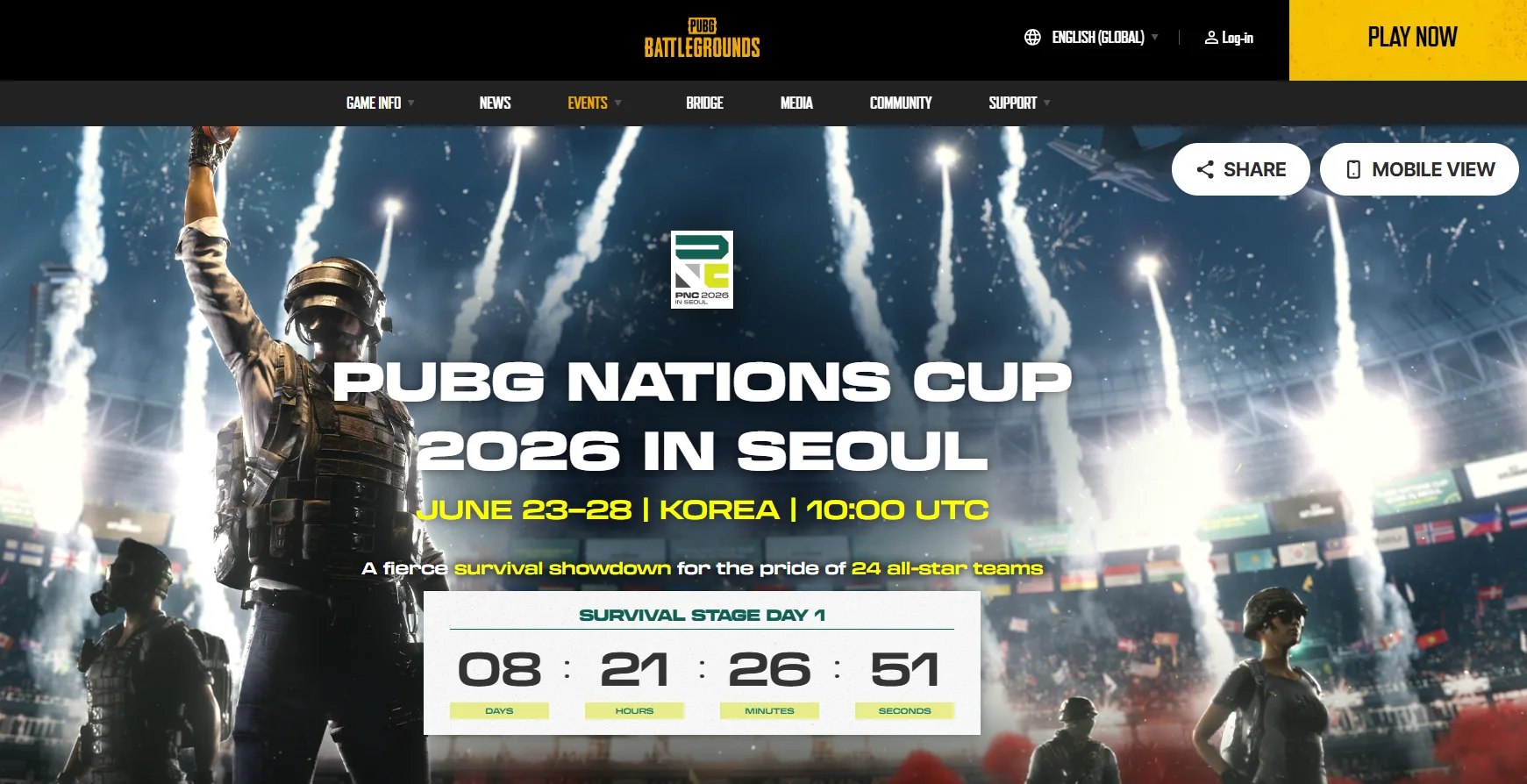
PNC 2026 in Seoul is a particularly effective stage for producing that kind of effect. PNC is a national competition within PUBG esports. National competitions draw out fan emotions more easily than ordinary leagues. Even people who are not usually interested in a specific team or player can find a reason to cheer when the name of a national team is involved. Even if they do not know the game well, it is easy to follow the question, “How far will Korea’s national team go?” At that point, esports expands from content for game fans into a broader cheering event.
The fact that the event is being held in Seoul also matters. A global esports tournament taking place in Korea gives local fans a stronger sense of presence. A match that was once watched only online becomes connected to a real place, and the players and fans seen on-screen are placed within the same city’s event. At that moment, PUBG is no longer just an online game. It becomes an offline event where people gather, cheer, and participate. The presence of the IP moves outside the game client.
From Krafton’s perspective, this is a way of extending PUBG’s lifespan. A long-running game must continue to feel fresh. But it cannot look like an entirely new game every time. Instead, it needs to create meaningful moments. Tournaments, national teams, venue events, and streamer content create those moments. They give users a reason to log back in, viewers a reason to watch again, and fans a reason to talk about the game again.
That is why this partnership goes beyond a strategy to show PUBG to more people. The core is to make PUBG feel like a current event again. An old IP does not survive on past success alone. It survives when people feel that the game is still being watched, discussed, and cheered for now.
For Krafton, esports is the device that creates that feeling. It creates not only the time people spend playing PUBG, but also the time they spend waiting for it, watching it, cheering for it, and returning to it. The life of a long-running IP is now made through both updates inside the game and fandom events outside the game.
A Fandom Loop Connecting Online and Offline
What deserves attention in this partnership is not online broadcasting alone. What matters more is the way it connects online and offline experiences. A flow is created in which fans watch content on CHZZK, discover the tournament through Naver and CHZZK banners, participate directly through venue booths and events, and then return online through streamer content and clips.
This structure is different from a simple promotional path. Promotion focuses on bringing people in once. A fandom loop, by contrast, makes an initial moment of interest lead into another experience. Pre-event content creates anticipation, live broadcasts gather reactions, and venue events leave memories. Those memories are then reprocessed into online content. Even after the tournament ends, the time of fandom does not immediately stop.
CHZZK-exclusive content sits at the starting point of this loop. When content featuring national team players or related narratives is released before the tournament begins, fans gain characters and context before watching the match. In esports, this context matters. A match watched without any information is merely a competition of wins and losses. But a match watched with knowledge of player stories and team atmosphere becomes something to cheer for. Pre-event content is the first step in turning viewers into fans.
Next comes live viewing. When the matches begin, fans can watch the tournament through several channels, including CHZZK, Naver TV, SOOP, and YouTube. Here, CHZZK’s point of differentiation lies in a community-based viewing experience rather than simple viewing. Even when watching the same match, the experience of watching with a streamer and reacting through chat is different. The match is one and the same, but the viewing experience changes depending on the platform and community.
The offline venue is also an important axis of this loop. PNC 2026 takes place in physical spaces such as PUBG Seongsu and Jangchung Arena. Venue booths and fan participation programs turn the tournament from an event on a screen into an event experienced with the body. A fan is no longer only someone who watched the match. They become someone who visited the place. That difference is not small. Offline experiences remain as photos, reviews, short videos, merchandise, fan meeting memories, and are then shared again online.
Naver and CHZZK promotions widen this flow. Main banners on the platform or exposure within the Naver ecosystem allow even people who are not existing PUBG fans to discover the tournament. It is not only about bringing in fans who are already interested. It is also about signaling to casual users passing by that “something is happening right now.” This is where the power of the platform lies. It does not merely call in the fandom that already belongs to the IP. It can also convert the platform’s floating traffic into new viewers.
Seen this way, the structure of this partnership becomes relatively clear. Pre-event content creates anticipation, live viewing gathers reactions, offline venues create memories, and streamers and communities spread those memories back into content. The more this cycle repeats, the more the tournament becomes not a one-time event but a bundle of time in which fandom remains.
What matters is that each actor plays a different role within this loop. Krafton creates the center of the tournament and the IP. CHZZK provides the platform where fans react and remain. Streamers translate that experience back into the language of fandom. Fans consume and share the content, and sometimes return to the game. In this sense, esports is not simply a match schedule. It becomes a circulating device connecting the game, the platform, and the fandom.
Ultimately, the core of this partnership is not merely strengthening online broadcasts. It is about creating a structure in which fans discover the event online, react in real time, experience it offline, and then spread it online again. The tournament is only the starting point. The real competition lies in how long fans’ attention can continue to circulate after that.
Streamers as an Extension Device for Esports
In this partnership, streamers are not an add-on. They are a key device that helps esports be consumed for longer inside the platform. Official broadcasts accurately deliver the flow and results of a match, but fans do not consume every match only through official language. They want to watch in a way that feels closer, more familiar, and more suited to their own tastes.
Streamers appear precisely at that point. They are translators between the official match and the fandom. They explain strategies in accessible ways, attach emotion to important moments, and create an atmosphere in which fans can laugh, be surprised, or feel disappointed together. A moment described in an official broadcast as a “strategic decision” can become a reaction and a meme in a streamer’s broadcast. Fandom responds more quickly to that kind of language.
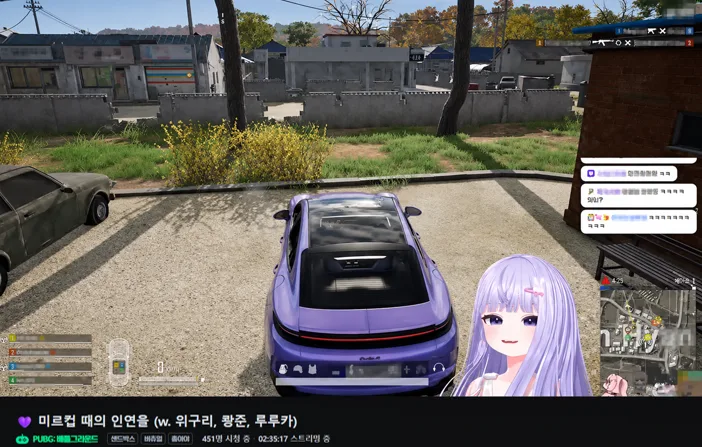
Even within the same PUBG esports match, the experience changes depending on which streamer fans watch with. Some streamers analyze the game tactically, some focus on reactions, and others mix player narratives with community jokes. Through this process, a single official match is reprocessed into different pieces of content across different fandoms.
The power of streamers also works before and after the match. Before a game, they can create preview and prediction content. During the game, they can host co-viewing streams. Afterward, they can produce reviews, highlights, and reaction compilations. The official match ends at a fixed time, but streamer content extends that time forward and backward. It creates material that allows fans to keep talking even after the tournament is over.
That is why streamers are not peripheral to esports. They are an extension device that makes the meaning of a match come alive again inside fandom. If the official match creates the event, streamers create the language that allows that event to remain inside fandom for longer. The vitality of esports does not come only from inside the arena. It is prolonged by how fans interpret, discuss, and consume the match again.
The Next Stage of Platform Competition
This partnership is not only a story about CHZZK and Krafton. More broadly, it shows where streaming platform competition is heading. In its early stage, competition focused on who could secure more streamers, who could provide more stable video quality and lower latency, and who had more broadcasts. But these factors alone make it difficult to maintain long-term differentiation between platforms.
Because of that, what becomes more important going forward is how a specific IP is experienced inside a platform. Even if the same match can be watched across multiple places, the experience changes depending on where it is watched. Is it only an official broadcast, or is it watched together with a streamer? Are chat and reactions alive? Are pre-event content and venue events connected? Is there content left to consume again after the match? Platform competition is increasingly moving toward creating this difference.
The interests of game companies and platforms also meet here. Game companies want to sustain the life of their IPs. This is especially true for long-running games, which need moments that make players pay attention again, log back in, and talk about the game once more. Platforms, on the other hand, want to increase user retention and time spent. They need a structure in which people watch longer, react more, and come back again. Esports is the point where these two goals meet.
For game companies, esports is a device for re-engagement. A tournament makes people remember the game again. A player’s performance shows the fun of the game again. National competitions and major events give fans a reason to cheer. Even users who have not logged in for a long time can be reminded of the game through a major tournament or a memorable moment.
For platforms, esports is a device for time spent. It brings users in before the match begins, holds them through chat and co-viewing during the match, and keeps them around afterward through clips and streamer content. A single tournament is divided into multiple pieces of content, and that content generates further fandom reactions. Through this time, the platform tries to turn one-time visitors into repeat users.
In this shift, platforms no longer remain behind the broadcast. They become actors that shape the fandom experience. They become involved in how fans encounter the IP created by the game company, in what kind of atmosphere they consume it, and in what kind of content they remember it through. The partnership between CHZZK and Krafton shows this change. The stage of esports may be the arena, but the time of fandom continues longer on the platform.
Who Shapes the Time of Fandom?
If we see the partnership between CHZZK and Krafton simply as an esports broadcasting agreement, the event may not seem particularly large. But the meaning of this partnership lies in how that familiar structure is beginning to change. The relationship is no longer limited to one in which the game company creates the tournament and the platform broadcasts it. Now, the platform also helps shape part of the fandom experience.
The lifespan of a game IP is no longer determined only by playtime. It still matters how long users spend playing the game, but it has also become important how often they watch it, talk about it, cheer for it, and recall it. Esports becomes a device that brings a game back to life outside the game itself.
Krafton holds the center of the PUBG IP. The tournament, the players, the rules of the game, and the play experience all begin with Krafton. CHZZK, meanwhile, tries to hold onto the time in which that IP is consumed by fans. It becomes involved in where fans watch, who they react with, and what content they return to afterward.
That is why this partnership is not a competition over fandom time, but an attempt by a game company and a platform to expand that time together. Krafton creates the moments that allow PUBG esports to keep being talked about, while CHZZK provides the space where those stories can gather, generate reactions, and continue. Their point of contact is the same: making people watch longer, talk more, and return more naturally around PUBG.
Now, the question of esports no longer stops at “who broadcasts the match?” The more important question is “who helps create the time fans spend around a game IP, and in what way?”
The partnership around PUBG esports shows this change. A game is not alive only in the moment it is played. It continues in the time spent watching tournaments, remembering scenes, listening to streamers’ interpretations, and talking with other fans.
The partnership between CHZZK and Krafton is closer to a way for PUBG to remain a current IP even in the time outside the game.