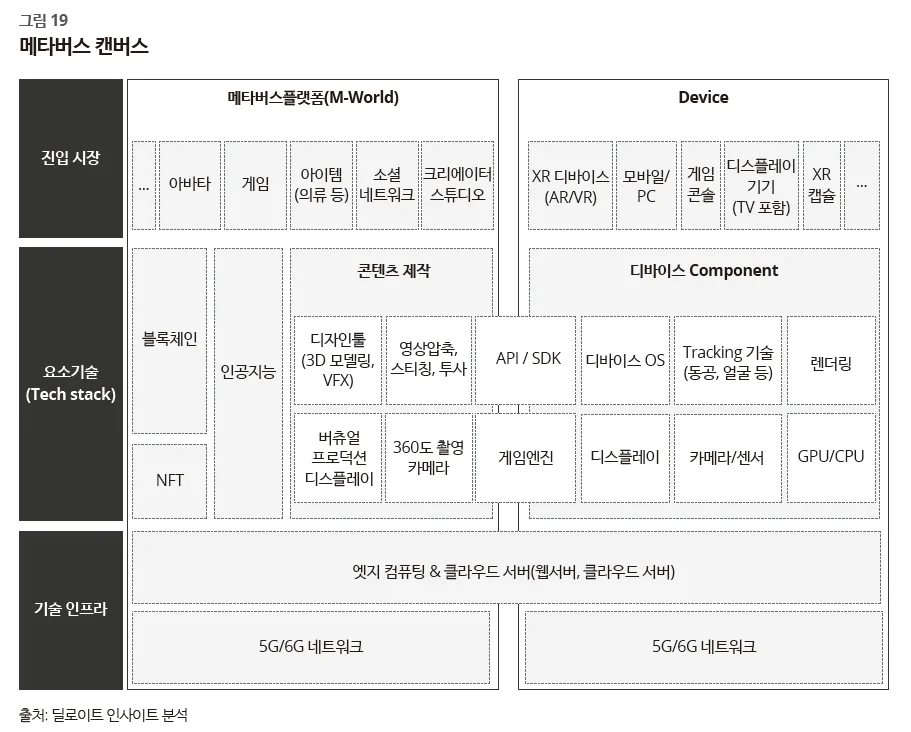
(1) Metaverse Platform Business (2) Visual (3) XR Device
(4) Pure Element Technology (5) Platform-Device Integration
Source: Deloitte Insights 2022 No. 23 "Invitation to the Metaverse -- A Land of Opportunity." The strategic question for companies entering the metaverse: be a Builder (create the infrastructure and platform) or an Adopter (use existing platforms to deliver value). Five metaverse business model categories: (1) Metaverse platform business -- creating the virtual world itself (Roblox, Epic Games, Meta Horizon Worlds); the highest risk, highest potential reward position; requires massive infrastructure investment and the ability to attract both creators and users simultaneously (two-sided network problem); (2) Visual/content business -- creating content and experiences within existing metaverse platforms; lower infrastructure investment; revenue from virtual goods, experiences, and services sold within platforms; brands like Nike, Gucci, and Adidas established virtual stores in Decentraland and Roblox; (3) XR device hardware -- building the physical access layer (Meta Quest, Apple Vision Pro, Microsoft HoloLens); requires semiconductor expertise, optical engineering, and consumer hardware distribution; high capital intensity; (4) Pure element technology -- providing enabling technologies (spatial audio, haptics, AI-generated content, 3D scanning, motion capture); enterprise B2B model; lower risk than platform building; (5) Platform-device integration -- vertical integration building both platform and device (Apple with iPhone + App Store model applied to spatial computing). The Builder vs Adopter decision: most companies should be Adopters initially -- test metaverse channel effectiveness using existing platforms before committing to platform-level investment; the Builder position is appropriate only for companies with sufficient capital, technology capability, and user base to achieve platform network effects.