How much of our conversations with AI should remain in its memory?
It is certainly convenient if we do not have to explain yesterday’s task all over again. It is even more useful if an AI can remember recurring workflows and apply what it learned from previous tasks to future ones.
But what if we take this one step further?
What if an AI can organize past records, preserve important information as long-term memory, and reuse useful procedures discovered through actual work?
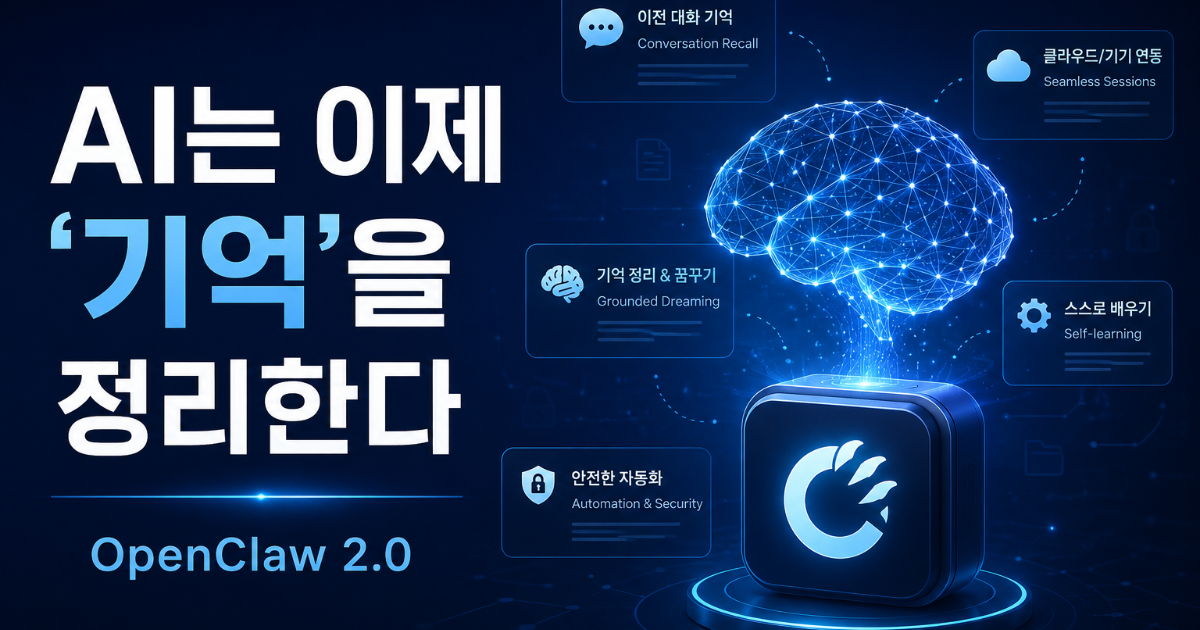
This is one of the most interesting aspects of OpenClaw v2026.8.1, also known as OpenClaw 2.0.
The update introduces a wide range of changes, including personal conversation recall, sessions that can extend across paired devices and cloud workers, progress tracking, automation permissions, and stronger credential protection.
Among these updates, however, three features are particularly noteworthy: Personal Conversation Recall, Grounded Dreaming, and Automatic Self-learning.
Together, they illustrate how AI agents are evolving beyond tools that simply answer questions toward systems capable of carrying context and work experience from one task to the next.
AI Can Recall the Context of Previous Conversations
Anyone who regularly uses AI chatbots has probably encountered a familiar inconvenience:
“What did I tell the AI last time?”
Users often have to explain where a project ended, how a previous task was handled, or what context had already been established.
OpenClaw 2.0's Personal Conversation Recall allows bounded context from previous private conversations with the same agent to be retrieved when Active Memory is enabled.
What is particularly interesting is that OpenClaw's concept of “memory” is not an abstract or mysterious capability.
According to the official documentation, memories are stored as ordinary Markdown files within the agent's workspace.
Long-term memory can be stored in MEMORY.md, while daily records can be maintained in files such as memory/YYYY-MM-DD.md. A human-readable Dream Diary can also be stored in DREAMS.md.
The documentation explains that the model only remembers what has been written to disk; there is no separate hidden memory state.
Behind the seemingly simple idea that “AI remembers me,” therefore, lies a concrete system for storing, retrieving, and managing information.
Why Does an AI “Dream”?
One of the most eye-catching names in OpenClaw 2.0 is Grounded Dreaming.
Of course, this does not mean that an AI literally sleeps and dreams like a human being.
In OpenClaw, Dreaming is a background memory consolidation system within memory-core.
It organizes accumulated short-term signals and identifies information that may be valuable enough to preserve as long-term memory.
The names of its stages are particularly interesting:
Light → REM → Deep
During the Light stage, recent short-term material is organized and candidates are prepared for further evaluation.
During REM, the system reflects on recent records to identify recurring ideas and themes.
Finally, during the Deep stage, candidates are evaluated and information that meets the required criteria can be promoted into long-term memory in MEMORY.md.
Part of this process can also be recorded in DREAMS.md, allowing users to inspect the results.
The terminology may sound imaginative, but the underlying problem is highly practical.
Should every conversation with an AI become permanent memory?
Some information may only be useful for a short period, while other information could remain valuable for months.
If AI agents are designed to assist users over long periods, they eventually have to confront a fundamental question:
What should be retained, and what should be allowed to fade away?
OpenClaw's Dreaming system is one approach to managing that problem.
What Does It Mean for an AI to “Learn” While Working?
Another notable feature is Automatic Self-learning.
The term “self-learning,” however, needs to be interpreted carefully.
It does not mean that OpenClaw independently retrains its underlying AI model or autonomously modifies the model's weights.
According to OpenClaw's documentation, Self-learning is closer to turning useful procedures discovered through user corrections and real-world tasks into reusable Skills.
This process is governed through a controlled mechanism called the Skill Workshop.
New or modified Skills can move through proposal, scanning, and application processes. Depending on the configured autonomy mode, the system distinguishes between changes that may be applied automatically and those that require human review.
Changes to user-authored Skills are designed to be held for review rather than silently overwritten.
The system also incorporates safeguards such as security scanning, hash checks for target content, and metadata that supports rollback.
The important point, therefore, is not that an AI somehow “grows” like a human being.
It is that:
A useful method discovered during one task can become a reusable resource for future tasks.
There is a significant difference between an AI that must be instructed from scratch every time and an AI that can reuse useful procedures accumulated through previous work.
From Remembering to Continuing the Work
OpenClaw 2.0's changes extend beyond memory.
Tasks can run on paired devices or cloud workers, and session workspaces can move with them so that work can continue in later cloud sessions.
Users can also follow ongoing tasks and subagent activity.
For recurring automations, permissions can be granted for specific operations and later inspected or revoked. If the task or requested operation changes, the system can require authorization again.
There is also an important change related to security.
When an agent needs credentials such as a password or API key, OpenClaw can request them through protected, masked mechanisms rather than placing those values directly into ordinary chat or model context.
Individually, these may appear to be separate product features.
Viewed together, however, they reveal a broader direction:
Remember → Work → Reuse experience → Continue working.
AI is gradually moving from an interface that merely answers questions toward an agent capable of carrying work across time.
Greater Convenience Makes AI Literacy More Important
This is where the importance of AI literacy becomes even clearer.
If an AI remembers nothing, users have to explain everything again and again.
That is inconvenient.
But what if an AI remembers previous conversations and tasks extremely well?
That is undoubtedly convenient.
At the same time, however, a new set of questions emerges.
Which parts of my conversations should become long-term memory?
Where are those memories stored?
How can incorrect memories be corrected?
If I delegate recurring work to an AI agent, how much authority should I give it?
And how should memories and permissions that are no longer needed be managed?
The central issue of the AI-agent era is no longer simply:
“How intelligent is the AI?”
Users increasingly need the ability to decide what an AI should remember, what work it should perform, and how much authority it should receive.
In that sense, the scope of AI literacy itself may also be expanding.
An Era in Which AI Remembers Us
Perhaps the most interesting aspect of OpenClaw 2.0 is not any single feature.
It is the gradual transformation of the way humans and AI work together.
From an AI that answers questions,
to an AI that retrieves the context of previous work,
to an AI that can reuse useful procedures from earlier tasks,
and to an AI that organizes accumulated memories so that valuable information can be used over the long term.
Terms such as “Dreaming” and “Self-learning” should not lead us to believe that AI literally dreams or independently develops consciousness like a human being.
These systems still operate within explicit storage structures, models, rules, permissions, and technical safeguards.
Nevertheless, the direction raises an interesting question.
In the future, perhaps the question we ask AI will no longer end with:
“What can you do?”
Instead, another question may become increasingly important:
“What do you remember about me?”
And the question that follows may matter even more:
“What should I allow AI to remember?”