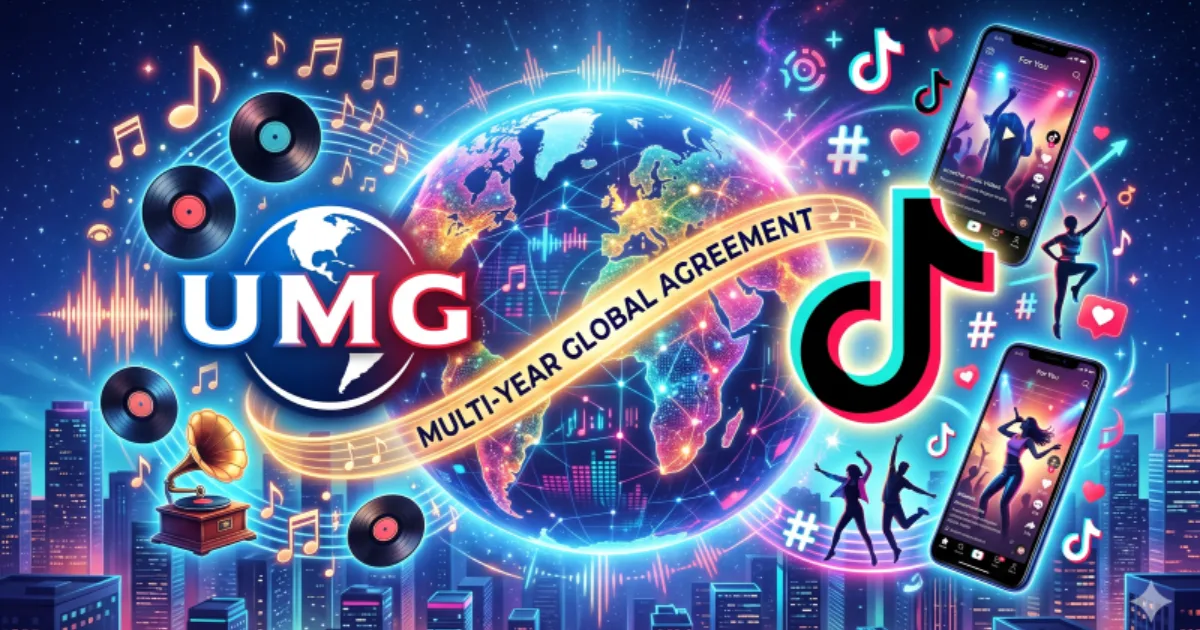
Universal Music Group, or UMG, and TikTok have signed a new multi-year global licensing agreement, marking a significant reset in one of the most closely watched relationships in the digital music industry. The two companies announced on May 22, 2026, that the agreement would deepen their existing partnership and provide additional benefits for artists, songwriters, creators and fans.
Under the agreement, TikTok will continue to offer UMG’s extensive recorded music and publishing catalog to users around the world. The companies also plan to expand engagement between creators and UMG artists and songwriters, using technology and promotional capabilities to strengthen music discovery and fan communities.
The significance of the deal goes beyond the extension of music licensing rights. Its core issue is the protection of rights in the age of AI-generated music. UMG and TikTok said they will work together to remove unauthorized AI-generated music from the platform and improve attribution for artists and songwriters. As generative AI disrupts the creation, distribution and monetization of music, the agreement signals that major rights holders and platforms are beginning to build a new set of rules.
A Continuation of the 2024 Conflict
The new agreement recalls the dispute between UMG and TikTok in 2024. At the time, licensing negotiations between the two sides broke down, and UMG pulled its music from TikTok. As a result, music connected to major artists such as Taylor Swift, Drake and Bad Bunny disappeared from the platform or was muted in existing videos.
The dispute centered on three issues. The first was whether artists and songwriters were being fairly compensated. The second was whether TikTok was doing enough to control AI-generated content that imitated the voices or styles of famous artists. The third was whether the economic value created by music on TikTok was being properly returned to rights holders.
In May 2024, the two companies reached an agreement and UMG’s music returned to TikTok. That deal was widely seen as including improved protections around AI, better compensation and expanded promotional opportunities. The 2026 agreement can be understood as a broader extension of that settlement. In other words, UMG and TikTok are not simply repairing a past conflict. They are moving toward institutionalizing how AI and short-form video platforms affect the music industry.
Why TikTok Needs UMG
TikTok describes itself as a leading platform for music discovery and promotion. Over the past several years, the platform has become one of the most important distribution channels in the global music industry. When a song spreads on TikTok through memes, challenges or dance videos, that momentum can translate into streaming chart performance, album sales, concert demand and wider recognition for artists.
In this structure, UMG’s catalog is a critical asset for TikTok. UMG is one of the world’s largest music companies, with a broad catalog of artists, songwriters and recordings across genres and generations. For TikTok, the absence of UMG music could weaken the platform’s cultural energy and creator ecosystem.
The 2024 removal of UMG music showed this clearly. Popular songs disappeared, existing videos were muted, creators had to find replacement tracks, and some artists temporarily lost access to TikTok as a viral marketing channel. On a short-form video platform, music is not just background sound. It is the emotional, rhythmic and participatory language that shapes how videos spread.
TikTok’s long-term agreement with UMG is therefore not simply about securing music content. It is about protecting a foundation of the platform’s cultural competitiveness. Without music, TikTok’s short-form videos would struggle to maintain the same level of cultural impact.
Why UMG Returned to the Table
UMG also needs TikTok. The platform is not merely a social network. It is a powerful channel for discovering new artists and reviving interest in established ones. In the past, radio, television, record stores and music programs were central to music discovery. Today, short-form video and algorithmic recommendation have become new entry points into music consumption.
Among younger audiences in particular, TikTok is not simply a place where people search for music. It is a place where they encounter songs by chance, create with them, join challenges and move from one track to an artist’s broader catalog. In this process, music is consumed and recreated at the same time.
For UMG, the discovery and fandom-building power of TikTok is difficult to ignore. Yet if rights protection and revenue sharing are inadequate, the platform’s marketing value alone cannot justify the partnership. The new agreement appears to be an effort to reset that balance: UMG can use TikTok’s viral reach while seeking to ensure that more of the economic value flows back to artists and songwriters.
AI Protection Is the Core of the New Deal
The most important element of the announcement is AI protection. The companies said they will work together to remove unauthorized AI-generated music from TikTok and improve attribution for artists and songwriters. This addresses one of the most sensitive issues facing the music industry today.
Generative AI has advanced to the point where it can imitate the voice, singing style and musical identity of specific artists. The problem is that such AI-generated music can be created and distributed without the permission of the original creators or performers. If an AI-generated song that imitates a famous artist goes viral, listeners may mistake it for an authentic release, while rights holders may see both their identity and economic rights undermined.
AI music also raises difficult questions for existing copyright frameworks. Is a voice a copyrighted work, a personality right, or a publicity right? How much imitation of a musical style should be allowed? If an AI-generated song evokes a particular artist without directly copying a specific recording, how should that be judged? These questions remain unresolved in both law and industry practice.
The new UMG-TikTok agreement represents an attempt to create operational rules in this uncertain environment. Rather than waiting for legal precedent to fully develop, the platform and the rights holder are introducing a practical standard: unauthorized AI-generated music should be removed.
Attribution Becomes More Important in the AI Era
The agreement also emphasizes improved attribution for artists and songwriters. This is especially important in the AI era. In an environment where content can be copied, remixed and transformed quickly, the names of original creators and rights holders can easily disappear.
On short-form video platforms, only a portion of a song may be used, or a track may be reshaped through remixes, memes and challenges. As a result, the connection between the original work and its creators can become blurred.
Attribution is not just a matter of credit. In the music industry, attribution is the starting point for revenue distribution, reputation, fandom connection and data analysis. To understand where and how a song is being used, which artists are connected to certain video cultures, and which songwriters are generating value, platforms need accurate attribution systems.
AI makes this issue more complex. AI-generated music, human-created music, human-created music altered by AI, and AI remixes of existing works can all circulate together. In the future, the competitiveness of music platforms may depend not only on the size of their catalogs, but also on their ability to reliably track who created what and how it was used.
Music Licensing Expands Into Fandom, Commerce and Advertising
The new agreement is not limited to music usage rights. The companies also mentioned expanded marketing and advertising campaigns, stronger access to e-commerce and artist-centered tools, fan engagement experiences and artist development initiatives.
This shows that the nature of music platform agreements is changing. In the past, the central questions in licensing were whether a platform could use music and how much it would pay for that use. But on platforms such as TikTok, music is connected to advertising, fandom, merchandise sales, live events, challenges, brand campaigns and new artist discovery.
Music is no longer just a file to be played. It has become cultural infrastructure that builds communities, drives fan behavior and connects to commerce and brand partnerships. The mention of e-commerce and artist-centered tools suggests that TikTok sees music not merely as content, but as a bridge between culture, commerce and fandom.
For UMG, this is also significant. Streaming revenue alone cannot fully explain the economic value of an artist. Fan-based sales, brand collaborations, concert demand and renewed attention from short-form virality all matter. The agreement can therefore be viewed as an effort by a major rights holder to work with a platform to capture that broader value more systematically.
A Shift in the Balance of Platform Power
The relationship between UMG and TikTok illustrates the changing balance of power in the modern content industry. Platforms control users, algorithms, data and distribution networks. Rights holders control music, artists, copyrights and the source of fandom. Neither side can fully create value alone.
The 2024 conflict showed what happens when that balance breaks down. UMG could remove its music, but doing so meant losing access to TikTok as a discovery channel. TikTok could continue operating, but the absence of a major music catalog risked weakening user experience and the creator ecosystem.
The 2026 agreement reflects the fact that both sides recognize their mutual dependence. But this time, the deal goes beyond simply restoring music access. It covers AI protection, improved monetization, attribution, fan experiences and e-commerce. This suggests that future negotiations between platforms and content rights holders will evolve beyond licensing fees into broader negotiations over data, AI, commerce and fan tools.
Implications for the Korean Music Industry
The agreement also carries important implications for the K-pop industry. K-pop has already expanded its global fandom through short-form platforms such as TikTok, YouTube Shorts and Instagram Reels. Challenges, dance covers, fan edits and meme culture have become central engines of K-pop’s global reach.
But the AI music era introduces new risks. AI covers that imitate the voices of specific idols, unauthorized remixes, fake duets and fan-made AI content can spread rapidly. These forms of content may expand fan participation, but they can also create problems around artist identity, distorted revenue distribution and misleading content.
Korean entertainment companies and music rights holders are therefore likely to demand more specific protections in platform agreements. These may include rules on AI-generated content, responses to voice cloning, attribution systems, data access and revenue sharing. In the future, the value of music IP will depend not only on songs themselves, but also on how the songs and artist identities are protected and used in AI-mediated environments.
Conclusion: The Next Music Contract Will Be Defined by Its AI Clauses
The new global licensing agreement between UMG and TikTok points clearly to the next direction of the music industry. Short-form platforms have become central channels for music discovery, while major music rights holders have become essential content suppliers for platform growth. At the same time, the spread of generative AI is creating new tensions in this relationship.
The core of the agreement is not simply the continued availability of music on TikTok. It is a structure designed to remove unauthorized AI-generated music, strengthen attribution for artists and songwriters, and ensure that more of the platform economy’s value flows back to creators.
Future music agreements will not be determined by licensing fees alone. AI protection, data transparency, fan tools, commerce integration and creator attribution will all become part of the negotiation table.
TikTok creates culture through music. UMG protects rights through music. The new agreement shows that these two forces cannot survive through conflict alone. They must coexist through new rules.
In the AI music era, the winner may not be the company with the largest catalog or the biggest platform. It may be the company that can protect the value of human creativity while opening new possibilities for distribution, fandom and participation.