Interoperability Between Metaverse Platforms
Building Capabilities to Prepare for the Future
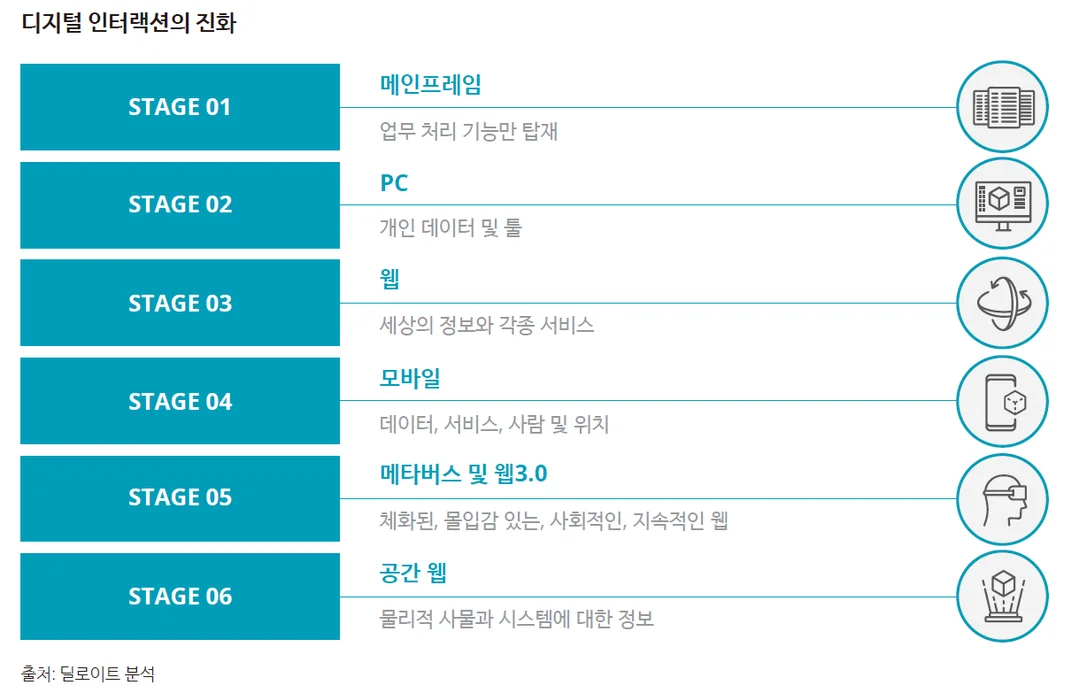
Source: Deloitte Insights 2022 No. 23 "Invitation to the Metaverse -- A Land of Opportunity." Web 3.0 and the metaverse are forming a new application layer of the internet. The internet eliminated the barriers of distance and enabled global commerce, communication, and information access -- but control remained centralized with platform companies (Google controls search, Meta controls social, Amazon controls commerce). Web 3.0 promises to redistribute this control through blockchain-based decentralization. The power balance transition: Web 1.0 (1990s-2000s): read-only internet; users consume content from centralized publishers; Web 2.0 (2000s-2020s): read-write internet; users create content on centralized platforms (Facebook, YouTube, Twitter); platform owners capture most of the economic value; Web 3.0 (emerging): read-write-own internet; users own their data, digital assets, and can participate in platform governance through tokens; economic value distributed to participants through token rewards. Metaverse interoperability: the critical question is whether metaverse platforms will be walled gardens (like today mobile apps -- separate, non-interoperable, controlled by platform owners) or open standards (like the web -- interoperable, with assets and identities portable across platforms). Current state is walled gardens (you cannot bring your Roblox avatar into Fortnite) but the vision is open metaverse where digital identity and assets are portable. Building capabilities for the future: for enterprises, three capabilities are required: (1) Understand blockchain and digital asset technology at a level sufficient for strategic decision-making; (2) Experiment with creator economy models to understand how value creation is changing; (3) Develop spatial computing literacy across the organization -- leaders, designers, and customer experience teams all need to understand what immersive 3D interaction enables that 2D interaction does not.