When a goal is scored in a soccer game, the crowd roars and the commentator raises their voice. In a basketball game, replays appear as if they were part of a TV broadcast. In a baseball game, the pitching form and batting stance of real players are recreated in detail. At some point, sports games became realistic enough to almost stand in for watching real matches.
But if we think about it, there is something strange about that. A game cannot actually kick, throw, or catch a ball. A computer does not directly understand the air of the stadium, the breathing of the players, or the heat of the crowd. And yet, we still feel a sense of tension and excitement in game matches that resembles real sports.
Sports Cannot Be Copied
People often think of sports games as one of the most realistic game genres. Real players appear, uniforms and stadiums are recreated, and player abilities are updated based on real-world records. Soccer games feature real clubs and leagues, basketball games add broadcast-like camera direction, and baseball games reproduce everything from a pitcher’s fingertips to a batter’s swing in fine detail.
But sports games did not begin by trying to copy reality as it was.
Rather, the history of sports games was closer to an attempt to translate real sports into rules and numbers that computers could understand. A game cannot actually kick or throw a ball. Developers have to turn player movement into animation, calculate the trajectory of the ball through physics, and implement referee decisions through conditional logic.
In the end, sports games did not begin as a genre that copied reality. They began as an attempt to translate the movements, judgments, and tension of competition that humans learn through their bodies into systems.
A Ball and Two Paddles: The Beginning of Sports Games
The history of such a vast genre began, surprisingly, from something very simple.
Released in 1972, Pong is often described as the first widely popular sports game. But by today’s standards, it would be difficult to call it a table tennis simulator. On the screen, there are only two paddles and one ball. The ball bounces at fixed angles, the paddles move up and down, and a player scores when the opponent misses the ball.
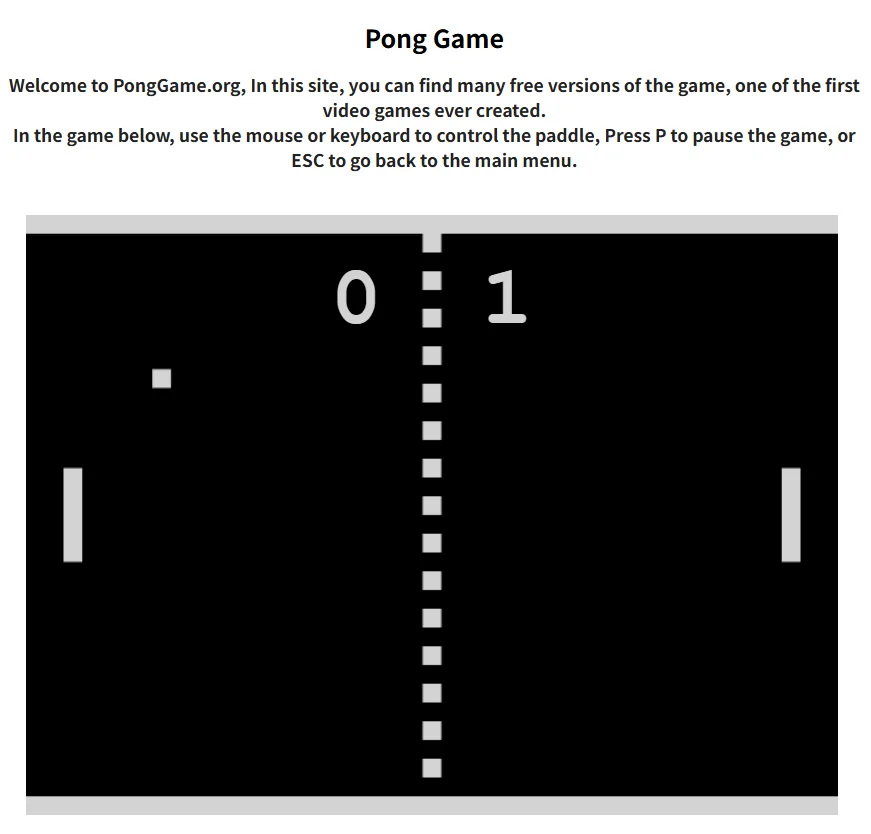
There is no spin, no player movement, and no racket angle like in real table tennis. And yet, it contains the core rule that defines the sport. Return the ball, and make the opponent miss it. The beginning of sports games was not about how closely reality could be reproduced. It was about choosing what to keep and what to remove from a sport.
What is interesting is that this philosophy has not changed all that much. Even today’s soccer games cannot reproduce every detail of a real match. Developers choose what matters most in a match and redesign it as playable rules. From the beginning, sports games were less about copying reality and more about understanding and translating it.
Three Ways to Turn Sports into Games
As technology advanced, developers found themselves facing a question.
“How realistic should sports games become?”
There was no single answer to that question. Some games chose to create sports that were more fun than reality. Some tried to reproduce real matches as accurately as possible. Others began to look at sports from the perspective of managers and club owners rather than players.
In this way, sports games split into three major paths.
The first is the arcade sports game. In this genre, real-world rules are not absolute. Players jump far beyond what is possible, fire off special shots, and the field sometimes becomes something closer to an action movie stage. Sports become a medium for delivering exhilarating pleasure and fantasy rather than realistic reproduction.
The second is the sports simulation game. This genre took the opposite path. It tried to recreate real player movements, ball physics, game rules, and team tactics as closely as possible. The soccer and baseball games that many people think of today largely belong to this lineage.
The last is the sports management game. These games go one step further and give up direct control of the players altogether. The player experiences sports not on the field, but from the bench or the office. Designing tactics, signing players, and growing a team become the game itself.
What is interesting is that all three genres deal with the same sports, but they give the player completely different roles. Some games let the player become an athlete. Some let the player become a hero stronger than reality. Others let the player become a manager or general manager. In the end, the history of sports games is also the history of interpreting and translating a single sport in different ways.
And among them, there was one genre that built the largest market and spent the longest time trying to move reality into the digital world.
That genre was the sports simulation game.
Calculating Sports
Sports simulation games have to implement far more than one might expect. Acceleration and deceleration, physical contact and inertia, the rotation and rebound of the ball, referee decisions, the positioning of AI teammates, changes in managerial tactics—all of these elements, which players and spectators intuitively understand in reality, must be calculated by computers through numbers and algorithms.
That is why sports simulation games are not simply about making graphics look realistic. They are closer to a genre that rewrites the movements, rules, choices, and judgments that make up real sports into systems inside a digital world.
If a racing game calculates the speed and friction of a single car, a soccer game calculates the entire space created by 22 players and one ball. The player with the ball is not the only thing that matters. Where the teammates I do not control will move, when the opposing defenders will press, and when empty spaces will open and close all have to be determined inside the system.
Of course, sports simulation games cannot be explained through soccer alone. Basketball games have translated individual movement and physical contact, baseball games have translated the psychological battle between pitcher and batter as well as the accumulation of records, and racing games have translated the sensations of speed, friction, and steering in their own ways.
Still, soccer games were the case where these elements were most complexly intertwined. Team-wide movement, ball physics, the judgment of AI teammates, and the constant updating of real leagues and player data all had to function at the same time on a single screen.
Why Did Soccer Become the Center of Simulation Games?
The rules of soccer are simple. Put the ball into the opponent’s goal. But the actual match is anything but simple. Passing, pressing, creating space, offside traps, spacing between players, and tactical shifts continue endlessly. Around a single ball, 22 players move at the same time, creating new situations every moment.
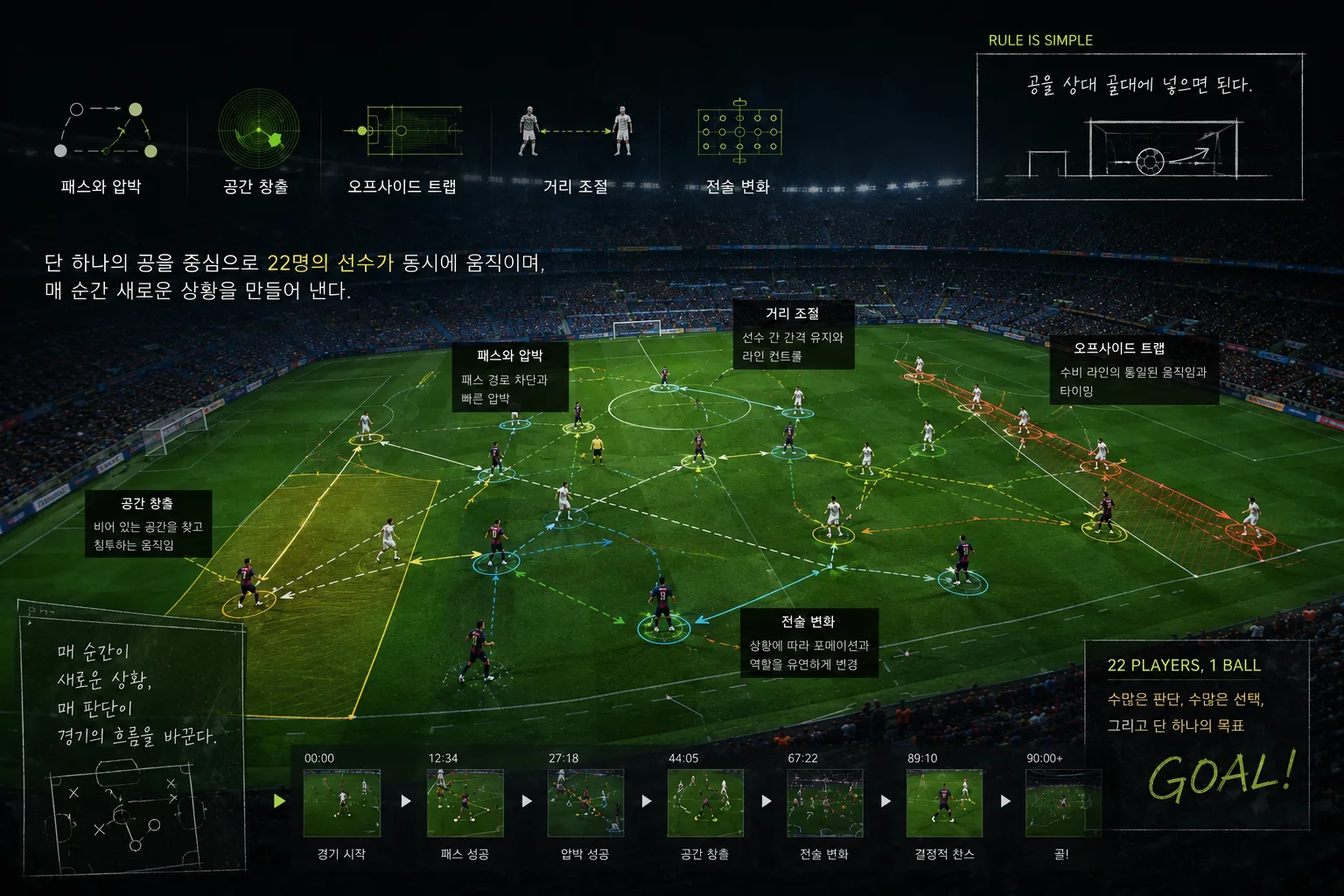
This complexity becomes even clearer when making a soccer game, or a soccer simulation game. The player usually controls only one player directly. But soccer is not a sport played alone. The game must continue to calculate where the ten teammates I do not control are moving, when the opposing defenders will press, and when spaces will open and close.
That is why a soccer game is not simply a game of direct control. It is closer to a cooperative simulation in which the player and AI form a team together. The player expects teammates they do not control to run into certain spaces, and developers have to implement movements and judgments that satisfy those expectations inside the system.
It was also important that soccer is the largest sport in the world. It has a massive fan base across Europe, South America, Asia, and the Middle East, while real leagues, national team matches, transfer markets, and seasonal data constantly create new stories. Because real soccer keeps moving, soccer games could also connect living sports to the digital world through updates and live services.
Ultimately, what makes soccer games special is not simply that they deal with the most popular sport. Soccer is a sport that contains the most complex movements and judgments within the simplest rules, while also constantly renewing its real-world leagues and player data. That is precisely what placed soccer games at the center of sports simulation games.
What Were Winning Eleven and FIFA Competing Over?
So the history of soccer games was not simply a history of graphical competition. It was a competition over how to understand soccer as a sport, and which parts of real soccer should be moved into the digital world.
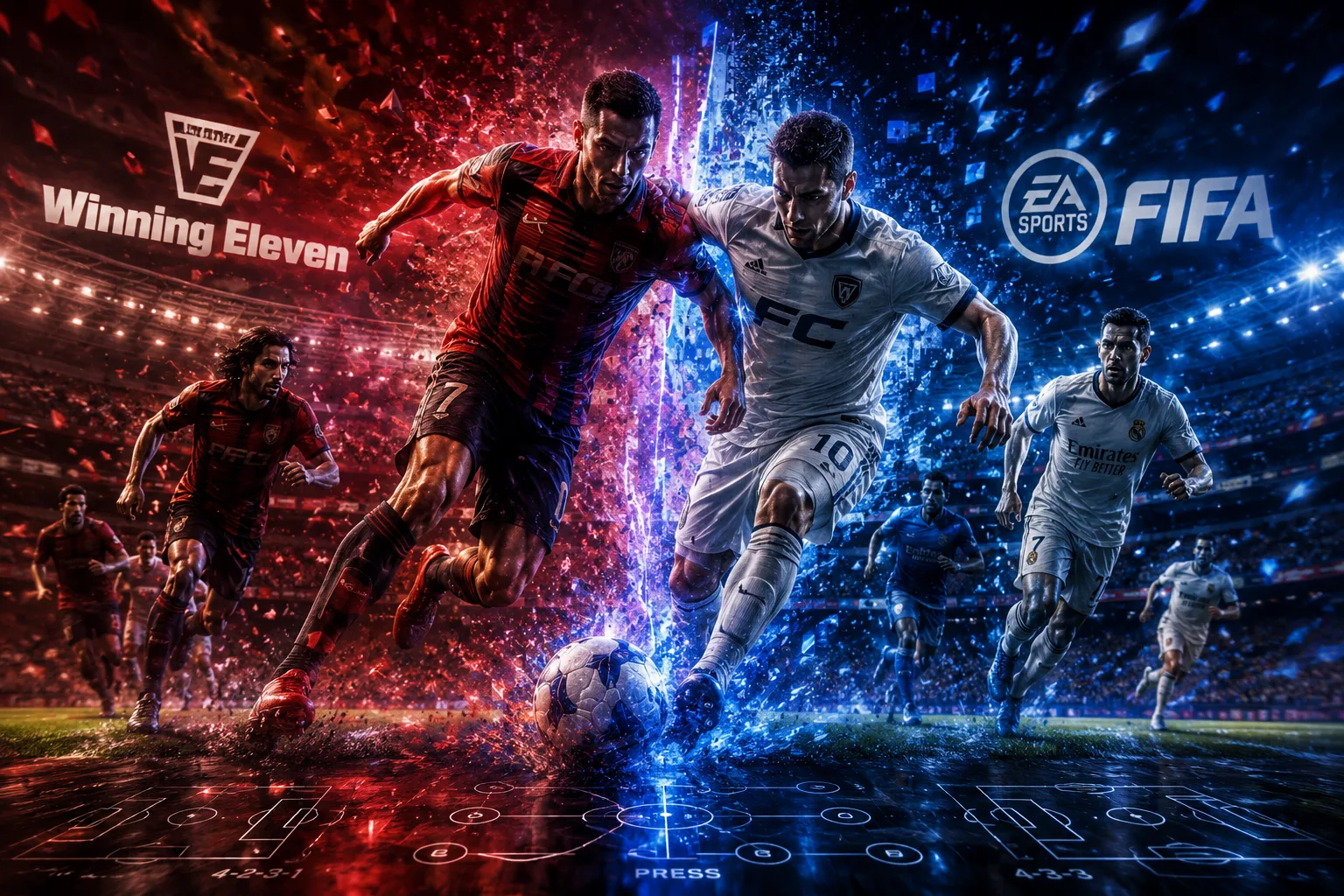
On one side was Winning Eleven. Known as Winning Eleven in Japan, Pro Evolution Soccer or PES overseas, and now continuing under the name eFootball, it is Konami’s soccer game series. Its origins go back to J.League Jikkyou Winning Eleven, released in 1995 and based on Japan’s J.League. The series later grew through World Soccer Winning Eleven and Pro Evolution Soccer, becoming one of the two major pillars of the global soccer game market alongside FIFA from the 2000s into the early 2010s.
In the 2000s, Winning Eleven was almost a symbol of “match feel” for soccer game fans. It often lagged behind FIFA in licenses and broadcast-style presentation, but many players felt that Winning understood real soccer better. The ball did not feel magnetically attached to a player’s foot, and passes had subtle differences in direction and strength. With each short pass, a small gap appeared between the player and the ball, and the player had to read that gap and tempo to create the next movement.
Anyone who spent a long time playing Winning in those days will remember it. The timing of threading a through pass, the feeling of the ball slightly rolling away from the foot, and the experience of sending a pass while trusting that a teammate would run into empty space. What Winning tried to implement was not a flashy broadcast screen, but the rhythm of the ball flowing across a real pitch.
In that sense, Winning understood soccer as the flow inside the stadium. The pleasure of real soccer does not simply lie in controlling famous players. It lies in predicting where the ball will go, waiting for a teammate to move into space, and creating a crack in the opposing defense with a single pass. Winning tried to translate that feeling into a system. More than a flashy exterior, what mattered was the weight of the ball, the tempo of passing, and the distance between attack and defense.
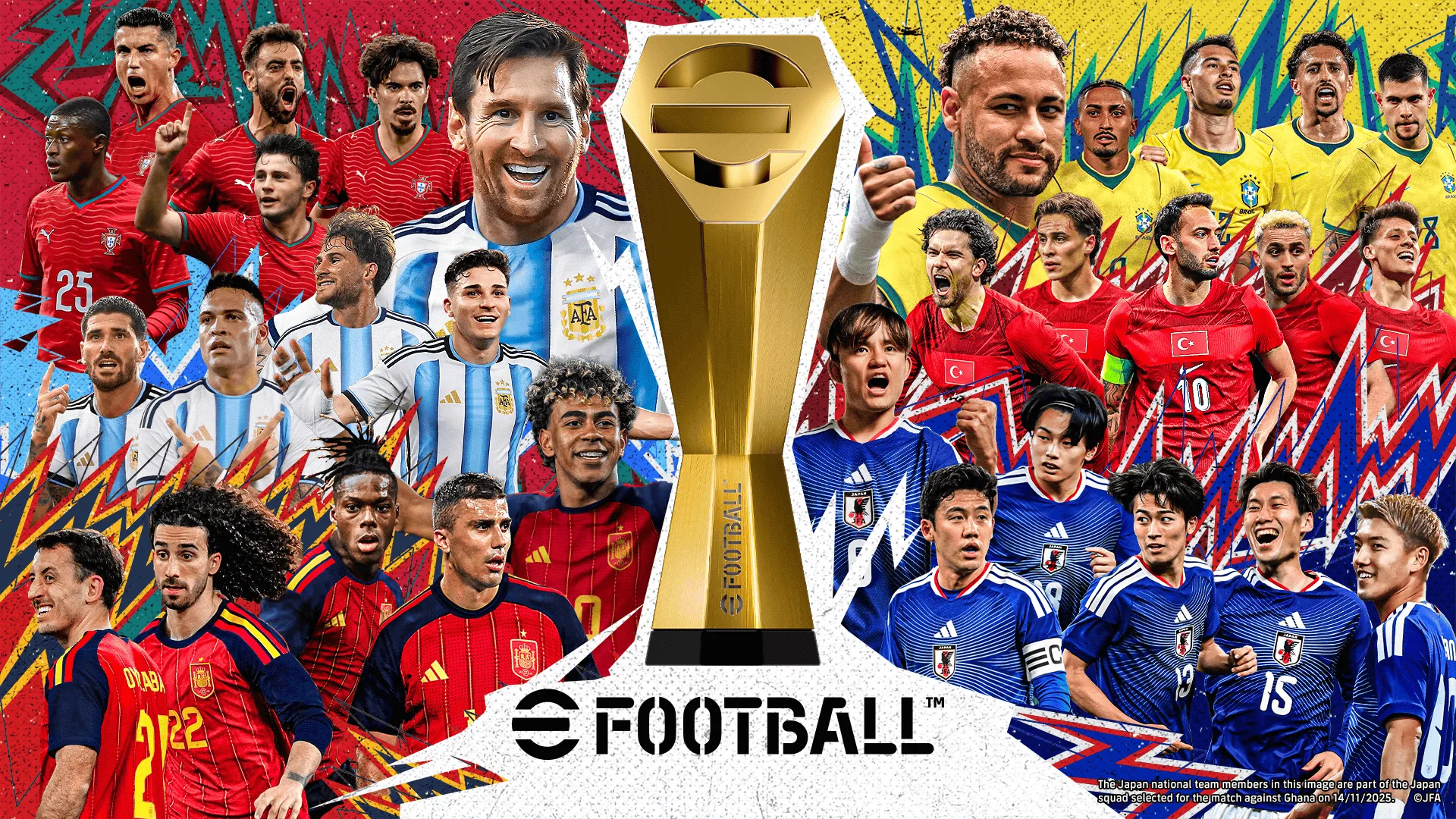
Of course, today’s Winning does not remain in the same form as the past. Konami’s soccer game began foregrounding online competition and esports through the name eFootball PES in 2019, and in 2020 it released eFootball PES 2021 Season Update instead of a fully new title. This was a title based on the gameplay of PES 2020, updated with the latest player and club data. Then, in 2021, Konami reorganized the series as eFootball, shifting from an annual package-based soccer game to a free-to-play, live-service platform.
If the old Winning was closer to a console soccer game where players enjoyed the feel of a match with a friend, today’s eFootball has the character of a service-based sports game centered on online matches, continuous updates, player recruitment, team development, and seasonal events.
That does not mean the philosophy Winning pursued has disappeared. The name and service structure have changed, but eFootball still treats the feel inside the stadium—spacing between players, ball movement, passing rhythm, and the use of space—as important values. In other words, if 2000s Winning was a game that translated the soccer match itself, today’s eFootball can be seen as a soccer platform that reinterprets that philosophy for the live-service era.
On the other side was FIFA. EA’s soccer game series began with FIFA International Soccer in 1993, used the official FIFA name for many years, and has continued since 2023 under the name EA SPORTS FC. In the 1990s and early 2000s, FIFA focused on bringing real players, national teams, leagues, and uniforms into the game. With the official authority of the FIFA name and a vast range of licenses, it chose the path of connecting real soccer and video games.
As the series entered the late 2000s and 2010s, FIFA grew beyond a simple soccer game into a digital soccer experience. Camera work and presentation that felt like watching a real broadcast, along with real leagues, clubs, stadiums, and players, gave players the feeling not merely of playing soccer, but of entering the world of soccer. Wearing the uniform of one’s favorite club, playing in a familiar league, and controlling real star players naturally connected the game to real soccer fandom.
This difference also changed how players experienced the game. If Winning was closer to “the taste of playing soccer,” FIFA was closer to “the feeling of entering the soccer world.” FIFA understood soccer not merely as a set of match rules, but as a vast form of content in which players, clubs, leagues, fan culture, and everything surrounding real soccer were connected.
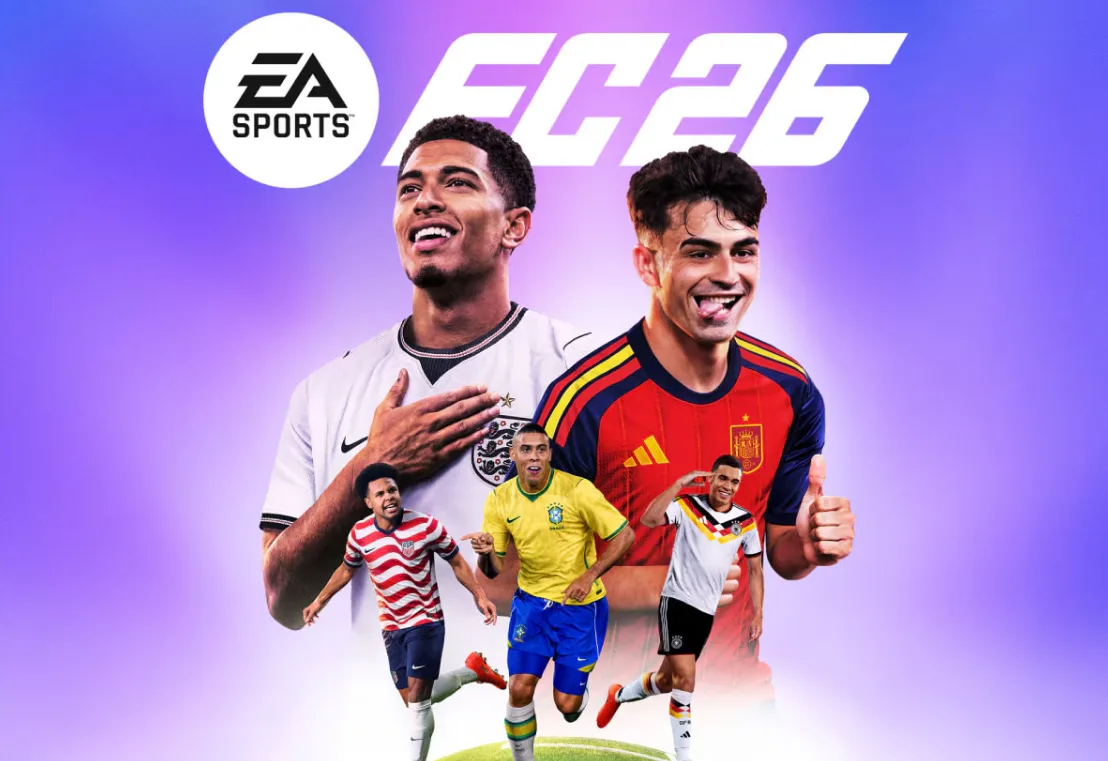
This philosophy becomes clearest in FIFA Ultimate Team, now Football Ultimate Team. In Ultimate Team, the player does not simply play matches with a fixed team. They collect real soccer players in the form of cards, build their own squad, and experience content that changes according to seasonal performances and events. When a player performs well in real life, a special card may appear in the game; when the transfer market opens, fans’ attention naturally flows into team-building inside the game.
At this point, the soccer game no longer remains a reproduction of a 90-minute match. The transfer market, player form, weekly events, legendary player cards, fan interest, and collecting culture all enter the game. Acquiring good players, building one’s own team, and updating an in-game squad in line with the flow of real soccer become the play itself.
Recent EA SPORTS FC goes one step further. While maintaining the framework of an annual packaged game, it continuously updates Ultimate Team, Clubs, and Career Mode, strengthens live content connected to the real season, and ties real soccer and the game together within a single service. Today’s FIFA, and now EA SPORTS FC, can be understood as a game that translates soccer not as a single match, but as a living ecosystem made up of constantly moving data, fandom, licenses, and community.
Winning translated the match, while FIFA translated the soccer ecosystem. One tried to capture the feeling of the ball flowing and the rhythm of the game. The other brought the entire world of real soccer—leagues, players, licenses, and fandom—into the game.
The competition between Winning Eleven and FIFA was not a battle over which game was more realistic. It was a competition over what should be considered most important in real soccer. And thanks to that competition, soccer games moved beyond simple sports reproduction and established themselves as the most representative genre of sports simulation games.
How Did Sports Become Games?
In the end, sports simulation games were not a genre that simply copied reality. Basketball translated bodily movement and physical contact, baseball translated the psychological battle between pitcher and batter and the accumulation of records, and racing translated the sensation of speed and friction into systems in their own ways.
Among them, soccer games became the most complex testing ground. They had to deal with the space created by 22 players and one ball, the movements of teammates the player did not control, and the continuous updating of real leagues and player data. The competition between Winning Eleven and FIFA was the history of translating that complex reality in different ways.
Sports games do not move reality into the game as it is. They choose what to keep, what to remove, and what to turn into playable rules. Sports were not copied inside games; they were rewritten as new systems.
But not all sports games chose the path of faithfully recreating reality. If sports simulation games tried to translate reality in detail, there were also games that chose a faster, flashier kind of fun than reality.
They were called arcade sports games.
Continued in:
[Game Genre Stories] Sports Games That Made Reality Playable ② Arcade Sports Games That Dreamed of Sports More Spectacular Than Reality