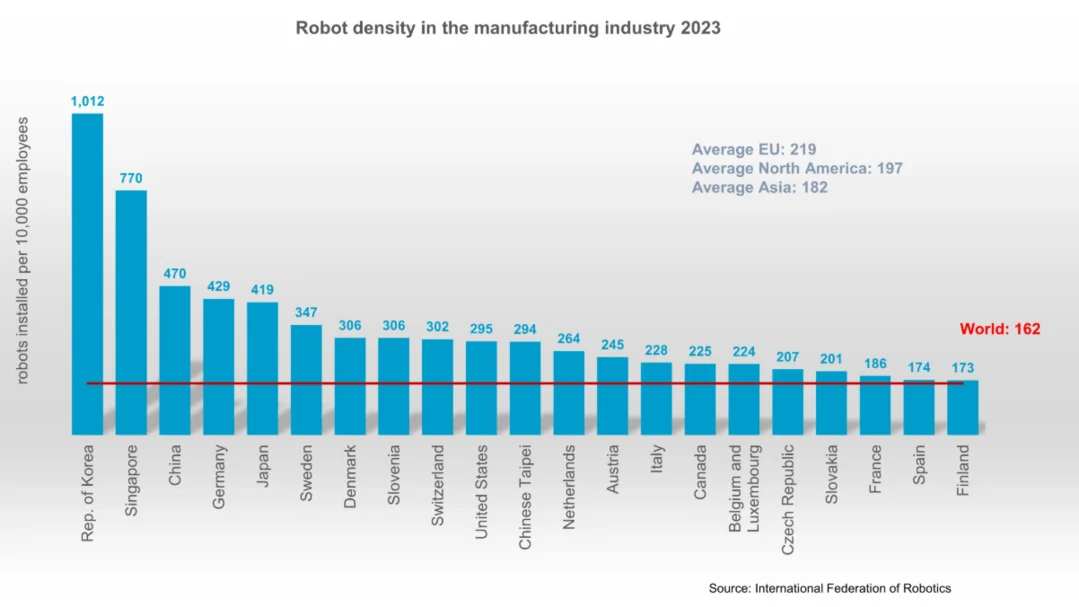
Korea is the world's most robot-dense country. The ratio of robots to factory workers reached a record high of 1,012 robots per 10,000 employees in 2023, surpassing Singapore (2nd), with China ranking 3rd — according to the International Federation of Robotics (IFR) "World Robotics 2024" report. IFR President Takayuki Ito: "Korea, with its powerful automotive industry and world-renowned electronics sector, is the leading user of industrial robots — robot density is a useful indicator for comparing manufacturing automation levels across countries." Korea's robot density has grown an average of 5% annually since 2018; producing 4.2 million vehicles in 2023 (5th largest producer globally), leading in LCD and memory chip manufacturing, and among the leaders in EV battery manufacturing.
Global rankings: Singapore 2nd (770 robots/10,000 employees); China 3rd (470 — up from 402 in 2022, doubled density in 4 years since first entering top 10 in 2019); Germany 4th (429, 5% CAGR since 2018); Japan 5th (419, 7% CAGR since 2018); US 10th (295). New global average: 162 robots per 10,000 employees (record high) — more than double the level of 7 years ago (74). EU average: 219 (up 5.2%), North America: 197 (up 4.2%), Asia: 182 (up 7.6%). Key insight: automation is accelerating globally across all major manufacturing regions, with Asia showing the fastest growth rate driven by China's aggressive robotics investment alongside Korea, Singapore, and Japan's continued dominance.