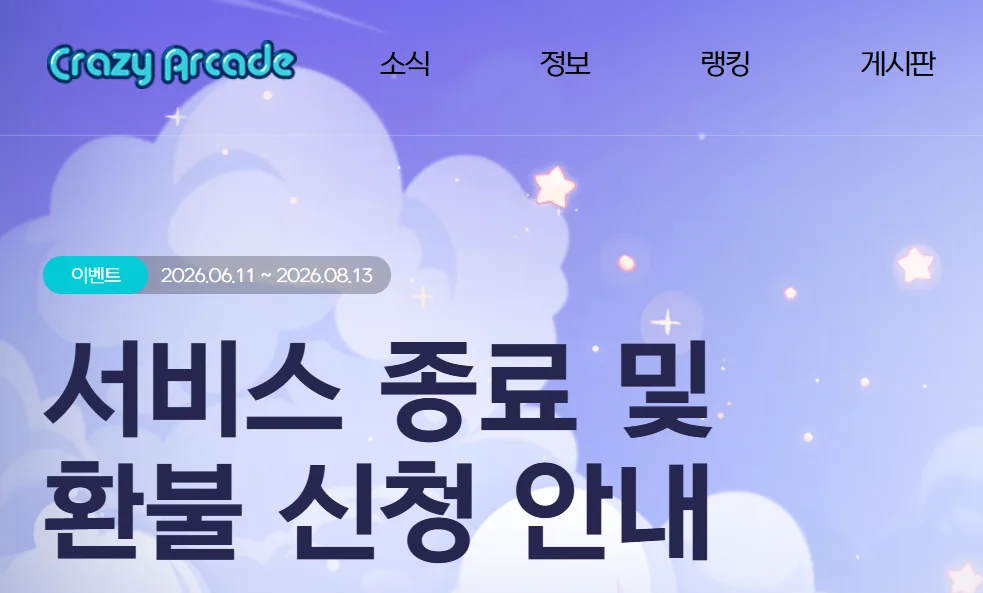
Nexon’s long-running online game Crazy Arcade is set to end its service after 25 years. On June 11, 2026, Nexon announced the service termination schedule through an official notice on the game’s website. The service will officially end at 9 a.m. on August 13, 2026. After that point, players will no longer be able to access the game, and the official website will also be shut down. A casual online game that had continued since its launch in 2001 is finally coming to a close.
This closure, however, should not be understood simply as the end of an old game. At NDC 2026, Nexon stated that although the service for Crazy Arcade would end, the IP, including characters such as Dao and Bazzi, could continue in other forms. In other words, the end of a game service does not necessarily mean the end of the IP itself.
At this point, the case raises a central question.
“Why does Crazy Arcade end, while Dao and Bazzi may continue?”
To answer this question, Crazy Arcade needs to be understood not only as a game system, but also as a form of play that operated within the user environment of the early 2000s. The reason Crazy Arcade was so strong, and the reason it is now coming to an end, are both closely tied to that environment.
Why Crazy Arcade Was Strong in the PC Bang Era
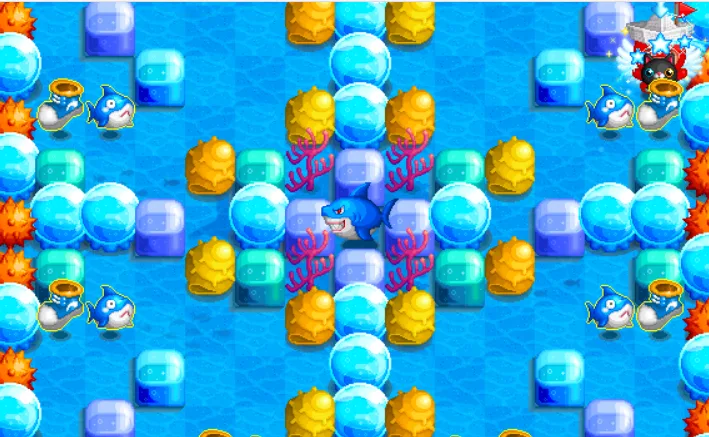
The rules of Crazy Arcade were simple. Players placed water balloons, trapped opponents, and used items to change the situation. After only a few rounds, players could understand the basic structure. Each match was also short. This simplicity was not a weakness. In the environment of the time, it was a strength.
In the early 2000s, the games that mattered in PC bangs were not only games that required long sessions or deep progression. There was also a need for games that friends could start immediately after sitting down together, that even first-time players could quickly join, and that naturally led to another round once a match ended. Crazy Arcade fit these conditions well.
Its low barrier to entry made it easy for several people to start together. Its short match length reduced the burden of losing and made it easy to rejoin even when friends were waiting. Items, map layouts, and the ability to rescue teammates helped soften the gap between skilled and inexperienced players. Better players had an advantage, but beginners were not completely excluded.
Above all, Crazy Arcade worked well with the reactions of people sitting next to each other. Someone would get trapped in a water balloon, narrowly escape, accidentally interfere with a teammate, or reverse the outcome at the last moment. These moments happened in quick cycles. They did not remain inside the screen. They led to comments, laughter, teasing, and immediate rematches among friends sitting nearby.
In that sense, Crazy Arcade was not simply a casual battle game. It was a medium of play through which friends gathered in the same space could reaffirm their relationships. The game was both a reason to meet and a subject of conversation. Rather than a game designed for solitary immersion, it was closer to a game that placed people who were already gathered into the same rhythm.
This is why Crazy Arcade can be seen as a social game of the PC bang era. Today, Discord, mobile messengers, social media, and community servers connect players. At the time, PC bangs and online games performed much of that role. Among them, Crazy Arcade connected friends in one of the lightest and most immediate ways.
What Disappeared Was Not the Desire, but the Form
To understand the end of Crazy Arcade, it is useful to first look at other examples. When a space or service disappears, the desire it once contained does not necessarily disappear with it. In many cases, what disappears is not the desire itself, but the way that desire was processed.
Arcades are a representative example. At one time, arcades were central spaces for competition through games. Players gathered around the same machine, waited for their turn, inserted coins, and competed directly against the person next to them. Skill was displayed on the spot, and spectators naturally formed around the player.
But the desire to compete did not disappear. Online matchmaking, ranking systems, esports, and streaming broadcasts took over that role. Skills that were once tested inside a local arcade are now compared through servers, ladders, global leagues, and broadcast platforms. Competition moved from a place-based structure to a network-based one.
Video rental stores offer a similar case. The desire to watch films and dramas did not decline. If anything, video content consumption has become more routine with the spread of streaming platforms. What changed was the method of access. In the past, people rented videotapes or DVDs and returned them by a set deadline. Today, they access a platform and play the content they want immediately. Content consumption shifted from the process of rental and return to the structure of subscription and access.
Cyworld shows a change in relationships and self-expression. Minihompy, Ilchon, Dotori, background music, and minirooms were ways for users to present themselves and manage relationships. But those functions have since been distributed across Instagram, TikTok, YouTube, Discord communities, and other platforms. Self-expression moved to feeds, short-form videos, and profile customization. Relationship-building moved to follows, direct messages, comments, and community servers.
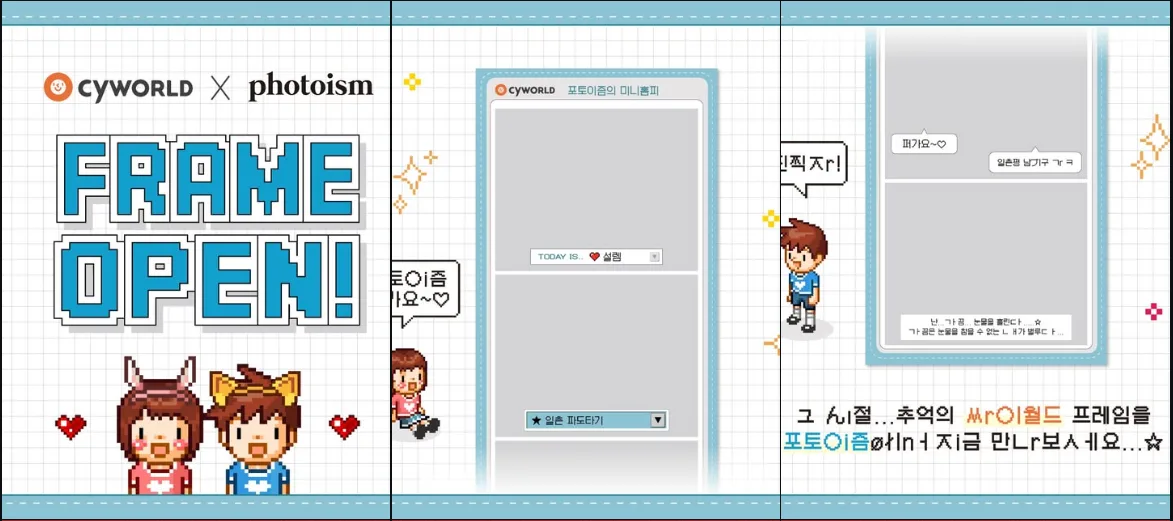
The common point across these three cases is clear. Competition, content consumption, relationships, and self-expression did not disappear. The spaces, procedures, and platforms that enabled them changed.
Crazy Arcade belongs to the same broader shift. The demand for light, social play with friends still exists. However, that demand is no longer formed only within the conditions of PC bangs, after-school routines, and neighborhood friend groups. This change altered the position of Crazy Arcade.
How the Environment Assumed by Crazy Arcade Changed
The weakening of Crazy Arcade cannot be explained only by outdated graphics or old systems. The more important change lies in the access environment the game assumed. Crazy Arcade was a game that functioned most strongly when combined with a specific way of life.
The first change is the order of relationships. In the past, friendships often came first, and the game was chosen within those relationships. Friends from the same school, neighborhood, or PC bang would choose a game they could play together. Crazy Arcade was strong at bringing already existing offline relationships into the game.
Today, that order has changed. Users often enter a specific game, platform, or community first, and then form new relationships within it. Discord servers, guilds, clans, streaming chats, open chat rooms, and game communities connect people outside of existing offline friend groups. Games no longer depend only on preexisting groups of friends. Platforms create relationships, and those relationships then help sustain play.
The second change is the meaning of simultaneous access. In the PC bang era, logging in together often meant sitting together in the same place. On-screen play and off-screen conversation were not separate. The reactions of the person sitting next to you were part of the game experience, and the outcome of a match immediately became part of the next conversation.
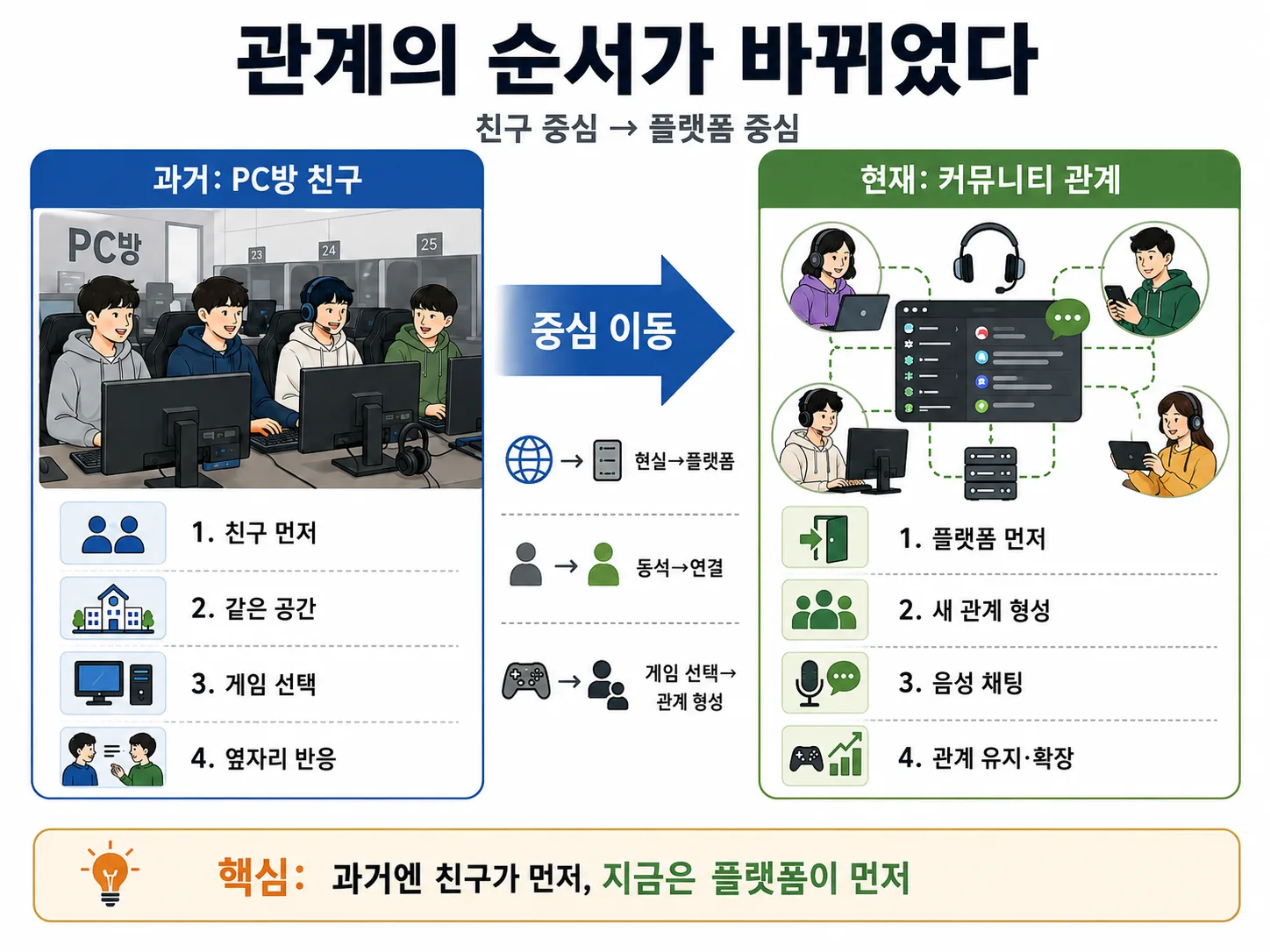
Today, simultaneous access is closer to networked connection than physical co-presence. Players connect from their homes, while moving, at school, at work, or in cafés. PC, mobile, console, tablet, and cloud environments all coexist. Voice chat, friend lists, invite systems, account linking, and cross-play now replace the role once played by physical proximity. In the past, being in the same place mattered. Today, what matters is the connectivity that links different environments.
The third change is the range of competitors that casual games must face. When Crazy Arcade was growing, its main competitors were other games inside the same PC bang. Users arrived at the PC bang and then chose what to play. Today, users choose from countless digital contents throughout the day. Mobile games, Steam games, console games, Roblox-style UGC platforms, short-form videos, streaming broadcasts, and messenger-based social activity all compete for the user’s time.
This shift has a particularly strong impact on casual games like Crazy Arcade. One of Crazy Arcade’s strengths was that players could enjoy “just a round or two.” But today’s digital environment offers many forms of content that are even shorter, more immediate, and easier to consume. In the past, short match length was a clear advantage. Today, being short is not enough to stand out.
The fourth change is the level of expectation toward multiplayer games. Today’s users expect more than simple access when playing together. Fast matchmaking, voice chat, friend invitations, seasonal rewards, account linking, community features, play records, shareability, and streaming-friendly design have become important. A game must now design not only the moment of play, but also the relationships and circulation that happen before and after play.
Crazy Arcade’s strengths were clear. It was easy, short, and quick to react to. But those strengths worked most naturally when combined with the place of the PC bang, the time of after-school play, and the relationships of real-life friends. As those conditions weakened, the game’s strengths could no longer spread as automatically as they once did.
Therefore, the end of Crazy Arcade is difficult to explain simply as a result of the game “no longer being fun.” More precisely, it reflects the fact that the environment in which Crazy Arcade worked best is no longer the central environment. The model of friends gathering in one place to play the same game has declined, and users now connect through different relationship networks across their own platforms. Crazy Arcade lost the stage on which it had been strongest.
Closing Service, Moving IP
This does not mean that the end of Crazy Arcade’s service is the end of the IP. What is notable in this case is that service termination and the possibility of IP continuation were mentioned at the same time. The original game will close, but the characters and the Crazy Park IP, including Dao and Bazzi, can move through other channels.
In the past, game IPs were strongly tied to specific services. When a game ended, its characters and world often faded with it, because the service was almost the only point of contact for the IP. Today, the situation is different. Characters and worlds no longer have to remain inside a single game. They can expand into other game genres, merchandise, emoticons, pop-up stores, brand collaborations, short-form content, UGC platforms, and more.
The Crazy Arcade IP is remembered less through complex narrative than through characters and play experiences. Dao and Bazzi are not so much protagonists of a specific story as faces associated with water balloon battles, short matches, playful interactions with friends, and memories of PC bangs. This is both an advantage and a challenge. Character recognition remains, but that recognition needs to be made meaningful again within today’s modes of use.
The key is not to revive the original game exactly as it was. It is to translate the function Crazy Arcade once performed into the current platform environment. If the essence of the original game had been only the water balloon rule itself, restoration would be relatively simple. But the game’s strength lay in an experience where short play, light competition, immediate reaction, and connection with friends worked together.
There are several possible ways to recreate that experience. It could be restructured as a mobile casual party game, or the characters could be used in collaborations with other Nexon IPs. Character-centered consumption through merchandise, emoticons, and short-form content is also possible. Another direction would be to let users reuse the characters, maps, and rules inside UGC platforms.
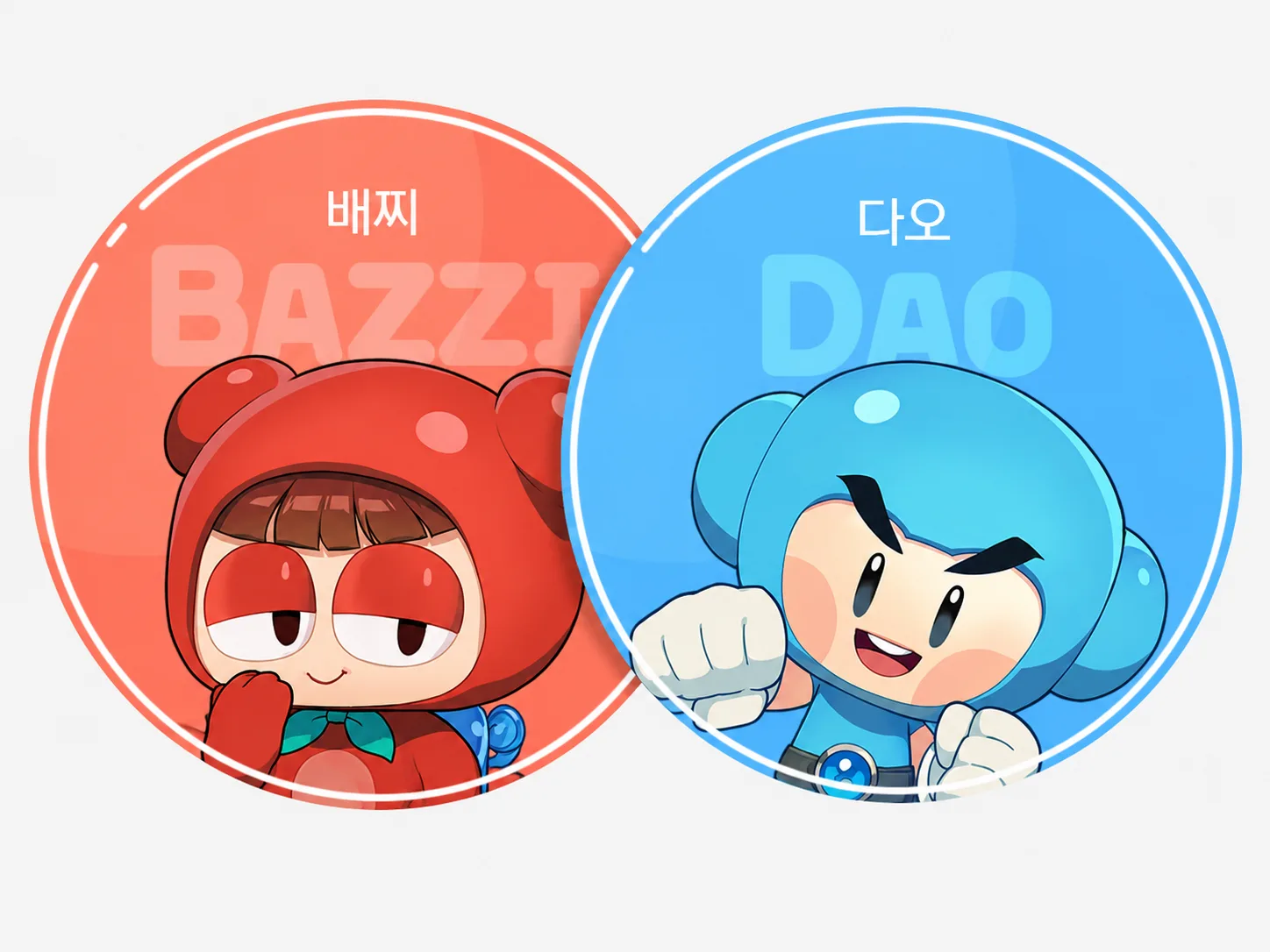
However, the reuse of an old IP cannot rely on nostalgia alone. For existing users, nostalgia may serve as an important point of entry. For new users, there must be a separate reason. It has to be clear why Dao and Bazzi should matter now, and what kind of appeal these characters can offer on current platforms. Satisfying original fans and creating accessibility for a new generation are different tasks.
For that reason, the next possibility of the Crazy Arcade IP depends less on restoration than on repositioning. Rather than repeating the old game as it was, the IP needs to move the social function once performed by the game into the grammar of current platforms. A service may end, but for an IP to move into another form, there must be a structure that allows the experience accumulated inside it to be used again.
What the End of Crazy Arcade Shows
The end of Crazy Arcade is not simply the retirement of a long-running game. It is a case that shows how the conditions that once supported PC bang-based casual social games in the early 2000s are no longer the center of the gaming environment.
Arcade competition moved to online matchmaking and esports. Video rental-based content consumption moved to streaming. Cyworld’s relationships and self-expression moved to social media and community platforms. Crazy Arcade belongs to the same pattern. The function once performed by the game remains, but the form that contains it has changed.
The meaning of this closure is not that Crazy Arcade is no longer valid. More accurately, it means that the environment in which Crazy Arcade was most naturally valid is no longer central.
This distinction matters. A game service is bound to technology, operation, user scale, and revenue structure. An IP, however, can move beyond the service. If Dao and Bazzi appear again, it should not be a repetition of Crazy Arcade as it once was, but a new form suited to the way today’s users play together and form relationships.
In the end, the closure of Crazy Arcade does not leave only the question of “why it ended.” The more important question comes after that.
What form can the relationships and play experiences created by an old game take after its service has closed?