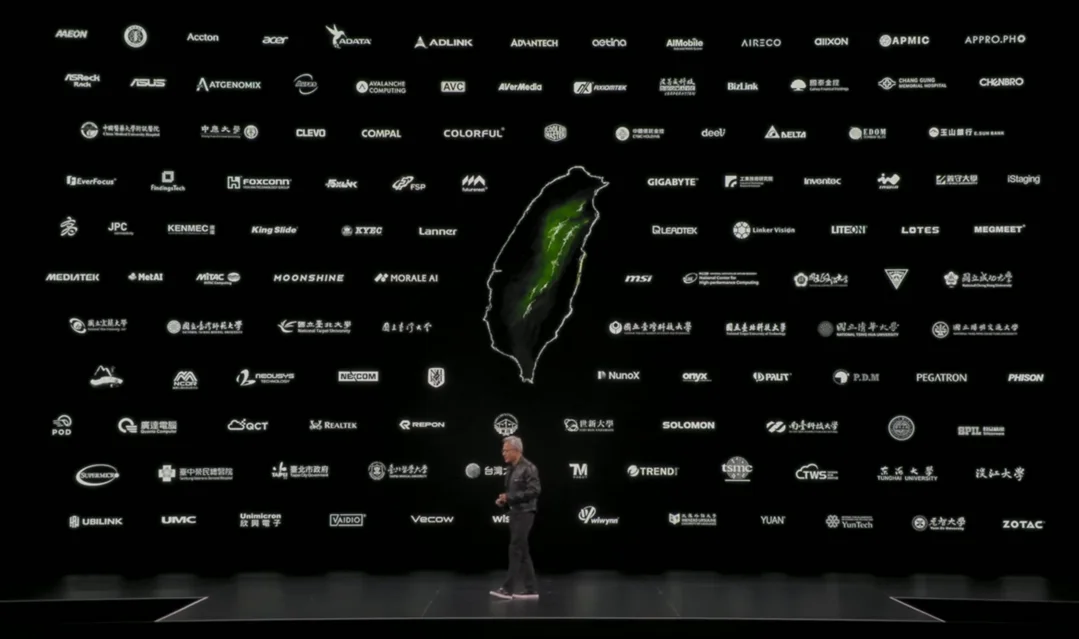
[Taipei, Taiwan=X] "Data centers of the past. They are, in fact, AI factories." On May 19, 2025, at COMPUTEX 2025 in Taipei, NVIDIA CEO Jensen Huang changed the industry landscape with a single sentence. His "AI Factory" transcended simple technological progress — it was a turning point changing the fundamental unit of future industry. Three core technologies powering AI Factories:
(1) Grace Blackwell — AI Brain: GPU and CPU combined into one superchip, processing 1.4TB/second with HBM3e ultra-high-speed memory, capable of processing 1 trillion tokens per day (sufficient to actually operate GPT-5-level models); (2) NVLink Fusion — AI Neural Network: enabling thousands of Grace Blackwell chips to operate together as one system, solving the speed degradation and bottleneck problems of multiple GPU connections — like billions of neurons in the human brain exchanging information; (3) Isaac Groot — AI Entering Reality: the operating system making AI move in the physical world (warehouse logistics, hospital drug delivery, café service robots) — translating AI model commands into real-world actions, enabling faster and more intuitive robot learning than existing systems.
Jensen Huang: "All companies will have their own AI Factories." Competitive power depends on how quickly and accurately AI can be trained and applied. Challenges: AI Factories require far more electricity and cooling than traditional data centers; GPU supply concentrated in global companies widens the gap between nations and companies with AI infrastructure access. The strategic message of "NVIDIA Constellation" in Beitou: NVIDIA chose Taiwan as a "neutral yet strategic production nation" between the US-China tech conflict. Korea's preparation question: Samsung Display's OLED panel exhibition was meaningful but diverged from the AI infrastructure "factory" transformation. Korean companies are experimenting with proprietary language models, cloud optimization, and lightweight AI models — but individual attempts aren't yet clearly connected to national industrial strategy or ecosystem structure. "The real risk is dependency structure — if over-reliance on foreign AI infrastructure solidifies, Korea risks losing sovereignty to self-train and deploy AI models." "Will we merely 'use' AI, or become a nation that 'produces' and 'deploys' AI?"