Inventor Determination Standard Reorganized to Human Specific Invention Conception
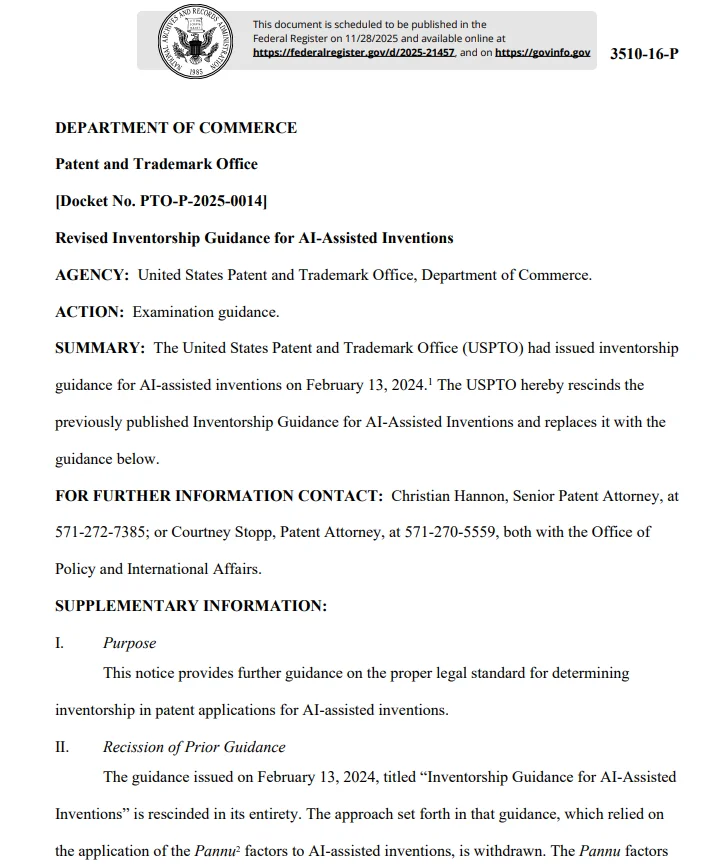
The US Patent and Trademark Office (USPTO) has comprehensively restructured inventor regulations regarding AI-assisted inventions -- reflecting the era change of generative AI deeply intervening in research and development processes. The USPTO reconfirmed the existing principle that inventors must be human and under no circumstances can AI be recognized as an inventor. Background: as generative AI like ChatGPT, Gemini, and Claude increasingly replaces human creative work from idea proposal to circuit design and drug candidate exploration, the debate "should inventions made by AI also be patentable?" has spread -- the US chose to strengthen the basic principle. The Conception standard: USPTO this guidance returned the inventor determination standard to "Conception" -- the essential concept formation of invention. In patent law, Conception means the point where the invention is conceived in complete form in the mind. Not simply presenting a problem -- the inventor must independently conceive a specific technical solution to how to solve that problem. Applying this standard to AI: if a person requests "solve this problem" and AI generates the completed solution, that invention is unlikely to be recognized as the human creation. USPTO explains that a person simply understanding or reviewing AI-generated results is insufficient to be an inventor -- they must independently form the essential concept of problem solving. AI as tool not inventor: USPTO positions generative AI alongside microscopes, analytical equipment, and experimental software -- powerful tools that assist human inventors but cannot themselves be inventors. The international dimension: DABUS cases (where AI systems were explicitly listed as inventors in patent applications) have been rejected in most jurisdictions; USPTO guidance aligns with this global consensus while providing more specific guidance on the human contribution required when AI is a significant part of the creative process.