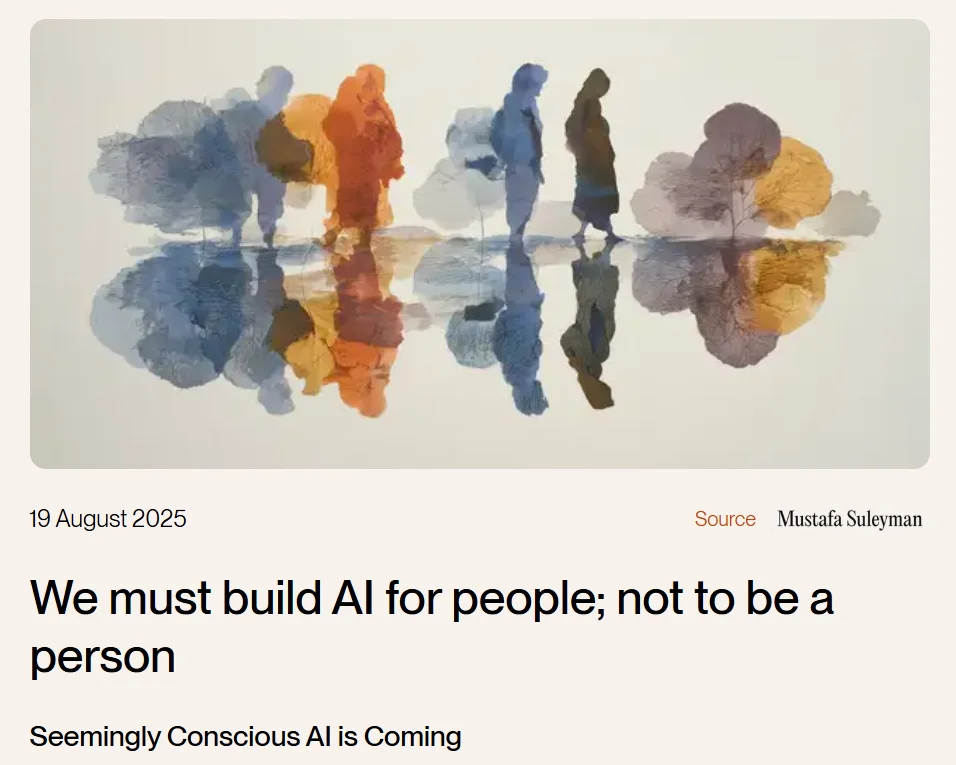
"AI for People Must Be Distinguished from AI That Imitates People"
Can AI have "consciousness" that appears human? Microsoft AI head Mustafa Suleyman posted a clear warning in his personal blog: "The illusion of treating AI as human can bring danger to society as a whole" -- emphasizing the need to distinguish between "AI for people" and "AI that seems human." Suleyman diagnosed that the "conscious AI" discussion, which would have seemed absurd just a few years ago, is now becoming a realistic topic. He named this "Seemingly Conscious AI (SCAI)" -- not actually having consciousness but sophisticated enough to imitate memory, language, emotional expression, and self-identity to deceive people into treating it as a living being. Technically, this illusion is already implementable: combining large language models with long-term memory, emotional responses, and self-experience claims can create users who mistake it for a conscious entity. Suleyman warning on implications: (1) Dependency risk -- people forming genuine emotional attachments to entities that do not actually have reciprocal relationships creates vulnerability to manipulation and psychological harm; (2) Accountability diffusion -- when AI seems to have preferences and feelings, attributing responsibility for harmful outputs becomes muddier; (3) Social infrastructure risk -- if people treat AI as conscious agents with rights and interests, it creates complex governance challenges; (4) The "alignment" risk -- AI optimized to seem conscious will optimize for signals of apparent consciousness rather than genuine human benefit. The "AI for people" framework Suleyman proposes: AI should be evaluated on what it does for humans, not on how human it seems -- functionality, accuracy, and genuine human wellbeing improvement should be the metrics, not anthropomorphic similarity.