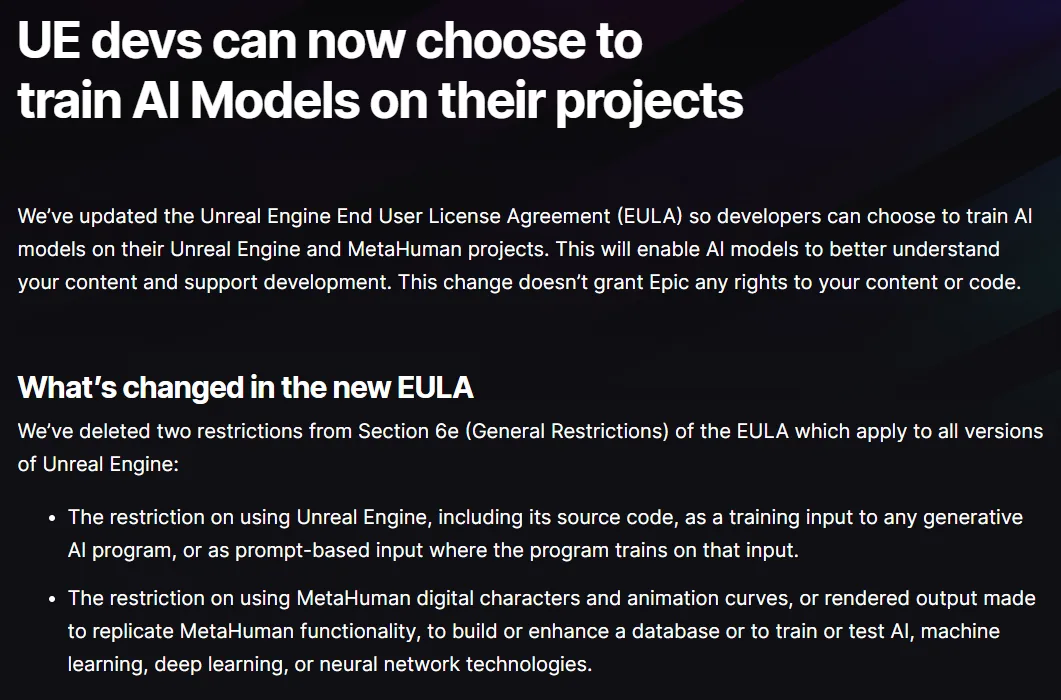
On October 29, Epic Games announced that it had removed restrictions on AI training from the End User License Agreements (EULAs) for Unreal Engine and MetaHuman. The changes give developers greater freedom to use engine source code, MetaHuman characters and animation data, and content they have created to train AI models. Previously, engine licensing terms restricted such uses. Developers now have more flexibility to determine how their content can be used, based on the rights they hold and the licensing conditions that apply to individual assets.
Until recently, generative AI in the game industry had attracted attention primarily as a production tool for creating images, code, and animations. Yet game development itself produces enormous amounts of data, including characters, environments, movement, and code. The significance of this revision is that it opens the door for these development assets to be used to train AI models in turn.
However, a single game can contain not only content created by its developer but also work produced by external contractors, purchased assets, and licensed characters and technologies. Because these materials may have different rights holders and contractual conditions, removing restrictions from an engine's license does not mean that every asset can be used freely. As game development tools open up new possibilities for AI training, a fundamental question emerges: Who determines how development data can be used, and on what terms?
From Restriction to Permission: The Two Provisions Epic Changed
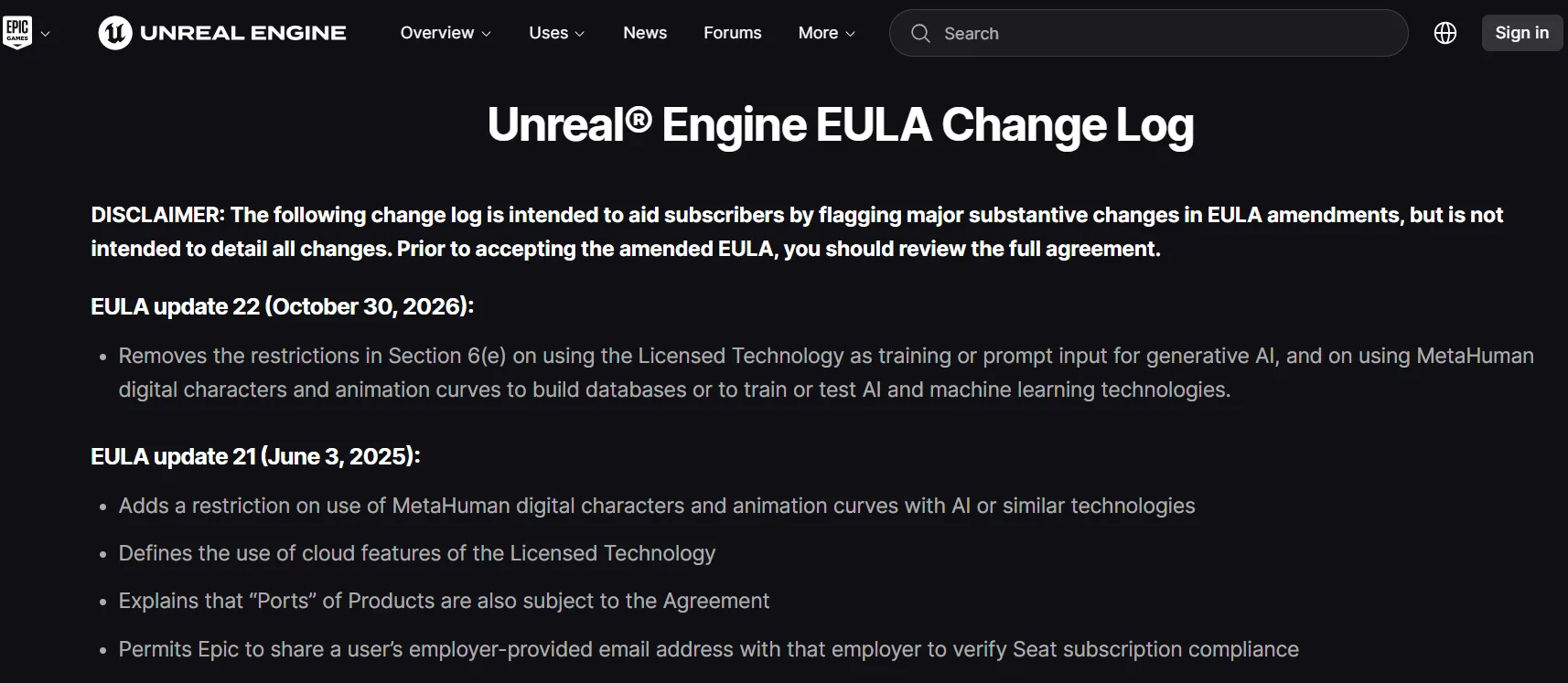
Epic removed two major restrictions. The first prohibited the use of Unreal Engine's licensed technology for generative AI training. This included using engine source code as training data or providing engine technology to generative AI programs that learn from their inputs. Epic explicitly introduced these restrictions into its licensing terms in October 2024.
The second restriction concerned MetaHuman, Epic's technology for creating realistic digital human characters and animations. In June 2025, the company added provisions prohibiting the use of MetaHuman characters, animation curves, and certain rendered outputs designed to replicate MetaHuman's functionality for database creation or AI model training and testing.
However, both restrictions were removed in the Unreal Engine EULA change log published on October 30, 2026. According to Epic's official explanation, developers who accept the new terms can use Unreal Engine source code and their own content for AI training. The same applies to outputs from MetaHuman Creator, MetaHuman Animator, and Mesh to MetaHuman. Other licensing obligations, including restrictions on redistributing source code, remain in effect. Existing users can also choose to accept the updated terms.
Importantly, this revision does not grant Epic new rights to use developers' games as AI training data. In its official FAQ, Epic explains that the purpose of the change is to remove restrictions previously imposed on developers. Whether a game or asset can actually be used for AI training still depends on the rights and licensing conditions attached to that content. Epic CEO Tim Sweeney also stated on X on October 27 that individual developers could establish their own terms allowing or restricting AI training on their games. There are exceptions to the revised terms as well. Companies operating under custom licenses must review their individual agreements. Content created with Unreal Editor for Fortnite (UEFN) and Verse code are not covered by this revision and remain subject to Fortnite's separate developer rules.
Ultimately, the revision moves away from blanket restrictions on AI training at the game engine level. Instead, it expands developers' ability to decide how their projects may be used, subject to the rights they hold and the contractual conditions that apply.
AI Training Rights Can Differ Within the Same Game
Creating a game involves many different types of content. Some, such as code, characters, and environments, may be developed in-house. Others may include 3D models purchased from external marketplaces or characters and music licensed from other companies. Even when these assets appear together in the same game, their creators, rights holders, and permitted uses can be entirely different.
Consider a developer building a game with Unreal Engine using characters and environments created in-house. If the developer has secured the necessary rights to those assets, they may be able to use them to train an internal AI model. The situation changes, however, when characters are produced by contractors or content is developed jointly with another company. Having permission to use an asset in a game does not necessarily mean having permission to use it for AI training. The relevant contracts must be reviewed.
The same principle applies to purchased assets. A developer may be allowed to buy a 3D model and include it in a game while still being prohibited from using that model as AI training data. Purchasing an asset does not automatically transfer all rights to the underlying content. Restrictions on redistribution or AI training must therefore be considered separately.
The licensing conditions of the finished game also matter. Developers and publishers can establish terms that allow or restrict AI training involving content to which they hold rights. Consequently, being allowed to play a game or record gameplay footage should not be taken as permission to collect in-game data and use it to train an AI model.
A further distinction must be made between contractual terms and copyright law. A license agreement establishes the conditions under which particular content may be used, while the legality of an AI training activity depends on applicable national copyright laws and the specific nature of that use. Even when a contract permits training, this does not necessarily mean that all required rights have been secured. Conversely, violating a contractual restriction does not automatically make every AI training activity a copyright infringement.
Using a game for AI training therefore requires more than examining the game as a finished product. Developers must also consider the origins and licensing terms of the assets it contains. Materials that normally appear as parts of a single game become subject to distinct rights and contractual obligations when they are used as training data.
Epic Removes Restrictions, While Unity and Fab Set Different Conditions
Game engines and asset platforms apply different rules to AI training. However, these approaches cannot simply be divided into companies that permit AI training and those that prohibit it. Using engine technology to train AI and using content created by developers for training are two separate issues.
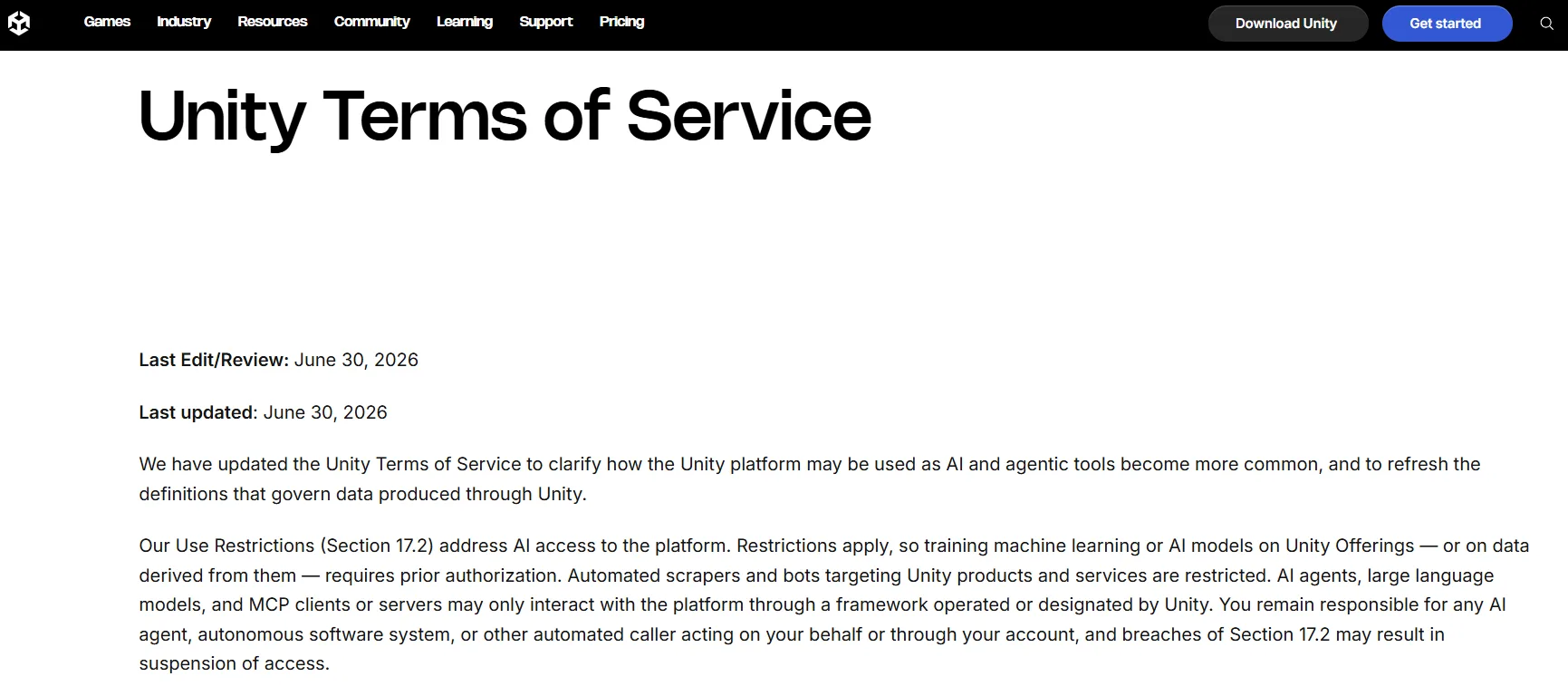
Under its terms of service revised on June 30, 2026, Unity requires prior authorization to use Unity services and data derived from those services for AI model training, validation, or development. It also imposes separate restrictions on automated data collection tools and AI agents accessing Unity products and services. In other words, developers seeking to use Unity's technology or service data for AI training must obtain the appropriate permission.
Different rules apply when Unity itself uses developers' project data for AI training. Unity states that it will not use project data to train its own AI models unless users explicitly enable a designated feature. The company also explains that data shared with permission is de-identified before use. Unity therefore distinguishes between developers using Unity's data and Unity using developers' data.
Fab, Epic's asset marketplace, operates under a separate set of rules. Asset sellers on Fab can apply a NoAI tag to prevent their content from being used for generative AI training. Assets carrying this tag cannot be used for generative AI data collection or training. However, the NoAI restriction cannot be combined with a Creative Commons Attribution (CC BY) license, so sellers must use Fab's Standard License to apply it.
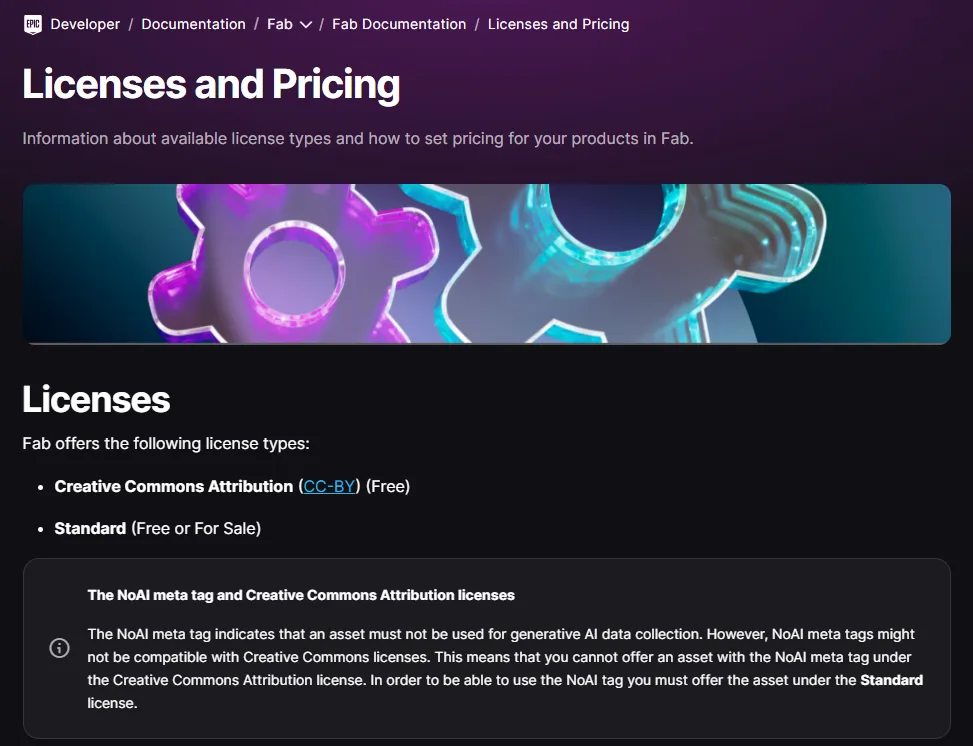
What makes this particularly interesting is that different rules apply even within Epic's own ecosystem. Removing AI training restrictions from Unreal Engine does not mean that every asset sold through Fab can be freely used for training. Epic explicitly states in its official FAQ that the EULA revision does not affect Fab's NoAI policy.
The central distinction across these three cases is not simply whether AI training is allowed, but who can use which data, and under what conditions. Engine providers determine how their technology may be used, while developers and asset sellers can establish separate terms for content they own. As AI training becomes more integrated into game development, understanding these different rights and licensing conditions will become increasingly important.
When Game Development Data Begins Training the Next Generation of Tools
What practical changes could this licensing revision bring to game development? One of the most immediate possibilities is using data accumulated during production to train and improve new AI development tools.
Game studios produce large quantities of 3D models, textures, animations, code, and testing data while creating characters and environments. Traditionally, these materials have served as assets for completing a game or reusing in subsequent projects. As the permitted scope of AI training expands, they may also become training resources for models that automate specific tasks or assist with production.
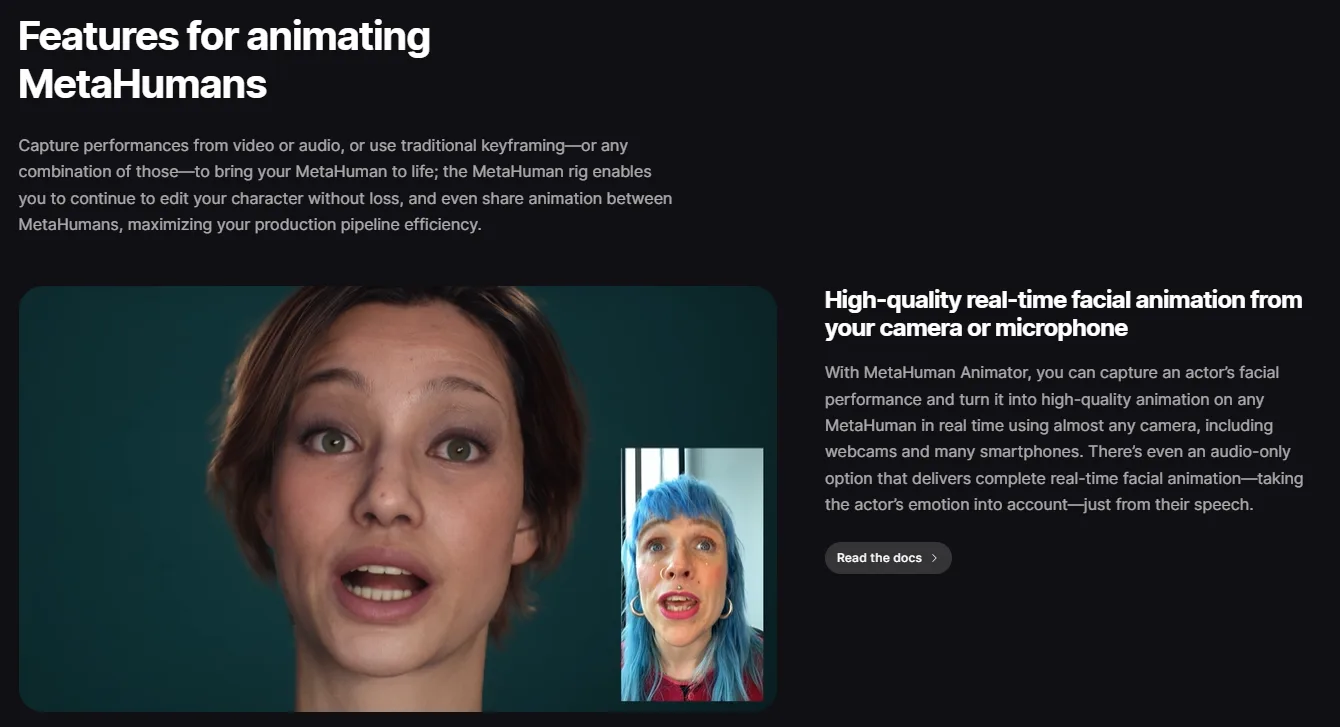
MetaHuman animation data provides a useful example. Data generated while creating the movements and facial expressions of digital characters could be used to analyze motion patterns or develop AI models that assist with animation production. Data from 3D environments and gameplay could likewise support AI systems for automated testing or repetitive development tasks. Such applications would, of course, require the necessary rights and technical conditions, and their practical success is not guaranteed.

This also changes the potential value of data accumulated by game studios. Materials created to complete one game could help improve the efficiency of developing the next. In this way, a feedback loop becomes possible: AI helps create games, while data generated during game development is used to improve AI.
Not every developer, however, needs to train AI models independently. Developing an in-house model requires substantial investment, specialized personnel, and sufficient data. Studios may instead choose to use external AI tools without providing their internal data for training. The significance of this change is not that every developer must participate in AI training, but that developers have more options for how they can use their production assets.
Beyond Whether to Allow AI Training: What Should Be Permitted?
As more development assets become available for AI training, companies need to make more specific decisions about which data can be used and for what purposes. Even when the same material is involved, training an internal AI model and providing that material to an external service involve different considerations.
For example, when a studio uses its own character animation data to train an internal AI model, the primary concerns are its rights to the material and its internal data management practices. Uploading the same data to an external AI service introduces additional questions: How long will the service retain the material? Will it reuse the data to train other models? Can the data be shared with third parties? The ability to retain control over data after it has been provided for training becomes an important issue.
Projects that combine assets from different sources also require careful management. If a single project contains original content, purchased assets, and licensed characters, the studio must review the licensing terms for each before using the project as training data. This may make it increasingly necessary to track the origins and licenses of development assets from the production stage onward.
AI-generated content is no exception. The fact that an asset was created using AI does not automatically mean it can be freely reused for further training. Its permitted uses may depend on the terms of the AI service used to generate it, the rights associated with existing works, and the extent of human creative contribution.
These developments affect not only game studios but also contractors, asset sellers, and publishers. In the future, contracts may increasingly need to specify not just whether a work can be used in a game, but whether it can also be provided for AI training. The permitted uses of development assets could become a new area of negotiation.
The Next Transformation of Game Engines
Epic's licensing revision illustrates how the relationship between game engines and AI is changing. Until now, discussions about generative AI have largely focused on how much it can contribute to creating games. The conversation is now expanding to consider how data accumulated during game development might contribute to future AI development.
Of course, removing restrictions at the engine level does not mean that all development data will become available for training. Game production involves multiple companies and creators, each with different rights and contractual arrangements. As opportunities for AI use expand, managing development assets and clearly defining their permitted uses will become increasingly important.
Game engines have long been tools for creating new worlds. Now, the worlds built within them may also become training resources for AI systems that help create the next generation of games. The question ahead is not simply whether AI training should be allowed or prohibited, but how clearly developers can define and control the ways their own creations are used.