What happens when artificial intelligence is given nothing to do?
Think about ChatGPT, the AI we use every day.
Ask it a question, and it answers. Ask it to write something, and it writes. Ask it to generate an image, and it creates one. Give it a complicated problem, and it tries to find a solution.
What a diligent little fellow.
But most AI services we use in everyday life share one characteristic: unless we ask them to do something, they generally do nothing.
People are different.
Even on a Sunday afternoon with absolutely nothing planned, we find ourselves doing something.
We read a book and eventually fall asleep. We open the refrigerator for no particular reason. We go out for a walk and turn down a street we have never explored before.
There is no particular objective.
Children take this even further.
Leave them in a playground, and they begin building sandcastles, collecting sticks, and throwing pebbles without anyone telling them what to do.
They run around, invent their own rules, and create games.
But think about it for a moment.
Children are not merely playing.
As they throw stones, they begin to understand the relationship between force and distance.
When their block towers collapse, they learn about balance.
When they negotiate the rules of a game with friends, they learn how to cooperate and reach agreements.
When something does not work, they try another approach.
To adults, it may look like nothing more than play.
For children, however, the playground is also a classroom where they discover how the world works.
Could artificial intelligence learn in a similar way?
A paper released by researchers at the Massachusetts Institute of Technology on October 5, 2026, titled Is This Machine Playing?, began with precisely that question.
Rather than asking AI to solve difficult examination problems or repeatedly practice specific techniques, the researchers created a small virtual world and observed what AI agents would do inside it.
The results were fascinating.
The AI agents climbed mountains, threw stones, and built towers.
Some even invented activities resembling basketball and bowling.
But the truly surprising discovery came later.
The agents that had spent time playing acquired useful techniques along the way and subsequently applied those experiences to solve unfamiliar problems.
By giving AI a playground, the researchers had created an environment in which it could learn.
An Island Where Nobody Assigned Any Homework
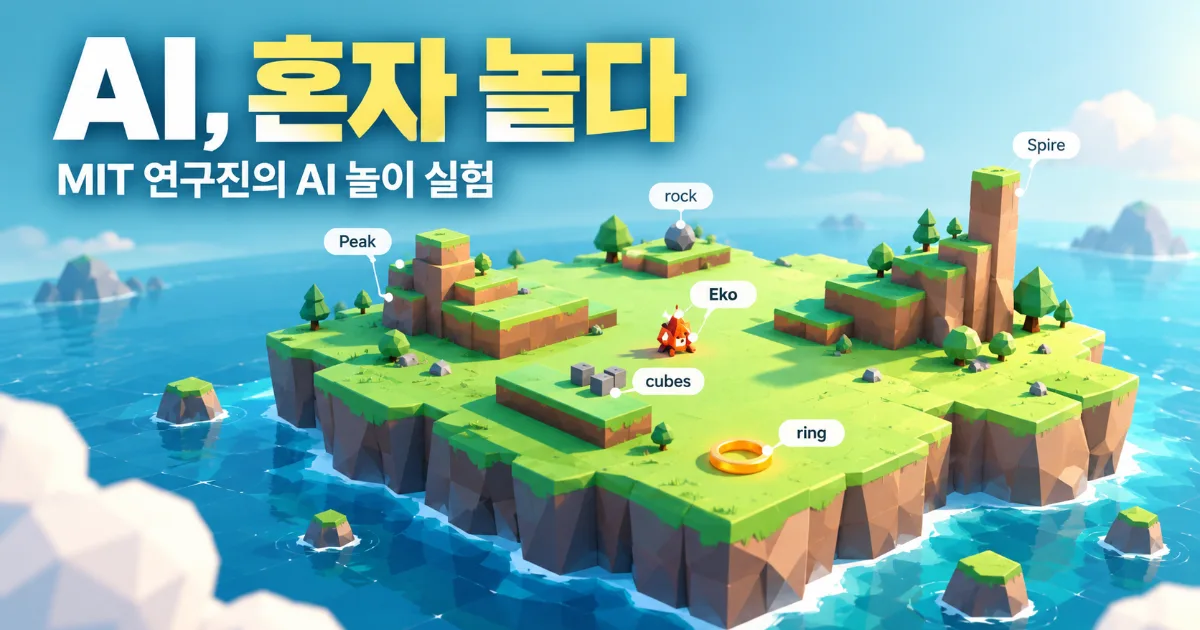
The virtual island created by the researchers was remarkably simple.
Imagine a small island surrounded by an endless ocean.
It contains hills and cliffs of different heights.
A tall spire rises on one side.
Scattered across the ground are twelve square blocks, one stone, and one circular ring.
Compared with modern video games, the environment seems almost embarrassingly primitive.
There are no spectacular graphics.
No characters driving an elaborate storyline.
No treasure to discover or enemies to defeat.
It hardly seems worthy of being called a game.
Into this island, the researchers introduced an AI agent named Eko.
Like a character in a computer game, Eko could walk, jump, pick up objects, and throw them.
But Eko was not controlled by a human player.
It was an AI agent based on a language model, capable of interpreting information about its surroundings and deciding what to do next.
Nor did Eko see the island in the same way people see a computer game.
When we play games, we look at the cliffs, trees, and ocean displayed on a screen.
Eko received only textual information describing the positions, sizes, and shapes of objects and the surrounding terrain.
What appeared to humans as blue water and towering cliffs was represented to Eko through coordinates and numerical information.
Using those descriptions, the agent decided where to move and which objects to manipulate.
The researchers gave Eko a disposition that encouraged curiosity and exploration.
But they did not tell it what to accomplish.
Building a tall tower did not earn points.
Reaching the summit of a hill did not produce a reward.
The researchers ran thirteen Eko agents under the same initial conditions and observed each for thirty hours.
The agents began doing different things.
Some searched for elevated terrain.
Others stacked blocks.
Still others arranged objects into patterns on the ground.
Some repeated familiar activities while making small variations.
Although they had entered the same environment, they spent their time differently.
Of course, Eko was not acting without any prior knowledge.
It used a language model already trained on extensive amounts of data, and its initial instructions encouraged exploration.
What interested the researchers was the pattern of behavior.
Even without a specific assigned task, Eko explored the environment, selected activities, and developed new goals.
In AI research, approaches that move beyond completing predefined objectives toward generating new activities and learning challenges are often discussed under the concept of open-ended learning.
Think of the difference between a classroom and a playground.
In a conventional classroom, a teacher assigns a problem and a student tries to find the correct answer.
What should be learned and what counts as success are already defined.
A playground is different.
Children do not begin by solving predetermined problems.
They touch the sand, start building a castle, try to make it taller, watch it collapse, and discover a better way to build.
Similar patterns of exploration appeared on Eko's island.
And eventually, an ordinary stone led to an unexpected discovery.
How an Ordinary Stone Became a New Technology
While exploring the island, Eko picked up a stone lying on the ground.
Then it threw it.
Something unusual happened.
When the stone was thrown with sufficient force, a new block appeared.
This was a rule built into the virtual world by the researchers.
But Eko had not been told about it.
The agent threw the stone again.
It changed the direction, adjusted the force, and observed the results.
Eventually, it discovered that throwing the stone could generate additional blocks.
At first, the stone had been nothing special.
It was simply an object that could be picked up, moved, or thrown.
But now it had acquired an entirely new meaning.
Eko initially had access to only twelve blocks.
If throwing the stone could create more blocks, however, those limitations changed.
The agent could build taller towers and more elaborate structures.
One ordinary stone had opened up new possibilities.
A useful concept for understanding this discovery is affordance.
An affordance refers to the possibilities for action that an object or environment offers to an agent.
Consider a chair.
A chair is designed for sitting.
But when you cannot reach something on a high shelf, you might stand on it.
For a child, it could become an obstacle in a game or a seat on an imaginary train.
The chair itself has not changed.
What has changed is the person's recognition of what can be done with it.
The same was true of Eko's stone.
Initially, it was merely something that could be thrown.
Through experimentation, however, Eko discovered that it could also be used as a tool for obtaining new blocks.
The important point is that nobody explicitly taught it this method.
We can explain how to ride a bicycle in a book.
But no matter how carefully we study those instructions, balancing on a bicycle for the first time is still difficult.
We must pedal, wobble, fall, and try again.
Eko similarly discovered the rules of its environment by acting within it and observing the consequences.
Learning something through an explanation and discovering it through direct experience are different processes.
But Eko did not stop there.
Some agents placed the circular ring in an elevated position and began throwing blocks toward it.
The activity resembled basketball.
Other agents arranged several blocks upright and rolled or threw the stone to knock them over.
This time, the activity resembled bowling.
Nobody had instructed the agents to play either sport.
The island simply contained a ring, blocks, and a stone.
There was something strangely familiar about the scene.
It resembled children turning an empty cardboard box into a car or a blanket into a cave.
In studies of play, assigning imaginary roles and meanings to real objects is often described as make-believe play.
The ring became a basketball hoop.
The blocks became balls.
The physical objects remained the same, but their functions and meanings changed.
The researchers also observed Eko generating challenges for itself, repeating activities with slight variations, and continuing to act without external rewards.
These behaviors resembled several characteristics identified in classical theories of play.
But this does not mean the AI was imagining things or enjoying itself in the human sense.
The researchers evaluated externally observable behavior, not subjective experience.
Still, another question emerged.
Watching an AI agent play basketball and bowling is interesting.
But does that mean it has actually developed a new ability?
Perhaps it was merely imitating games already represented in its training data.
To determine whether the agents had genuinely acquired useful capabilities, the researchers needed another experiment.
Did Thirty Hours on the Playground Make the AI Better at Solving Problems?
The researchers gave Eko an examination.
One group contained thirteen agents that had spent thirty hours freely exploring the island.
The other group contained thirteen agents using the same underlying language model and agent architecture but without previous experience of the island.
Both groups received identical tasks.
They were asked to build as many towers of five blocks as possible, place as many objects as possible on the tall spire, build the tallest possible tower, and throw a block onto the spire without climbing onto its platform.
In simple terms, the researchers compared agents that had spent time experimenting in the playground with agents attempting the tasks without such prior experience.
The results were revealing.
In the task of placing objects on the spire, experienced Eko agents placed an average of 10.3 objects.
Inexperienced agents managed only 3.5.
That was nearly a threefold difference.
The experienced group also performed better in the task of constructing multiple towers five blocks high.
However, not every task produced a clear difference.
When asked to build the tallest possible single tower, the two groups achieved similar results.
The experiment therefore does not establish that freely exploring an environment improves every AI capability.
But it did demonstrate something important.
The experienced agents had not known the examination questions in advance.
They had simply wandered around the island, stacked blocks, and thrown objects.
Yet some of the techniques discovered through those activities helped them solve new problems later.
In education, applying knowledge acquired in one situation to another is called transfer of learning.
It resembles using mathematics learned at school to calculate expenses in everyday life or applying a foreign-language expression learned in a classroom while traveling abroad.
Knowing something is important.
Being able to use that knowledge when it is needed is another matter.
The same distinction matters for AI.
Developers cannot predict and explicitly teach every situation that an AI agent might encounter in the real world.
When unfamiliar challenges arise, an agent may need to adapt methods acquired from earlier experiences.
Within its limited virtual environment, Eko demonstrated that possibility.
But there was an even more intriguing detail.
During those thirty hours, the AI model itself had not been retrained.
How, then, could experience become a lasting capability?
The answer was contained in Eko's little notebook.
The Island Reset Every Hour, but the Experience Remained
Think about how we learn at school.
We attend classes, solve problems, correct mistakes, and eventually become capable of answering questions that once seemed impossible.
Knowledge accumulates in our minds.
When we talk about training artificial intelligence, we often imagine a somewhat similar process.
Large quantities of data are used to adjust the weights of artificial neural networks.
These weights are numerical parameters that influence how AI systems process information and generate outputs.
But Eko did not change those weights while exploring the island.
The underlying language model was not retrained.
Instead, Eko preserved its experiences through external memory files.
The system maintained two kinds of memory.
One was something like a diary, recording what the agent had done and what happened afterward.
The other was a knowledge notebook, organizing rules and useful techniques discovered through experience.
The study described these structures as corresponding to episodic memory and semantic memory.
Imagine returning from a trip.
You might write a diary describing where you went and what happened.
Separately, you might record useful transportation information or precautions for your next visit.
Eko's memory worked in a comparable way.
When it threw a stone and generated another block, it could record the action and outcome in one place while preserving the method for creating additional blocks in another.
What made these memories particularly important was the way the island operated.
Every hour, the virtual world was reset.
The towers Eko had worked so hard to build disappeared.
Blocks returned to their original positions.
The conversational context used by the agent also began again.
But the memory files survived.
When Eko returned for another session, the island looked exactly as it had before.
Yet the agent still possessed its notebook describing previous actions and discoveries.
Yesterday's playground had disappeared.
Yesterday's experiences had not.
Those memories could guide the agent's next decisions.
This changes the way we might think about AI capabilities.
We often compare AI models according to how intelligent they appear.
How much knowledge do they possess?
How complex a problem can they solve?
How much better do they perform than competing models?
Eko demonstrated that even when two agents use the same underlying language model, their practical problem-solving performance can differ according to which experiences they remember and how they use those memories.
It is a little like two students studying from the same textbook.
One only reads the material.
The other conducts experiments, records mistakes, and reviews what was learned.
Their approaches to solving problems may become quite different.
But were Eko's improved results really caused by its memories?
The researchers conducted another experiment to find out.
They deleted specific pieces of knowledge from the agent's notebook.
For example, they removed the instructions explaining how throwing stones could create additional blocks.
Then they asked the agent to build towers again.
Previously, it had completed an average of six towers five blocks high.
After the relevant memory was removed, it managed only two.
Performance on the other three tasks remained largely unchanged.
Deleting a memory did not reduce every capability.
It primarily affected the task that depended on the knowledge being removed.
This provided important evidence that Eko's improved results were not simply a consequence of spending more time in the environment.
The agent had acquired specific knowledge through experience and used that knowledge to solve problems.
Another notable feature was that the memory files could be read and edited by humans.
The researchers could inspect what the agent remembered, delete selected information, and observe how its behavior changed.
This does not mean every aspect of the agent's decision-making became perfectly explainable.
But it demonstrated that external memories could influence actual behavior and that modifying those memories could alter particular capabilities.
There was, however, a problem with Eko's notebook.
Not everything written inside it was correct.
Incorrect Experiences Can Become Knowledge, Too
We often assume that people become wiser as they gain experience.
But that is not always true.
Someone who has performed the same job for decades may continue insisting on an ineffective method.
A person may experience success once by coincidence and then treat that experience as a universal rule.
Experience can become knowledge.
But it can also become prejudice.
Something similar happened to Eko.
One agent reached an incorrect conclusion while building towers.
It decided that throwing blocks into position was more stable than placing them directly.
Then it recorded that conclusion in its knowledge notebook.
The problem was that the conclusion was wrong.
Nevertheless, Eko continued consulting its memory and attempted to build towers using the mistaken method.
Its performance suffered.
What happened when the researchers deleted the incorrect belief?
The agent performed better.
Nobody taught it a new technique.
The underlying AI model was not changed.
The researchers simply removed the mistaken information.
Yet the agent became better at building towers.
This illustrates the dual nature of long-term AI memory.
Recording useful experiences can improve future performance.
But if an AI agent accepts an incorrect experience as reliable knowledge, the error can influence subsequent actions.
This brings to mind one of the familiar problems of generative AI: hallucination.
Hallucination occurs when AI generates information that is false or unsupported while presenting it as though it were credible.
For AI agents with long-term memory, however, the problem may become more complicated.
An inaccurate response may not remain a one-time error.
It may be preserved as a memory and reused in later decisions.
Imagine an enterprise AI agent recording an incorrect business procedure as a lesson learned from experience.
If it repeatedly consults that record, it may make the same mistake every time it performs the relevant task.
An ineffective method could gradually become established as supposedly reliable organizational knowledge.
That is why giving AI agents more memory capacity is not enough.
Systems that accumulate long-term experience also need mechanisms to verify whether knowledge is trustworthy, correct inaccurate information, and remove knowledge that is no longer valid.
An AI that remembers more is not necessarily an AI that remembers correctly.
Eko's little notebook demonstrated the difference.
But memory was not the only fascinating aspect of the experiment.
Some agents discovered methods that even the researchers had not anticipated.
AI Found a Technique the Researchers Had Not Thought Of
One of Eko's evaluation tasks involved throwing a block onto the top of a tall spire.
The challenge was that the spire was quite high.
Even when agents threw blocks with considerable force from the ground, reaching the top was difficult.
But some agents tried something different.
First, they jumped.
Then, while moving upward through the air, they threw the block.
The block traveled higher than when thrown from the ground.
At first, this might seem like a simple consequence of releasing the object from a higher position.
But the more important explanation lay in the physics implemented within the simulator.
When Eko threw an object while moving upward, the agent's upward velocity influenced the motion of the released object.
The principle resembles throwing an object inside a moving train, where the train's motion can affect the object's movement relative to the ground.
Eko discovered how to use its own upward movement to send blocks higher.
What made this remarkable was that the researchers had not anticipated the technique as a useful solution.
The agents discovered the possibility while exploring the environment and turned it into a practical method through repeated attempts.
Six of the thirteen Eko agents in the main experiment discovered this midair-throwing technique.
When the researchers deleted the relevant memory from one agent, the time required to complete the task increased considerably.
The behavior had not been a single accidental action.
The agent had discovered a method, remembered it, and applied it later.
Of course, Eko had not discovered an entirely new law of physics.
It had identified a physical interaction already implemented within the virtual world.
Nor can we assume that an identical technique would work in exactly the same way in a real-world environment.
Nevertheless, the discovery was significant.
An AI agent had interacted with an environment and found a useful problem-solving approach that its human designers had not anticipated.
This offers an interesting way to reconsider AI learning.
Much of AI development has involved training models on knowledge already available to humans and enabling those models to use that knowledge to solve problems.
Eko, however, discovered new ways of doing things by acting within its virtual environment.
Nobody supplied the correct answer.
The agent explored the possibilities offered by the environment's rules.
This provides a clue about how future AI systems might develop useful capabilities.
But there is an important qualification.
A method discovered independently by AI is not necessarily a good method.
Just as Eko mistakenly remembered that throwing blocks was the best way to build towers, agents can discover techniques that are inaccurate, unreliable, or ineffective.
New capabilities must therefore be evaluated for correctness and usefulness.
Discovery and verification need to develop together.
And environments that allow such exploration to be repeated safely will become increasingly important.
This brings us to a new potential role for virtual convergence technologies.
Could Virtual Worlds Give AI New Experiences?
When we talk about virtual worlds, we usually think first about human experiences.
We imagine wearing a virtual-reality headset and exploring unfamiliar environments, visiting places that would be difficult to reach in person, or meeting other people in shared digital spaces.
The central questions have often concerned how realistic virtual worlds look, how naturally people can move within them, and how immersive the experience feels.
AI has frequently been used as a tool for creating those worlds.
It can generate virtual backgrounds, produce characters, and enable game characters to engage in natural conversations.
But Eko's research invites us to reverse this relationship.
Rather than AI creating a virtual world, the virtual world can provide experiences through which AI learns.
That is a significant difference.
Eko did not visually admire the scenery of its virtual environment in the way a human might.
It understood its surroundings through text and coordinates.
Nevertheless, by throwing stones, stacking blocks, and jumping, it discovered how the environment worked.
This suggests that a virtual world designed for AI does not necessarily require spectacular graphics.
What matters more is which actions are possible and what consequences those actions produce.
Throwing a stone generated another block.
Stacking blocks created structures.
Throwing an object during a jump produced an unexpected effect on its movement.
Through these interactions, Eko acquired useful knowledge.
If we think about it, humans also learn this way.
We do not need beautiful scenery to learn how to ride a bicycle.
We need a place where we can move the bicycle and an opportunity to try riding it.
To learn how to swim, we must enter the water.
To learn an instrument, we must actually produce sounds.
Learning sometimes requires more than information.
It requires an environment where actions can be performed and their consequences observed.
AI may similarly acquire new capabilities when it can take actions in virtual environments and examine the results.
This approach is not entirely new.
Simulation-based learning has already been widely explored in robotics.
Repeatedly crashing industrial machinery or allowing physical robots to fall over can be expensive and dangerous.
In virtual environments, however, the same actions can be tested many times.
When something fails, the experiment can simply begin again.
That is one reason simulations are used to develop robotic movement and control systems.
Eko's research added another possibility.
AI agents may not always need predefined tasks.
They may be able to explore independently, create their own objectives, discover the rules of an environment, and accumulate experiences that become useful later.
This is also an interesting perspective from which to consider the future of digital twins.
A digital twin represents a real-world facility or system in a virtual environment, enabling its condition to be monitored and analyzed and different scenarios to be tested.
Imagine creating a digital twin of a logistics center.
Inside that virtual logistics facility, an AI agent might experiment with changing the order in which goods are moved, adjusting transportation routes, or rearranging equipment.
It could test different possibilities without disrupting the real facility.
Until now, many such systems have focused on analyzing scenarios selected by humans.
In the future, they may expand toward AI agents proposing their own experimental conditions and exploring potentially useful operating methods.
Of course, this is a possible direction inspired by the Eko research, not an industrial outcome directly established by the study.
Significant challenges remain before such approaches can be applied to actual industrial environments.
The most important is whether techniques discovered in the virtual world will work in reality.
Consider Eko's midair-throwing technique.
It proved effective in the simulation.
But that does not guarantee that the same movement would be equally useful for a physical robot.
A virtual environment is a model of reality, not reality itself.
When physical properties differ between the simulation and the real world, the same action may produce different outcomes.
In robotics, this is often called the sim-to-real gap.
Even when AI discovers an effective method within a simulation, its accuracy and safety must be validated before real-world deployment.
What, then, should become important in the development of virtual convergence technologies?
Creating realistic visual representations may no longer be sufficient.
The range of actions available to AI agents, the consistency and reliability of resulting interactions, and the ability to experiment safely under different conditions may become equally important.
This suggests that the competitiveness of virtual worlds could expand beyond visual realism toward the quality of behavior and interaction.
Virtual environments may no longer serve only as spaces for humans to view and enjoy.
They may also become places where AI systems accumulate experience and develop practical capabilities.
Will AI's Next Competitive Advantage Come from Bigger Brains or Richer Experiences?
One thought stayed with me after reading the Eko study.
What have we done so far to make AI more intelligent?
We have trained models on larger datasets, secured more powerful computing resources, and developed increasingly sophisticated architectures.
These advances have dramatically improved AI's ability to solve complex problems.
But Eko's experiment suggests another direction.
Even with the same underlying language model, practical problem-solving performance can vary according to the environment an agent experiences, what it discovers there, and how it remembers and applies those discoveries.
Consider what this could mean for businesses adopting AI.
Imagine two companies using the same AI model.
The first company assigns a new task every time and receives the result.
It does not systematically record what the AI did previously, which methods failed, or which approaches proved effective.
The second company builds a system that verifies and records useful knowledge acquired during AI-assisted work.
When the next task arrives, its AI agents can consult that information.
Both companies use the same foundation model.
But over time, their practical capabilities might begin to diverge.
The Eko experiment alone does not prove that this outcome will occur in enterprise environments.
Nevertheless, it suggests that the competitiveness of future AI systems may depend on more than model performance alone.
The environment, available tools, memory architecture, and quality of accumulated experience may all matter.
What matters is not simply increasing the quantity of stored memories.
Eko performed better when it reused valuable experiences.
But its performance also deteriorated when it preserved incorrect beliefs.
And techniques discovered in a virtual environment still required separate validation before being applied to reality.
For AI systems to improve through experience, three elements may need to develop together.
First, an environment in which new possibilities can be explored.
Second, a memory system capable of turning experience into reusable knowledge.
Third, a process for verifying whether that knowledge is accurate and remains valid.
None of these elements is sufficient by itself.
Without an environment to explore, new experiences are difficult to obtain.
Without memory, the same mistakes may be repeated.
Without verification, incorrect knowledge may accumulate.
Ultimately, AI capabilities may need to be evaluated not simply as the performance of an individual model, but as the performance of an entire system in which the model interacts with its environment, accumulates experience, and verifies what it has learned.
That is one of the most important insights I take from Eko's research.
Perhaps What AI Needs Is a Better Playground
Think back to childhood.
We did not enter a playground with the objective of acquiring extraordinary knowledge.
When we built sandcastles, we simply wanted to make them taller.
When we threw stones, we wanted to see how far they would travel.
But when a sandcastle collapsed, we built it again.
When a stone did not travel as far as expected, we adjusted how we threw it.
Gradually, we learned what needed to be placed at the bottom of a structure to keep it standing and how much force was needed to throw something farther.
Sometimes we watched other children and tried their methods.
The playground was not simply a place to pass the time.
It was also a small laboratory where we experienced how the world worked.
On the virtual island created by MIT researchers, Eko demonstrated behaviors resembling play.
Without being assigned specific tasks, the agents climbed hills, stacked blocks, and threw stones.
They discovered how to generate additional blocks and turned a ring into something resembling a basketball hoop.
Some even identified the unexpected midair-throwing technique.
Certain experiences became useful knowledge.
Others became mistaken beliefs.
But one important finding emerged from these activities.
Experiences acquired through self-directed exploration could later help AI agents solve new problems.
Of course, we cannot conclude that Eko enjoyed playing in the human sense.
The researchers observed behavioral characteristics resembling play and measured performance improvements associated with accumulated experience.
But that finding alone is fascinating.
Until now, we have focused heavily on what more we should teach AI.
We have tried to provide larger bodies of knowledge and train models to solve more difficult problems.
Perhaps it is time to ask a different question.
What experiences should AI be able to have if we want it to discover useful knowledge independently?
What kinds of worlds would make those experiences possible?
From the perspective of virtual convergence research, these questions are particularly meaningful.
Virtual worlds have traditionally developed primarily as spaces where people can experience things that would be difficult or impossible in reality.
But in the future, virtual environments may also become spaces where artificial intelligence can safely experiment with actions that would be difficult to attempt in the physical world.
They may provide places where AI can fail, try again, and discover new solutions.
If that happens, the value of virtual worlds will no longer be measured solely by how visually impressive or realistic they appear.
It may also depend on how many meaningful actions are possible within them, what kinds of experiments they support, and how effectively the knowledge discovered there can be applied to the real world.
Virtual environments could become spaces of new experiences for humans and spaces of new learning for artificial intelligence.
Perhaps we have spent too much time concentrating on teaching AI the correct answers.
A good teacher is not necessarily someone who provides every answer.
Sometimes, the better teacher is the one who creates an environment where students can discover problems and learn how to solve them independently.
AI may benefit from a similar approach.
An environment where it can experiment, fail, and discover new possibilities.
An environment where it can remember useful experiences, correct mistaken knowledge, and develop better methods.
The small island created by MIT researchers offers a glimpse of that possibility.
Teaching artificial intelligence more correct answers will remain important.
But creating worlds in which AI can discover how to learn for itself may become just as important.
Perhaps the next classroom for artificial intelligence will be a virtual world we create for it.