
2. The Speed of Technological Development and the Winner-Takes-All Law
3. Artificial Intelligence and Decentralized Economic Systems
4. The New Era of AI and the Metaverse
5. The Revolutionary Changes of Web3 and DePIN
6. Analysis of Amazon's Cloud Cost Structure
7. DePIN's Economic Advantages and Challenges
On April 27, 2025, at Sogang University's Gabriel Hall Room G109 in Seoul, the "DePINA Korea Cohort 0 Bootcamp" was held, casting deep light on the future that AI and Decentralized Physical Infrastructure Networks (DePIN) will create.
At this bootcamp, Dean Hyun Dae-won of Sogang University's Graduate School of Metaverse touched on the turning point of technological innovation and the essence of economic paradigm changes with the theme of "AI & DePIN."
Dean Hyun diagnosed 2025 as "the era of extreme gaps and winner-takes-all." Presenting technology hyper-acceleration, the partnership between humans and AI, and the advent of co-evolution and co-creation as key keywords, he emphasized that the sophistication of AI, the Web3-based ownership revolution, and the convergence of reality and virtual space are advancing across all fronts.
In particular, he analyzed that AI has now established itself as a companion in daily life that understands human emotions and context and interacts with them, going beyond simple automation technology, and that DePIN is building new economic infrastructure by decentralizing the way resources in the real world are owned and operated.
The Inevitability of AI Transformation and DePIN
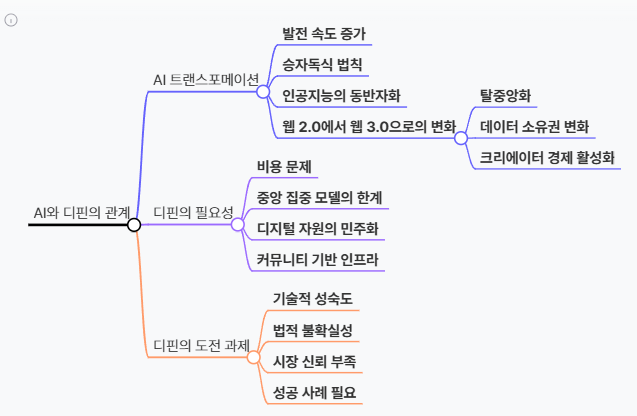
Over the past two years, DePIN has begun to be discussed in earnest. AI transformation is leading to an explosion in data demand and increased computing power, revealing the limitations of existing centralized infrastructure models. According to the presentation, DePIN is drawing attention as a key solution that enables the construction of autonomous infrastructure centered on individuals amid such environmental changes.
Technological Development and Deepening Winner-Takes-All
Data growth, rapidly increasing internet traffic, and the explosive proliferation of digital devices are accelerating the AI era. From 2025, the emergence of quantum computing has broken the old Moore's Law, and the transition to an AI-based economic structure has begun in earnest. Accordingly, the market dominance of a small number of big tech companies like Apple is further strengthening, and this is becoming a major background deepening the winner-takes-all structure.
Artificial Intelligence and Decentralized Economic Systems
AI is now showing the possibility of evolving from a companion of humans to a dominant force, with the paradigm shift from Web 2.0 to Web 3.0 accelerating. Decentralized economic systems based on blockchain technology are leading the change of returning data ownership to individuals, and this aligns with the core concept of DePIN. In the future, the value of creative and emotional labor is expected to be further emphasized.
The New Era Led by AI and the Metaverse
Through the convergence of AI, AR, and XR technologies, the metaverse environment is being realized, and the "co-evolution era" in which humans and AI create together is opening. As an environment is being created where anyone can code and create content through Natural User Interfaces (NUI) without separate training, a revolution surrounding personal data ownership is beginning in earnest.
The Innovation Presented by Web 3.0 and DePIN
In the Web 3.0 era, users directly own the data they create, and a structure is established in which the revenue generated through this also returns to users. This is fundamentally different innovation from existing cloud-based models. As an alternative to the high-cost centralized model monopolized by a small number of companies such as AWS, Google, and MS Azure, DePIN presents the possibility of community-based autonomous infrastructure construction.
Comparison of Amazon's Cloud Cost Structure and DePIN
In the case of AWS, initial entry costs are low, but there is a structure where transmission and output costs explode as usage increases. Compared to this, DePIN has the advantage of being able to lower fixed costs through resource sharing based on distributed participants, and minimize data transmission costs. This allows users to be provided with a more predictable and economical cost structure.
DePIN's Economic Advantages and Challenges
DePIN has the flexibility to lower fixed costs and allow the community to directly adjust prices as distributed participants voluntarily provide resources. A virtuous cycle structure that improves user experience through economies of scale and network effects is also possible. The number of DePIN-related projects has now grown to about 170, with a market size of approximately $50 billion. However, technological maturity, regulatory uncertainty, and lack of market trust remain as major challenges.
Cost and Governance Advantages
DePIN has low fixed costs, virtually no data transmission costs, and enables community-led fee determination, clearly distinguishing it from centralized services. Participants can also be involved in governance to a certain extent through providing computing power.
Revenue Ecosystem and Growth Potential
DePIN has a structure where the per-unit cost decreases as more users join, and a virtuous cycle in which the ecosystem value also rises due to increased liquidity can be expected. In fact, the number of projects has increased dramatically over the past two years.
Challenges and Opportunities
Revenue is still at the level of $500 million, but growth potential is sufficient if awareness improvement and regulatory refinement proceed simultaneously. In particular, as proof-of-concept cases increase in various industries, market trust is expected to be gained.
Legal Uncertainty and Market Trust Issues
Insufficient legal systems and regulatory uncertainty remain challenges to be resolved. In particular, institutional refinement is urgently needed in many countries including South Korea. However, as DePIN-based coins in the global market are pursuing entry into the mainstream financial system, the situation is likely to gradually change positively.
DePIN: A Healthy Alternative for the Web 3.0 Era
The evolution from Web 2.0 to Web 3.0 means not just a technical transition but the recovery of individual sovereignty. DePIN will establish itself as a healthy alternative network that aligns with the interests of individuals in this process. Recovery of data ownership, cost efficiency, and community-based infrastructure construction are expected to emerge as core values of future digital society.