The model generates clips of up to 15 seconds, accepts multimodal references, and costs less, while complex motion and physics remain areas for improvement
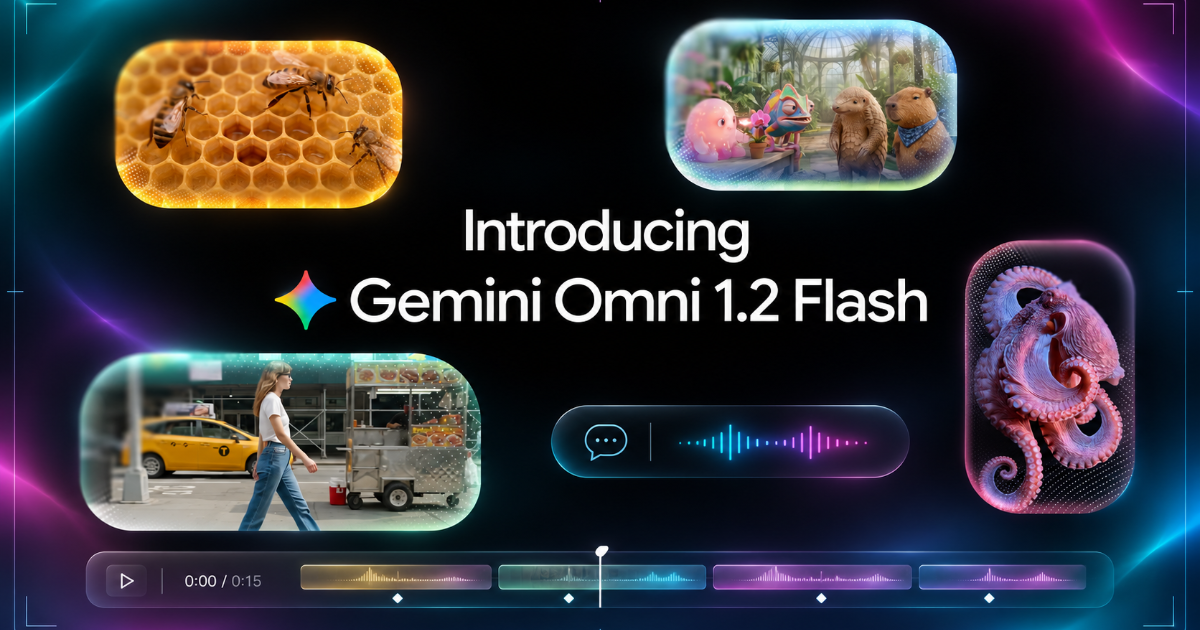
Google has released Gemini Omni 1.2 Flash, a video model that allows users to refine an existing result through continued conversation instead of generating a new clip for every change. Announced on November 5, 2026, the model became generally available through the Gemini API and Google Cloud the same day. Its maximum native clip length has increased from 10 to 15 seconds, while the price of 720p generation has fallen by 30 percent to $0.07 per second.
The more consequential change is not the extra five seconds. Generative video systems often alter a character’s face, a product’s shape, or the camera composition when the user asks to change only one part of a scene. Gemini Omni 1.2 Flash introduces multi-turn conversational editing, allowing users to adjust the background, lighting, product, weather, or aspect ratio while continuing from the current clip.
Google is positioning the model less as a one-prompt video generator and more as an iterative production tool. That claim is currently supported mainly by demonstrations selected by Google and accounts from early partners. Broader testing will be needed to determine how well the model preserves details after repeated edits and across a wider range of material.
Fifteen-Second Clips at a Lower Price
Gemini Omni 1.2 Flash can generate clips from three to 15 seconds in one-second increments. Users can produce drafts at 360p or 720p, then upscale selected results to 1080p or 4K. At $0.07 per second for 720p video, the model costs 30 percent less than Omni 1.1 Flash, according to Google.
Fifteen seconds is still too short to produce a complete film or program in a single generation. It is more relevant to work built around repeatable short formats: social advertising, product demonstrations, virtual try-ons, sales material, and brief educational videos. Extending the native length from 10 to 15 seconds gives users more room to construct a complete scene or standard advertising unit without stitching together as many separate generations.
The lower price also matters because generative video costs accumulate through repetition. If users can draft at a lower resolution, revise only the element that needs changing, and upscale only the selected output, they may avoid some unnecessary regeneration. A 30 percent reduction in the model’s listed rate, however, does not automatically translate into a 30 percent reduction in total production cost. The final amount will depend on resolution, the number of attempts, and how reliably editing works.
Editing One Element Without Rebuilding the Scene
Multi-turn conversational editing is the central feature of the release. A user can take an existing clip and ask the model to move the scene to a forest, change the lighting to night, replace a product, or convert a horizontal video into a vertical format. The model is designed to make the requested change while preserving the characters’ performances, camera framing, and other elements of the original clip.
The system also accepts more than text. Character, product, and style images can be combined with motion clips of up to three seconds and audio references. Google says the new version follows details such as faces, garments, packaging text, and brand colors more consistently across changes in camera angle. It can also generate motion between specified opening and closing frames or apply motion from one subject to another.
If these capabilities hold up in ordinary use, they could change the basic unit of generative-video work. Until now, an unsatisfactory result often meant revising the prompt and generating another clip. With conversational editing, the current result becomes the starting point for the next instruction. Generation and editing begin to merge, and the prompt becomes an interface for successive direction rather than a single request for a finished output.
The distinction remains important: conversational editing is not yet equivalent to the precision of a conventional editing or compositing application. Even Google’s public comparisons contain small changes in props and scene details. Errors are likely to become more difficult when a scene contains rapid motion, overlapping characters, or complicated physical contact.
One Model for Video and Sound
Gemini Omni 1.2 Flash accepts text, images, video, and audio, and produces video with synchronized sound. Google says it has improved multi-speaker conditioning, dialogue, and lip synchronization. Audio references can be used to associate voices with different characters, while the model can also generate music, effects, and spoken content as part of the clip.
Access to audio-reference features is currently restricted through an allowlist. Google is also limiting the model’s ability to change a person’s speech while it studies how to deploy that capability safely. The model card identifies speech alteration as a specific risk associated with conversational video editing.
Generated outputs carry SynthID, Google’s imperceptible watermark for synthetic media. The watermark can help identify content as AI-generated, but it does not establish that a scene or claim is accurate. Uses involving identifiable people, commercial products, or informational material still require separate consideration of consent, copyright, disclosure, and factual verification.
General Availability Does Not Mean Identical Access Everywhere
Google has made the model generally available through the Gemini API and Google Cloud, allowing organizations to integrate it into their own services. Related capabilities are also being introduced through Google Vids and Flow, while Adobe Firefly, Figma Weave, Picsart, Runway, Photoroom, and other creative platforms were named among early users or integration partners.
That does not mean every Google user received every feature on November 5. Fifteen-second video generation in the Gemini app is rolling out to Google AI Ultra subscribers, and the timing of business-facing features differs by product. The general availability of the underlying API and cloud model should therefore be distinguished from staged rollouts inside individual applications.
This distribution strategy also shows why competition in generative video is no longer limited to model quality. API pricing, latency, enterprise security, service-level commitments, and integration with existing tools can determine whether a model becomes part of routine work. By placing Omni across Google products and third-party platforms, Google is attempting to turn video generation from a separate experiment into an embedded production capability.
Similar to Genie 4, but Built for a Different Task
Gemini Omni 1.2 Flash may appear similar to Genie 4 because both generate visual environments. Their objectives are different. Genie 4 is designed as an interactive world simulation in which the next state changes in real time as a person or AI agent acts. Omni 1.2 Flash generates a video of a specified length and lets the user revise that output through conversation.
Genie 4 points toward simulated environments for agents and robots. Omni 1.2 Flash is positioned closer to product videos, advertisements, virtual try-ons, explainers, and other high-volume media tasks. This release is therefore best understood as a change in the consistency, editability, and economics of generated video, rather than an extension of Google’s real-time world-model project.
Consistency After Repeated Edits Is the Real Test
Google acknowledges that fast sports action, rapid script changes, and complex physics remain areas for improvement. The new model card also refers readers to the earlier Gemini Omni Flash documentation for detailed limitations, rather than publishing a comprehensive new evaluation for version 1.2. Independent evidence remains limited.
The decisive questions will concern repeated use rather than the quality of a single demonstration. Can the same person or product remain stable across several scenes? Do unrequested elements stay unchanged after multiple conversational edits? Does audio remain synchronized over longer sequences? How do actual generation time and cost compare with the listed rate?
Gemini Omni 1.2 Flash broadens the competition in AI video from image quality and generation speed to editability and workflow continuity. The ability to request a revision in natural language is meaningful, but it should not be confused with precise editorial control. Generative video will become a dependable production tool only when users can revise what they have already made without losing the details they intended to keep.