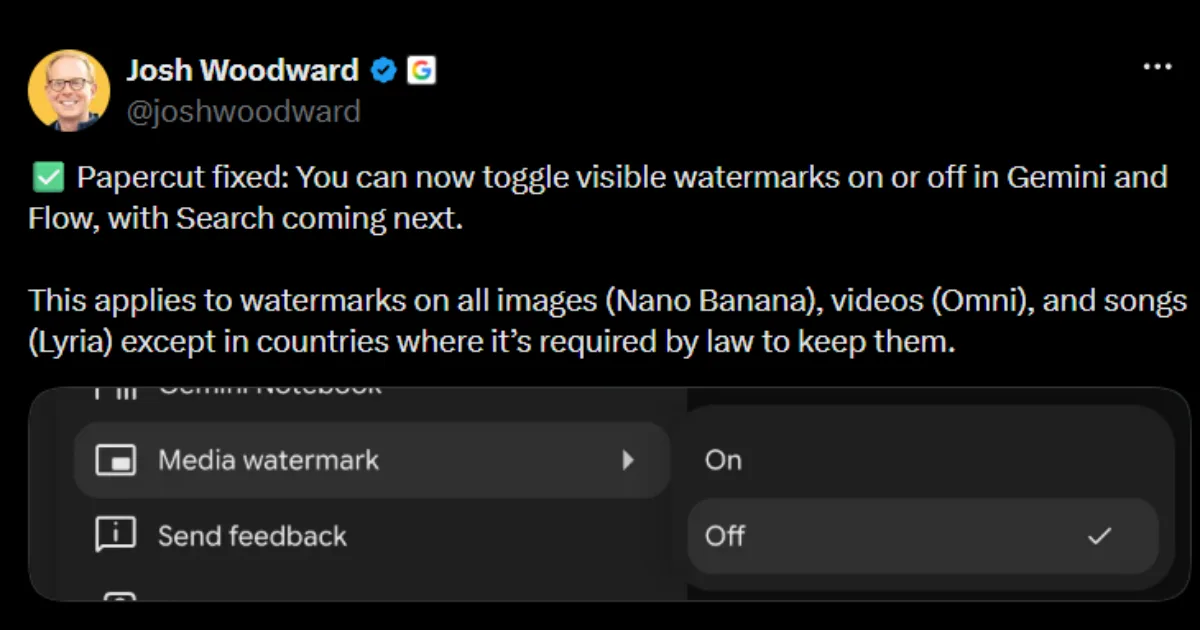
Google is now allowing users to turn visible watermarks on and off for AI-generated content.
Josh Woodward announced that Gemini and Flow now support a visible-watermark toggle for images created with Nano Banana, videos created with Omni and music created with Lyria. Search is expected to follow next. The exception is countries where the law requires visible watermarks to remain in place.
It was a short post.
But the meaning is significant.
AI-generated content labeling has entered a new phase. Generative AI companies have been struggling with how to indicate that images, videos, music and text were created by AI. If they do not label the content, misinformation, impersonation, copyright disputes and platform-trust problems can arise. But if they label too aggressively, users may feel that the output is difficult to use as finished work.
Google’s move shows this tension clearly.
AI-generated content needs transparency.
Users need polished results.
Law may require disclosure.
Creators may want to remove visible logos.
Google’s answer is a compromise.
Visible watermarks can be optional, except where the law requires them.
What “Papercut Fixed” Means
Woodward described the change as a “papercut fixed.”
A papercut is not a major bug. It is a small but repeated source of friction. That phrase suggests that Google itself recognized visible watermarks as a user-experience problem.
Users who create AI images, videos or music care about the finished quality of the result. If a generated image for a presentation, a video for social media, a product mockup, a music demo, an advertising concept or a personal project carries a visible watermark, it can feel less complete.
This becomes more important as AI-generated media moves beyond experimentation.
At first, a visible “AI-generated” mark can provide trust.
But when users want to include the result inside their own work, the mark becomes friction.
Google’s watermark toggle shows that AI-generated outputs are no longer just demo artifacts.
They are becoming work products.
Users want to edit, publish, present, sell and share them.
The Strengths and Limits of Visible Watermarks
Visible watermarks are intuitive.
If a mark appears on an image or video, anyone can immediately see that the content was generated by AI. No special tool is required. If the mark remains after sharing, viewers receive at least some context.
But visible watermarks have clear limits.
First, they can reduce content quality. If a watermark covers part of an image or video, the result may look less polished. In music, the issue is different, but platform labeling and file presentation can still affect usability.
Second, they can be removed. Image watermarks can be cropped, retouched, regenerated, screen-captured or edited away. Video marks can be weakened through editing and re-encoding.
Third, the same visible label is not appropriate in every context. A personal image draft, internal design concept, presentation background, news image, political synthetic image and commercial advertisement carry different risks. A single visible-watermark policy can be too strong in one case and too weak in another.
Fourth, a visible mark is not the same as verification. Someone can add a fake watermark. Someone can remove a real one.
Visible watermarks can be a starting point for transparency.
They are not a complete solution.
Google’s toggle can be read as an acknowledgment of that limit.
Transparency Is Not Disappearing. It Is Becoming Layered.
It would be too simple to say that Google is abandoning AI watermarking.
A better interpretation is that transparency is becoming layered.
The first layer is what users can see directly: visible watermarks on images or videos, platform labels or phrases such as “generated by AI.”
The second layer is what systems can verify: probabilistic text watermarks, file metadata, cryptographic provenance credentials, audio fingerprinting and similar mechanisms. These may not be visible to ordinary users, but platforms and verification tools can use them to confirm content origin.
The third layer is policy and context. Some countries may legally require visible marks. Some platforms may require users to disclose AI generation during upload. Some institutions may require AI-use disclosure for submissions.
Google’s change affects the first layer.
It gives users more control over visible watermarks, while keeping legal exceptions in place.
That does not mean transparency is gone.
It means visible labeling, technical verification and legal compliance are being separated.
The future of AI-generated content labeling is unlikely to be a single label.
It will likely combine visible marks, invisible watermarks, file metadata, platform policies, legal disclosure and verification APIs.
How This Compares With Anthropic’s Text Watermark
Anthropic recently explained that future Claude text outputs will carry an invisible watermark. Its method does not add hidden characters or visible labels. Instead, it leaves a probabilistic pattern in word choices that can later help estimate whether Claude was involved in producing the text.
Google’s visible-watermark toggle and Anthropic’s text watermark may appear to move in different directions.
In reality, they address the same question.
How should AI-generated content be identified?
Anthropic focuses on invisible verification.
Google is reducing the friction created by visible marks.
Both are trying to make AI-content transparency coexist with user experience.
That matters because AI labeling is not simply a question of adding a logo.
Text cannot easily carry a visible logo.
Images can carry a logo, but that may damage the work.
Music needs file-level or platform-level signals rather than visual labels.
Video can carry visible marks, but they can be removed or edited away.
Each content format needs a different approach.
AI transparency will therefore become more layered and format-specific.
Where the Law Requires It, Users Cannot Turn It Off
The most important phrase in Woodward’s announcement was the exception: visible watermarks can be turned off except in countries where the law requires them to remain.
That phrase shows that AI-generated content labeling is no longer only a product-design decision.
It is also a compliance issue.
Different countries may create different transparency rules for AI-generated content. One country may require explicit visible labels. Another may accept metadata or technical detectability. Another may require stronger disclosure only for political advertising or public-interest content.
Global AI services must reflect these differences.
In one country, users may be able to turn off the watermark.
In another, they may not.
One content type may require disclosure.
Another may make disclosure optional.
This makes AI product design more complex.
In the past, a company could often ship one feature globally. Now it may need to adjust watermarking and disclosure systems by country, legal requirement, platform policy and content-risk category.
Google’s toggle looks like a small feature update.
But it is also product policy shaped by global regulation.
Why Search Matters
Woodward also said the feature is coming to Search next.
That part is especially important.
Gemini and Flow are creative tools. Users go there to generate images, videos or music. In that context, turning visible watermarks on or off is mainly a creator-experience issue.
Search is different.
Search is an information environment. Users go there to find information, view images and videos, and form judgments about the world. When AI-generated content enters Search, the trust issue becomes more serious.
If an AI-generated image appears in a search context, users need to know whether it is a real photograph, a concept image, a historical reconstruction, an advertising mockup or a synthetic scene. The risk of misunderstanding is especially high for disasters, politics, war, public figures, medical issues, financial matters and location information.
Therefore, how the visible-watermark toggle works in Search will matter.
Is it a toggle for user-generated AI images created through Search?
Is it a display policy for AI-generated content surfaced in search results?
In which contexts must the mark remain?
Search is part of Google’s trust infrastructure.
When AI-generated content moves into Search, information reliability matters more than simple creative convenience.
The Link to Google Earth and Nano Banana
Google has already faced trust issues when generative imagery entered reality-based services.
In Google Earth, a Nano Banana image-generation feature reportedly raised concerns when users shared generated images in ways that could blur policy boundaries. The core issue was that Google Earth is not just a creative app. It is a tool people use to understand the real world. Maps and satellite images function as windows into reality. Adding AI-imagined scenes on top of that can blur the line between creation and evidence.
Google’s visible-watermark toggle reflects the same problem from another angle.
When AI-generated imagery is playful, a watermark may feel inconvenient.
When it appears in search, maps, news or public-interest contexts, disclosure may be necessary.
The important question is not whether one universal rule should apply.
It is where the content is created, where it is displayed, how it is consumed, whether it could be mistaken for reality and whether the law requires disclosure.
Google’s visible-watermark toggle improves user experience.
It also increases the need for more precise context-based AI labeling policies.
More Freedom for Creators, More Responsibility for Platforms
For creators, the ability to turn off visible watermarks is useful.
An AI image used in a poster draft, a video clip placed in a presentation or AI-generated music used in a personal project becomes easier to use when a visible mark is removed. Users want to use AI as a tool. They do not always want the final work to visibly announce that AI was used.
But platform responsibility does not disappear.
It increases.
If visible marks become optional, platforms must do more with invisible provenance signals and policy enforcement. Even if a user shares an image without a visible mark, the platform may still need a way to verify whether it was AI-generated. It must detect abuse and restrict watermark removal where laws or high-risk contexts require disclosure.
The visible-watermark toggle increases user freedom.
At the same time, it increases the platform’s invisible responsibility.
AI companies will increasingly need to say:
Users can control the appearance of their outputs.
But platforms must maintain verification infrastructure for provenance and abuse prevention.
If that balance fails, watermark toggles may be criticized as a retreat from transparency.
The Impact on Advertising, Design and Content Production
This change may also affect advertising, design and content production.
AI-generated images and videos are already being used in marketing drafts, advertising concepts, social posts, product mockups, brand campaigns and music demos. Visible watermarks make such work harder to use externally. In commercial content, a watermark can weaken brand polish.
Google’s toggle lowers that barrier.
AI-generated outputs can enter professional workflows more naturally. Gemini and Flow move closer to production tools rather than only creative experiments. Nano Banana images, Omni videos and Lyria music may find more room in marketing and creative workflows.
But broader use also complicates rights and disclosure.
Should advertising disclose AI-generated imagery?
How should platforms identify AI music used in brand campaigns?
Who is responsible if an AI image includes a real person or brand?
What happens if a watermark-free output is used for misinformation?
The more commercial use expands, the more important transparency policy becomes.
Removing a visible watermark gives creators flexibility.
It does not remove responsibility.
Why Invisible Verification Infrastructure Matters More
As visible watermarks become optional, invisible verification infrastructure becomes more important.
For text, probabilistic watermarks are being discussed. For images and files, provenance metadata such as C2PA can be used. For audio, watermarking and fingerprinting become important. For video, metadata, frame-level watermarking, platform upload records and generation provenance may need to work together.
The central question is whether content origin can still be verified after the content leaves the generating platform.
AI-generated content is easy to copy.
It can be screen-captured.
It can be reuploaded.
It can be edited.
It can move across platforms.
Visible watermarks alone cannot reliably track that movement. Invisible verification signals also have limits. Metadata can be stripped during conversion or upload. Watermarks can be weakened by editing.
There is no perfect solution.
But the direction is clear.
The center of AI-content labeling is moving from logos on the screen to verifiable signals about generation history and provenance.
Visible marks give immediate information to viewers.
Invisible signals allow platforms and verifiers to check origin later.
They should complement each other, not replace each other.
What Users Should Remember
Users should not interpret the ability to turn off visible watermarks as permission to hide AI generation in every context.
External submissions, commercial content, school assignments, journalism, publishing, political content and public-interest materials may still be subject to disclosure rules or platform policies. Even if the watermark can be turned off, hiding AI use may create problems.
Users need practical judgment.
Is the content for private experimentation or external distribution?
Is it commercial or non-commercial?
Could it be mistaken for a real photograph, recording or event?
Does it include a real person, brand or copyrighted material?
Do platform rules or national laws require disclosure?
Should an additional explanation or label be added?
A watermark toggle is a tool setting.
It does not toggle ethical or legal responsibility.
What This Means for Korea
Korea will also need to confront AI-generated content labeling more seriously.
AI-generated images, videos and music are increasingly used in advertising, education, journalism, public institutions, elections, entertainment, K-content and platform services. Korea will need to decide when visible watermarks should be required, when metadata-based disclosure is enough and which types of content require stronger labeling.
Several issues are especially important.
First, advertising and commerce need standards for AI-generated product imagery. Consumers should not confuse synthetic product images with actual product photos.
Second, journalism needs clear labeling rules for AI-generated or AI-edited images. Synthetic images must not be consumed as documentary photographs.
Third, public institutions and schools need transparency standards for AI use in presentations, promotional materials and educational content.
Fourth, K-pop and entertainment need provenance policies for AI music and video. Fan creativity, unauthorized imitation and commercial exploitation must be distinguished.
Fifth, platform policies need consistency. If Google, YouTube, Instagram, TikTok, Naver and Kakao use different labeling practices for the same type of AI image, users will be confused.
Google’s visible-watermark toggle raises a direct question for Korean companies and regulators.
When should visible labels be required?
When should invisible verification be accepted?
Where is the boundary between user control and public transparency?
The Future of Watermarking Will Not Be Decided by Visible Marks Alone
Google’s visible-watermark toggle may look like a small user-experience improvement.
But it points to a major shift in AI-generated content transparency.
In Gemini and Flow, users can now turn visible watermarks on or off for AI-generated images, videos and music. Search is expected to follow. But countries where the law requires visible watermarks remain an exception.
This shows that AI-generated content labeling is not simple.
Visible watermarks are intuitive, but inconvenient.
Invisible watermarks and metadata are less disruptive, but require verification tools.
Laws differ by country.
Risk differs by content type.
Creators want control.
Platforms must protect trust.
Google’s update reduces user friction. But it also makes invisible provenance verification and context-based labeling more important.
The future question may not be whether a watermark is visible.
The more important questions are these:
Can the content still be reliably identified as AI-generated after it leaves the platform?
When must users disclose AI use?
How should platforms balance legal requirements with creative polish?
What additional signals are needed when content may be mistaken for reality?
The future of AI watermarking will not be determined by one logo on the screen.
It will be shaped by visible labels, invisible verification, platform policy, legal obligation and user responsibility working together.
Google’s visible-watermark toggle is a signal of that transition.
AI-generated content will enter our work more naturally.
The more it does, the more sophisticated provenance and accountability infrastructure must become.
The watermark is not disappearing.
It is moving from where everyone can see it to where systems can verify it.