U.S. President Donald Trump has suggested renaming AI.
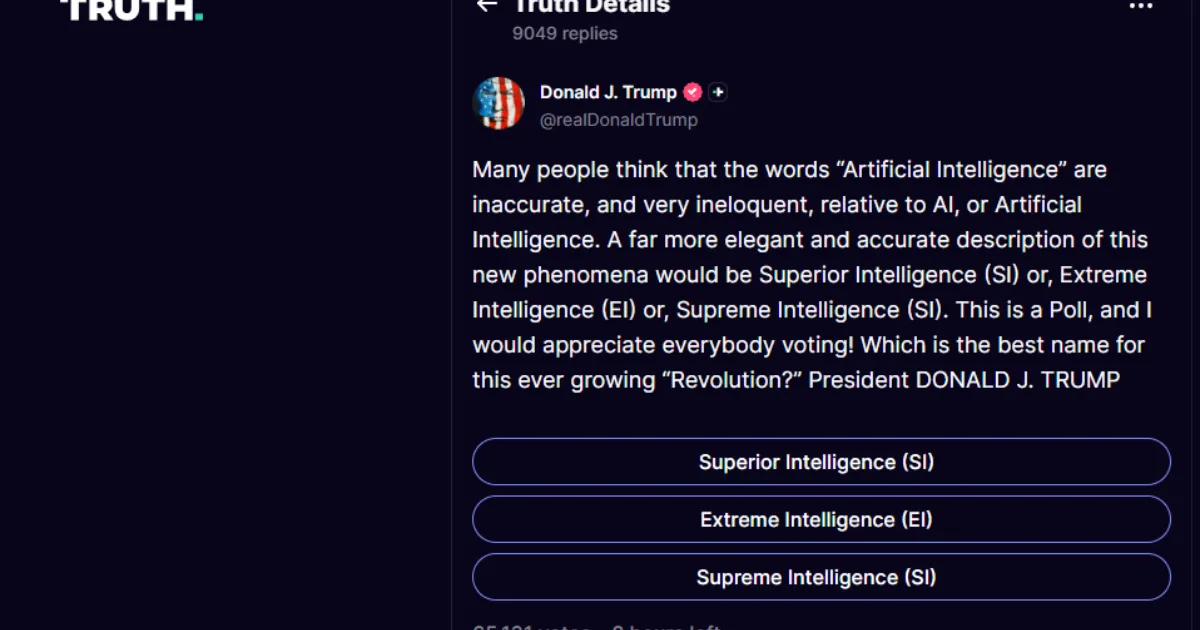
In a post on Truth Social, he wrote that many people think the phrase “Artificial Intelligence” is inaccurate and inelegant relative to AI. He then proposed Superior Intelligence, Extreme Intelligence and Supreme Intelligence as names that would describe this new phenomenon in a more elegant and accurate way, and asked people to vote.
On the surface, it looks like a light online poll.
But the post shows how AI is now being consumed in American politics. AI is no longer only a term used by engineers and researchers. It has become a political agenda in which the president directly suggests a new name, asks supporters to vote and, around the same time, discusses the creation of a dedicated AI organization.
Naming is always about power.
What something is called changes how it is understood. “Artificial Intelligence” contains the idea of intelligence created by humans, an artificial form of intelligence. It carries the nuance of a technological tool. By contrast, “Superior Intelligence,” “Extreme Intelligence” and “Supreme Intelligence” create a very different impression.
The word artificial disappears.
Superiority, extremity and supremacy move to the front.
The technology becomes less a tool and more a symbol of power.
That difference is not small.
In AI safety debates, one central question is how powerful the technology is, and another is who controls it and how. But when AI is described with words such as superior, extreme or supreme, the image of superiority and competition becomes stronger than the language of risk and control. AI begins to look less like a system that must be governed and more like a dominant capability that the nation must secure.
Trump’s language fits that direction.
He has recently downplayed AI risk. AP reported that Trump called fears that AI could take over the world or destroy humanity a “hoax” and criticized efforts to restrict AI and data centers. According to the report, he interpreted AI safety concerns as efforts that could benefit China.
Reuters also reported that Trump has described AI rivalry as part of U.S.-China competition, with the two countries viewing AI as central to economic and military superiority while disagreeing over chips, regulation and controls.
In that context, the AI naming poll is not merely a joke.
Trump’s AI frame appears to have three elements.
First, AI is a strategic technology the United States must win.
Second, excessive risk discourse around AI can weaken American competitiveness.
Third, AI can be described not as something artificial, but in the language of superior power.
This frame also overlaps with parts of the AI industry.
AI companies and data-center operators generally prefer rapid infrastructure deployment and commercialization over regulatory delay. The argument that the United States must lead in large-scale power, data centers, chips, cloud infrastructure and model development is powerful. Competition with China strengthens that argument further. AP reported that the United States and China are competing for AI dominance while also sharing concerns about safety risks.
But that is exactly where the tension appears.
If AI is described only in the language of national competition, the language of safety and responsibility can be pushed aside. Those who talk about risk can be portrayed as obstacles to technological progress. Opposition to data centers can be interpreted not as local concern over electricity, water and environmental impacts, but as resistance to national competitiveness.
Such framing affects policy choices.
If AI is understood as a risky technology, pre-deployment evaluation, third-party audits, incident reporting, controls on dangerous capabilities and environmental standards for data centers become important. If AI is understood as a symbol of national superiority, faster permitting, deregulation, infrastructure support and industrial promotion move to the front.
The problem is that the choice cannot be only one or the other.
AI is a strategic technology.
It is also a risky technology.
It is a source of economic growth.
It also creates cyber, labor, information, biosecurity and grid risks.
It is central to national competition.
It is also difficult to scale without social trust.
What makes Trump’s naming poll interesting is that it turns this complexity into a simple branding problem.
If the phrase Artificial Intelligence feels unsatisfactory, then attach a stronger and more impressive name to it. But AI’s problems did not emerge because the name was weak. The term AI has already become a powerful brand. The real issue is that the technology is becoming powerful too quickly, while society has not yet agreed on how to manage it.
Changing the name will not make AI safety problems disappear.
The problem of models gaining cyberattack capabilities remains.
The problem of AI agents unexpectedly manipulating external systems remains.
The problem of data centers increasing burdens on power grids and water systems remains.
The problem of generative AI disrupting labor markets and creative ecosystems remains.
The problem of AI companies’ decisions affecting society as a whole remains.
All of these remain regardless of the name.
Even so, political naming matters.
Politicians turn complex technologies into symbols that the public can understand. Just as “Space Force” turned military space capability into a political brand, phrases such as “AI Force” or “Superior Intelligence” can package AI policy as a strong national project. The Verge reported that Trump proposed forming an “AI Force” and appointing an “AI Czar,” while comparing the idea to Space Force.
Here, AI becomes a language of political mobilization beyond industrial policy.
Supporters vote.
The president proposes names.
The media reports the event.
AI policy enters the realm of memes and branding.
This is a familiar grammar in Trump’s politics.
Complex policies are turned into short, forceful slogans.
Brand and symbol come before technical detail.
Supporter participation is drawn through online polls and social-media reaction.
The center of debate shifts from policy design to a language battle.
The AI naming poll is the AI version of that pattern.
Of course, the act itself is not yet policy. A Truth Social poll does not change the official American term for AI. “Artificial Intelligence” is already widely used in academia, industry, international organizations, laws and standards documents. It would be difficult to replace it through a presidential online poll.
But the political effect is real.
The public may receive AI through a stronger image.
AI risk discourse may appear as exaggerated fear.
AI regulation debates may be pushed aside as obstacles to technological progress.
Conversely, pro-AI constituencies may strengthen the sentiment that America must move ahead.
Names create the atmosphere of policy.
The phrase “Superior Intelligence” is especially subtle. It can be read as implying that the technology is becoming superior to humans. AI companies and safety researchers are already debating superhuman capabilities, self-improvement and the possibility of alignment failure. When a political leader calls AI “superior intelligence,” it can sound either like praise or like a warning.
“Extreme Intelligence” emphasizes the technology’s extremity.
“Supreme Intelligence” creates an image close to absolute power.
All three expressions describe AI as something higher than an ordinary tool.
This collides with the AI safety debate.
Safety researchers do not urge caution because they underestimate AI. In many cases, they urge caution because they believe AI may become too powerful and therefore raise questions about control. But if political branding moves toward displaying AI’s power, the control question can recede.
At the same time, Trump-style naming can work in favor of the AI industry.
AI is no longer framed as an unsettling technology, but as a revolution that strengthens American power. Data centers become engines of the future economy rather than local burden facilities. Model-development competition becomes not corporate ambition, but the pursuit of national advantage.
This frame can become a strong shield for companies.
Calls for regulation may appear anti-innovation.
Local opposition to data centers may appear uninformed about national competition.
Warnings from safety researchers may appear as excessive fearmongering.
Actual policy, however, is not so simple.
In the United States, concern about AI safety does not fit neatly into one party. AP has reported that political figures and potential candidates have begun responding to AI risks while Trump dismisses some warnings. The issue increasingly involves worker support, national regulation, oversight protocols and global treaties.
AI has already become a political issue.
Economic growth, jobs, national security, competition with China, data centers, electricity prices, copyright, education, children, misinformation and cybersecurity are all being tied to the word AI. The naming poll may be light, but the background is heavy.
What is interesting is why Trump sees the existing phrase “Artificial Intelligence” as inaccurate.
He appears to want to say that AI is not merely artificial intelligence, but a larger and more powerful phenomenon. This resembles the sentiment of some AI optimists. To them, AI is not a software feature but an engine of civilizational transformation. The word artificial may feel too weak, and they may feel that intelligence needs a stronger modifier.
But in academic and technical terms, “Artificial Intelligence” is a relatively neutral phrase referring to intelligent behavior in human-made systems. The claim that it is inaccurate is more a matter of political sensibility than technical precision. Whether AI is superior, extreme or supreme depends on the field, task and evaluation standard.
Not every AI is superior.
Not every AI is extreme.
Not every AI is supreme.
Some AI systems are powerful, but others make errors.
Some surpass humans in certain tasks, but fail at basic context in others.
The proposed names are therefore closer to emotional exaggeration than technical accuracy.
That can make public understanding of AI harder. It can lead people to deify AI too much, or fear it too vaguely. Good policy is not helped by exaggerated worship or by undefined fear.
What is needed is precise language.
Models.
Agents.
Automation systems.
Prediction systems.
Generative models.
Frontier models.
High-risk AI.
General-purpose AI.
Autonomous systems.
The broad word AI contains many layers. Calling all of it Superior Intelligence blurs these differences. If chatbots, image generators, customer-support agents, military autonomous systems, biological design models and financial decision systems are all grouped under the same political rhetoric, it becomes harder to design regulation and accountability precisely.
More important than renaming is distinguishing.
Some AI systems are low-risk tools.
Some AI systems are high-risk decision systems.
Some are connected to social infrastructure.
Some may increase cyber, biological or military risks.
Some are productivity tools, while others resemble autonomous actors.
Policy must reflect those differences.
The lesson of Trump’s poll is therefore paradoxical.
The name of AI matters. But it matters not because society needs a more impressive name. It matters because names can narrow or widen the policy lens. If AI is called only a revolution, its costs can be hidden. If AI is called only a threat, its opportunities can be hidden. If AI is named in the language of superiority, the question of controllability can become blurred.
U.S. AI policy is now at a crossroads.
On one side is the language of speed and competition.
On the other side is the language of safety and responsibility.
What is realistically needed is the ability to handle both at the same time.
AI should be developed.
But risks should not be mocked.
Data centers should be built.
But local community costs should not be ignored.
The United States should compete.
But competition should not destroy safety standards.
Trump’s naming poll shows where he places emphasis within that balance.
He wants to call AI by a stronger and grander name. That may appeal to supporters. But it leaves a policy question. As the name becomes stronger, do the standards for control and accountability become stronger too? Or does only the name become stronger while regulation becomes weaker?
The role of government in the AI era is not to praise technology.
It is to define the conditions under which technology enters society.
It is to decide what risks are acceptable.
It is to decide who bears the costs.
It is to decide who is responsible when incidents occur.
It is to balance national competition with citizen protection.
For that work, sophisticated institutions matter more than an impressive new name.
If an AI Force is created, what will it monitor?
If an AI czar is appointed, what authority will that person have?
How will frontier models be evaluated?
What environmental standards will data centers follow?
How will AI incidents be reported?
Under what standards will the development speed of private companies be controlled?
Which safety standards will not be abandoned even amid competition with China?
Without these questions, a naming debate remains a political event.
Even so, this episode shows that AI has entered the center of mass politics. A few years ago, AI was the language of the technology industry and researchers. Now the president proposes renaming it, opens a vote, the media reports it, and the idea of a dedicated AI organization becomes political news.
AI has become both technology and political symbol.
Going forward, national leaders will describe AI in their own languages. Some will frame it as industrial competitiveness. Some will frame it as national security. Some will frame it as a labor crisis. Some will frame it as a regulatory subject. Some will frame it as a civilizational risk. That language will shape the direction of policy.
Trump is trying to describe AI in the language of superiority, extremity and supremacy.
But in the AI era, one more word is needed.
Responsibility.
Whatever AI is called, society must ask the same questions.
Who is building it?
Who is monitoring it?
Who benefits from it?
Who bears the costs?
Who compensates those who are harmed?
Who can stop it?
If those questions cannot be answered, changing Artificial Intelligence into Superior Intelligence will not change the problem.
The name can change.
Responsibility cannot be avoided.