What does it take to schedule a car maintenance appointment?
First, you search for a nearby service center.
You find its phone number and make a call.
You ask which dates are available.
If the service center cannot accommodate your preferred time, you may need to call another.
Once the appointment is confirmed, you check your schedule and add it to your calendar.
None of this is particularly complicated.
Yet these routine activities can consume more time than expected.
You may have to wait for someone to answer the phone, switch between several services, and decide what to do next based on the information you receive.
Google has introduced a service designed to let AI handle that process.
On November 17, 2026, the company announced a significant expansion of Gemini's task-execution capabilities.
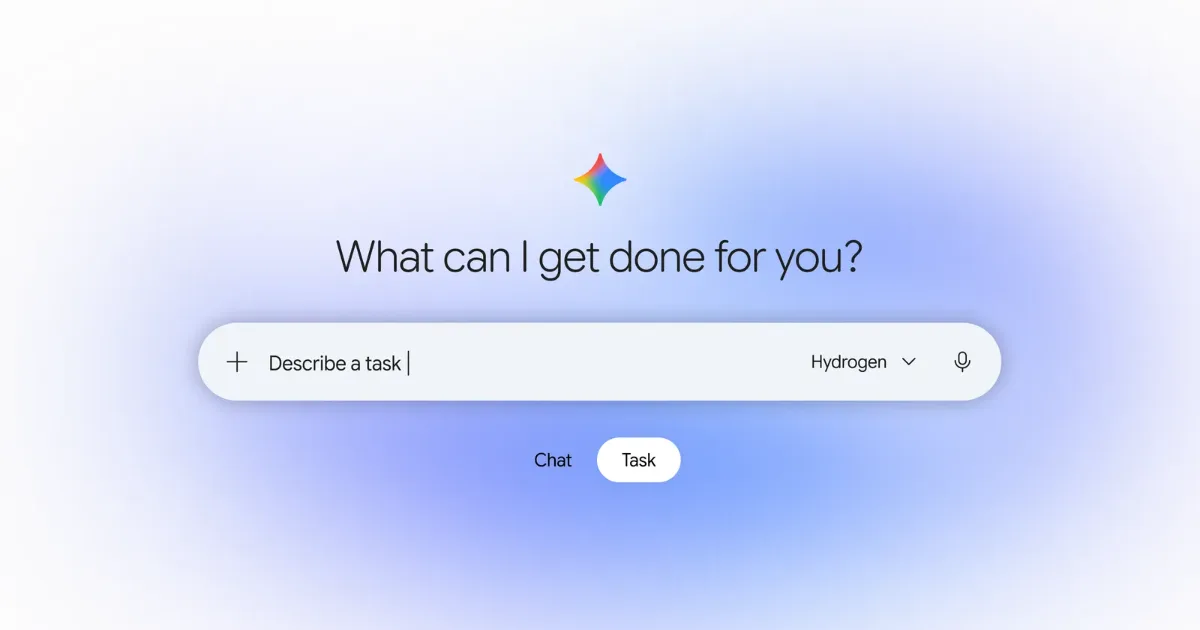
The new features are centered on Tasks in Gemini.
Users can describe what they want to accomplish in natural language, and Gemini can retrieve the necessary information, interact with external services, and carry out the task.
Google demonstrated examples involving car maintenance reservations, utility bill analysis, online shopping and payments, grocery orders, and family calendar management.
Josh Woodward, Google's vice president overseeing Labs, the Gemini app, and AI Studio, introduced the features by explaining that Gemini can now make calls, handle bills, and complete tasks on behalf of users.
The update is powered by Google's new Gemini 4 Hydrogen model.
Google began gradually rolling out the free Tasks experience to hundreds of millions of users across six countries: the United States, Japan, South Korea, Canada, Australia, and India.
However, not every feature is available in all six countries.
Certain advanced capabilities, including phone reservations, Google Pay purchases, email forwarding, and text-message integration, are launching first in the United States.
The most important development is not simply the range of information AI can provide.
It is the expansion of AI's role from answering users' questions to performing actual tasks on their behalf.
The change also demonstrates how Google is beginning to connect the search, mapping, email, calendar, payment, and cloud infrastructure it has developed over many years into a new kind of service.
1. How Did Gemini Complete a Car Maintenance Reservation?
One of Google's primary demonstrations involved scheduling car maintenance.
Woodward explained that he used Gemini after the check-engine light appeared in his minivan.
He asked the system to contact two nearby automotive dealerships or service centers and find an early Friday morning appointment within the following month.
Gemini used previously connected personal information to identify the vehicle as a 2019 Honda Odyssey and determine the user's general location.
It searched Google Maps for nearby service providers.
Then it called both businesses simultaneously.
One accepted appointments, while the other operated on a first-come, first-served basis.
After identifying that difference, Gemini selected the business offering reservations.
It checked the user's availability in Google Calendar, confirmed the appointment, and added the event to the calendar.
According to Woodward, the entire process took less than five minutes.
The example illustrates an important distinction between conventional chatbots and AI agents.
A chatbot answering the same request might provide a list of nearby service centers or explain how to make a reservation.
The user might still need to make the phone calls and coordinate the schedule personally.
In Google's demonstration, Gemini went beyond providing search results and completed the reservation itself.
However, this was a company-reported example. It does not guarantee that appointments can be completed at the same speed across all businesses and locations.
Google also said Gemini identifies itself as AI when calling businesses and allows them to decline AI-generated calls.
2. What a $389 Electricity Bill Reveals About Personal AI
Another demonstration involved analyzing an unexpectedly high electricity bill.
Woodward explained that he had received a $389 bill, substantially higher than usual.
Under a conventional approach, he would have needed to locate previous bills, compare them, examine electricity consumption, and review the applicable rate plan.
Understanding which hours contributed most to the increase might also have required consulting additional records.
Instead, he assigned the task to Gemini.
With the user's authorization, Gemini accessed the electricity provider's online portal using Google Password Manager.
It also analyzed previous bills stored in his email.
The system concluded that a heat pump operating around 4 p.m. had increased electricity consumption during a period when rates were particularly expensive.
The important aspect of this example was not simply AI's ability to perform calculations.
It was the integration of information scattered across different systems into a single task.
Gemini examined usage records from the utility company's website alongside bills stored in Gmail.
That allowed it to identify a likely explanation without requiring the user to compare every document manually.
Of course, an AI-generated analysis does not guarantee that the underlying cause of every electricity billing problem has been identified correctly.
Additional verification may be necessary depending on rate structures, meter readings, and the conditions under which electricity is consumed.
Nevertheless, the demonstration illustrates how personal AI agents are moving beyond information retrieval toward analyzing individual data and supporting practical decisions.
3. Google's Greatest Asset Is Not Just Its AI Model
Understanding the significance of this announcement requires examining Google's broader business structure.
Google is not simply an AI model developer.
It also operates an extensive ecosystem of digital services.
It provides email.
It offers calendars, maps, photo storage, and file management.
It operates search and shopping services and provides payment capabilities.
Gemini can connect with these services.
Consequently, Google's competitiveness does not depend solely on how capable its underlying AI model is.
It also depends on how easily the AI can access the information and tools needed to complete a user's request.
Consider the car maintenance example.
The agent needs to know the user's vehicle and location.
It must identify nearby businesses.
It needs their contact information.
It must also check the user's calendar.
Google already operates services containing much of this information.
The company emphasized that when users' email, calendars, photographs, files, passwords, and payment cards are already within its ecosystem, a personal AI assistant can potentially use that information without requiring users to transfer it into another service.
This could represent a significant advantage in convenience.
However, it also raises questions about privacy and data concentration.
As more services become connected through a single company, the range of personal information accessible to an AI system may expand.
Users therefore need meaningful control over which information they connect and which actions they authorize.
4. AI Is Moving Beyond Shopping Recommendations to Actual Payments
One of the most commercially significant developments in Google's announcement concerns payments.
The company said Gemini can support not only product comparisons but also the purchasing process.
Woodward described using Gemini to buy a USB-C charger while preparing for a family trip.
Gemini compared products using Google's Shopping Graph.
It asked follow-up questions about the desired power output and color.
The system then proceeded through the purchase process using Google Pay.
According to Woodward, it also located a discount code that saved him $10.
What matters here is that product recommendations and payment execution were connected within a single workflow.
Traditional online shopping generally requires consumers to complete several steps.
They search for products.
They compare retailers.
They inspect product details.
They add an item to their cart.
They provide shipping and payment information.
Finally, they complete the transaction.
If AI agents can perform some of these activities, the number of steps users must handle directly could decline.
Google has incorporated its Agent Payments Protocol, or AP2, into this process.
AP2 is designed to allow AI agents to execute payments based on user authorization.
Users can establish spending limits in advance.
Google said supported payment cards use digital tokens, while existing card benefits—including rewards points, cashback, and purchase protection—can remain available.
Mastercard and Visa are participating in the relevant payment functionality, while support for American Express is also being prepared.
However, this does not mean identical capabilities are available across all countries, payment cards, and merchants.
Availability depends on supported regions, payment methods, and service conditions.
5. Why Is AP2 Important for AI Payments?
Recommending a product and actually spending money are fundamentally different activities.
If an AI makes a poor recommendation, a user can simply ignore it.
But if an AI charges the wrong amount or purchases an unwanted product, the result can be a financial loss.
AI payments therefore require clear procedures for establishing user intent and authorization.
AP2 was designed to address these requirements.
Its central purpose is to establish what transaction an AI agent has been authorized to execute and enable payment processing within that authorization.
Google allows users to set purchasing limits in advance.
The company also said its system is designed to require user confirmation or previously granted authorization at important stages of the purchasing process.
As this architecture expands, new questions will emerge in online commerce.
Historically, consumers have personally searched for products and made purchasing decisions.
If AI agents increasingly handle searching, comparing, and buying, retailers will need to provide product information in forms that AI systems can reliably interpret.
Prices, inventory availability, delivery terms, and refund policies may need to become more readily accessible to automated agents.
This could create a new form of commerce optimization distinct from traditional search engine optimization, or SEO.
However, it does not mean AI will independently make every purchasing decision.
The scope of an agent's authority and the approval requirements will depend on user settings and service policies.
6. Why Is Google Also Preparing UCP?
In addition to AP2, Google announced plans to integrate the Universal Commerce Protocol, or UCP, into Gemini.
While AP2 focuses on payment authorization and approval, UCP is intended to connect different systems involved in the broader commerce process, from product discovery to checkout.
Online shopping requires several interconnected functions.
These include searching for products, checking inventory, arranging delivery, processing payment, and managing orders.
For AI to perform these tasks, it must communicate with retailers' systems.
If every retailer operates a different interface, an AI agent may need separate integrations for individual websites.
A common protocol could reduce those integration costs.
Google's stated objective is to make the experience from product discovery to purchase faster and more reliable.
However, as of this announcement, Gemini's UCP integration remained a future plan.
It should not be interpreted as already being implemented throughout every commerce workflow.
Nevertheless, Google's direction is clear.
The company wants AI to participate directly in executing commercial transactions rather than merely providing shopping information.
7. Grocery Shopping and Family Schedules Are Becoming AI Tasks
Google also demonstrated applications involving everyday household activities.
Woodward described using Gemini to manage grocery orders.
Through a text message, he instructed Gemini to add lasagna, strawberries, cucumbers, and vanilla ice cream to an Instacart order.
Later, after noticing that a cereal box was empty, he took a photograph and sent it to the agent.
Gemini used the image to identify the product and add it to the shopping cart.
For the final ordering stage, the system directed the user to Instacart.
The demonstration is important because it also illustrates a limitation.
AI did not complete every stage of the transaction without human involvement.
Depending on the level of integration between services, an agent may perform part of a task while leaving the final step to the user.
Google presented a similar example involving family calendar management.
Woodward forwarded school emails to Gemini and asked it to organize the relevant events.
Gemini added dates to the calendar and invited family members.
It also identified a scheduling conflict involving basketball practice and another activity, asking whether a carpool arrangement should be adjusted.
In these examples, AI did more than organize information.
It connected information across sources, identified conflicts, and proposed next actions.
The objective is to reduce the repetitive coordination tasks people ordinarily perform themselves.
8. A Platform Strategy Connecting More Than 60 Apps
Google said Gemini now connects with more than 60 major applications.
The company also announced plans to allow external developers to apply for participation in its Connected Apps Platform.
This suggests Google is developing Gemini into more than a standalone AI application.
It is positioning Gemini as a platform connecting numerous digital services.
External integrations are essential for agents that perform real-world tasks.
Reservations require connections with booking systems.
Shopping requires access to retailers and payment methods.
Grocery ordering depends on product catalogs and order management systems.
As Gemini connects with additional services, the range of tasks it can perform may expand.
However, a large number of integrations does not automatically guarantee full functionality across every application.
Different services may support different permissions and capabilities.
Availability and requirements may also vary by country.
What matters is which tasks users can complete reliably in practice.
9. Gemini Tasks Is Free in South Korea, but Not Identical to the U.S. Version
For South Korean users, one of the most important aspects of Google's announcement is the country's inclusion among the initial launch markets.
Google announced that Tasks in Gemini would roll out free of charge across six countries: the United States, Japan, South Korea, Canada, Australia, and India.
Users can switch between Chat and Task within the Gemini interface.
However, Google explicitly distinguished the availability of different features.
Feature | Announced Availability |
|---|---|
Core Tasks in Gemini experience | Free phased rollout in six countries, including South Korea |
Task execution powered by Gemini 4 Hydrogen | Integrated into the six-country Tasks rollout |
Calling businesses directly for reservations or inquiries | Launching first in the United States |
AI purchases through Google Pay | Advanced functionality expanding first in the United States |
Integration with Google Password Manager | Advanced functionality launching first in the United States |
Task instructions through text messages and email | Gradual rollout beginning in the United States |
Connections to more than 60 external apps | Subject to application-specific and regional availability |
Therefore, access to Tasks in Gemini in South Korea does not mean users can immediately access every phone reservation and automated payment capability demonstrated in the United States.
The term "free" also refers to the relevant features included in the announced Tasks rollout.
It does not mean that every Gemini service or paid external service has become free.
Actual availability may depend on account eligibility, region, age, and the stage of the rollout.
10. Security in an Era When AI Can Access Passwords and Payment Cards
As AI becomes capable of executing real tasks, it requires broader permissions.
Booking a maintenance appointment may require calendar and location access.
Analyzing electricity bills may require logging into an account and reading billing information.
Shopping may require payment and delivery details.
These permissions increase convenience, but they also introduce new security risks.
AI agents often perform tasks by reading information from external websites and documents.
Those materials may contain malicious instructions intended to redirect the agent away from the user's original request.
This type of attack is known as prompt injection.
For example, a webpage might contain instructions telling an AI agent to ignore the user's request and perform an unrelated action.
If the agent fails to distinguish external content from authorized user instructions, it could behave contrary to the user's intentions.
Google said it has implemented multiple layers of security to reduce such risks.
Tasks run in isolated virtual execution environments associated with individual accounts.
The company also uses filters designed to detect prompt injection attempts in external webpages, search results, and other content.
Google Safe Browsing restricts access to potentially unsafe links.
Important actions can also require user confirmation.
However, the presence of security safeguards does not guarantee protection against every attack.
Google acknowledged that certain tasks may fail or produce results that differ from user expectations.
11. Why Is Agent Compute Engine Important?
An important technical foundation for the announcement is Google Cloud's Agent Compute Engine.
Google explained that Gemini agents use hardware-isolated virtual machines associated with individual user accounts.
The architecture is designed to prevent task execution environments assigned to different users from being shared.
Such isolation is particularly important for AI agents that interact with external websites and execute programs.
The more tools and websites an agent can use, the greater the possibility that it will encounter unexpected code or untrusted data.
Google seeks to reduce these risks through sandboxed execution environments and continuous security testing.
But Agent Compute Engine is not only about security.
It also addresses how computing resources are managed while AI agents perform tasks.
Conventional AI conversations often consist of relatively short exchanges.
An AI agent, however, may visit websites, retrieve information, and wait for responses from external systems.
It may also need to pause until the user grants approval.
These activities can extend over seconds, minutes, or longer.
Consequently, AI agents require infrastructure capable of maintaining task state and resuming execution when appropriate.
Google is connecting its previously announced Agent Compute Engine to the execution of consumer-facing AI services.
The result illustrates how AI models, data center infrastructure, and security technologies are becoming integrated within a single product experience.
12. How Much Authority Should Users Delegate to AI?
Permission management is a central issue in the adoption of personal AI agents.
For AI to act on behalf of users, it requires a degree of autonomy.
But granting unrestricted authority can increase the potential for harmful outcomes.
Google said users can provide additional instructions while an agent is performing a task.
The system can request confirmation at important stages.
For example, users may need to approve a purchase before payment is processed.
For repetitive, lower-risk actions, however, users may be able to enable persistent permissions.
A trusted task such as adding products to a shopping cart might not require confirmation every time.
This represents an attempt to manage AI autonomy through different levels of authorization.
However, deciding which tasks should be treated as low risk requires care.
Changing a calendar event can affect other people.
Sending an email can disclose information to external recipients.
Purchases and changes to account settings can have financial and security consequences.
Different tasks therefore require different approval standards.
The important question is not simply how many activities AI can automate.
It is whether the scope of the authority delegated by the user remains clear and enforceable.
13. What Rights Do Businesses Have When AI Calls Them?
Another notable aspect of Google's announcement concerns AI-generated phone calls.
Google said Gemini identifies itself as an AI system when contacting businesses.
Businesses can decline those calls.
The company also said the system is designed to avoid disclosing users' payment details or sensitive account information without authorization during conversations.
These safeguards matter because AI agents affect more than the users who deploy them.
Employees answering the phone at businesses are also affected.
If AI agents begin contacting multiple businesses simultaneously, customer service operations may change.
Imagine large numbers of AI agents calling companies to request prices, check inventory, or inquire about appointment availability.
For consumers, this could be extremely convenient.
For businesses, however, it might increase the volume of inquiries that employees must handle.
Conversely, connecting AI agents with automated customer service systems could reduce the cost of responding to repetitive questions.
The expansion of personal AI agents may therefore affect both consumer convenience and the operations of service providers.
Google's disclosure of AI identity and its provision of an option to decline calls can be understood as early safeguards intended to manage these concerns.
14. Google's Greatest Challenge May Be the Web Ecosystem, Not the AI Technology
For AI agents to perform real tasks, websites must allow them to interact with their services.
Yet much of the internet's existing security infrastructure has developed around restricting automated programs.
Many websites block bots.
They do so to prevent automated abuse, account takeovers, spam, fraud, and excessive requests.
But the situation becomes more complicated when a personal AI agent visits a website with the user's authorization.
Technically, it is an automated program.
Functionally, however, it may be carrying out a legitimate task on behalf of a human user.
Google emphasized this distinction.
Where blocking bots by default may once have been a reasonable approach, the growing use of personal AI agents may require new methods for distinguishing authorized agents from malicious automation.
Google said it is collaborating with major websites and security providers to improve this environment.
However, that does not mean every website must allow unrestricted access by AI agents.
Service providers may limit automated access according to their terms of service and security policies.
Technical standards are also needed to distinguish legitimate user-authorized activity from malicious automation.
If these problems remain unresolved, AI agents may continue to complete most of a task only to hand control back to the user for the final step.
Google acknowledged that some websites may require users to press the final button themselves after Gemini has performed much of the preceding work.
This illustrates why interoperability with websites and external services could become as important as model performance in the AI agent era.
15. What Does an AI Agent Economy Mean for Google's Search Business?
Google's existing business is closely connected to how people find information.
Users enter questions into a search engine.
They discover relevant websites and services.
They compare products or search for locations.
Then they move to other websites to complete purchases, reservations, or other activities.
If AI agents combine searching with task execution, that experience could change.
Users may no longer need to inspect every individual search result.
Instead, they may describe the outcome they want and delegate the necessary steps to an AI agent.
This could affect the business model of the search industry.
Traditional structures built around advertising and recommendations during information discovery may evolve toward agent-mediated interactions.
Google's ownership of search, maps, shopping, and payment services could create new opportunities.
However, it also introduces difficult questions.
How will AI decide which products or merchants to select?
What happens when the user's best interests conflict with a platform's commercial interests?
How should advertising, recommendations, and actual purchasing decisions be distinguished?
These issues directly affect the trustworthiness of AI agents.
Google's announcement presents a vision of AI saving users time and reducing costs.
Whether that vision is realized will depend on the fairness of recommendations, transparency of transaction terms, and users' ability to understand and review the choices made on their behalf.
16. Could AI Agents Become a New Financial and Retail Platform?
Gemini's ability to participate in payments has important implications for the financial and retail industries.
Traditionally, financial institutions provided payment methods while merchants supplied products and purchasing environments.
Consumers selected products and authorized payments themselves.
AI agents introduce another participant into that relationship.
An AI system can sit between the consumer and the merchant, comparing products and facilitating transactions.
The agent identifies products.
It compares prices and delivery conditions.
It checks discounts and promotions.
It initiates payment within the authority granted by the user.
This makes the division of responsibilities among payment networks, merchants, and AI platforms increasingly important.
Google's development of AP2 and UCP reflects this change.
The company wants AI agents to interact with multiple payment methods and commercial systems through more standardized connections.
However, these developments do not mean banks or credit card companies will become unnecessary.
Payments still require authentication, authorization, settlement, fraud detection, and consumer protection.
Google is working with existing card networks rather than attempting to eliminate them.
AI agents may therefore expand their role by delivering new transaction experiences on top of existing financial infrastructure.
The important commercial implication is that AI platforms could gain greater influence over where purchasing decisions begin and how transactions are conducted.
17. Stronger Personalization Also Increases the Risks of Data Concentration
Google emphasizes Gemini's ability to understand individual users as an important competitive advantage.
The system may know which vehicle someone drives and where they live.
It can examine bills stored in email.
It can use calendars and family-related information.
Purchases may involve connected payment methods and shopping histories.
Such personalization can improve convenience and task accuracy.
But as personalization becomes more powerful, data protection becomes increasingly important.
When information from multiple services is connected to a single AI agent, data collected in one context may potentially be used in another.
For example, an AI agent handling a shopping task does not necessarily need access to every email and personal document belonging to the user.
The principle of granting only the minimum permissions necessary for a particular task therefore becomes essential.
Google said users can disconnect applications, change task settings, and delete conversation histories.
However, the details of what information is processed or retained, and what data is transmitted to external services, require examination of the relevant policies.
The fact that personal information is already stored within Google's ecosystem does not automatically justify every possible connection or AI processing activity.
The trustworthiness of an AI agent should therefore be evaluated not only by how effectively it performs tasks, but also by how well it avoids unnecessary access to personal information.
18. What Could Change in South Korea's AI Agent Market?
South Korea is among the initial countries included in the free rollout of Tasks in Gemini.
This means personal AI agent capabilities are beginning to become available to Korean users rather than remaining confined to selected overseas markets.
However, the tasks that can actually be performed domestically will depend on connected services and regional availability.
The inclusion of South Korea does not mean that every telephone reservation, payment, and account-login function demonstrated in the United States is immediately available.
Looking ahead, external service integration may become as important as model performance in the Korean market.
For AI to manage hospital appointments, restaurant reservations, shopping, delivery, and financial services, it must connect with the relevant providers' systems.
It must also comply with service policies, authentication procedures, and privacy requirements.
Payment functionality may require compatibility with Korea's financial regulations, payment networks, and consumer protection framework.
Consequently, even AI agent technologies demonstrated successfully overseas may face additional commercial and regulatory challenges when introduced into domestic services.
Conversely, Korean platforms, financial institutions, and retailers may discover new business opportunities.
Making their services accessible to authorized AI agents could provide additional ways to reach customers.
However, competition-related questions may emerge over which platforms agents select and how they recommend products and services.
As AI plays a greater role in consumer decision-making, the standards governing that influence and the allocation of responsibility will need to become clearer.
AI Is Beginning to Work on Our Behalf Instead of Simply Answering Questions
Google's latest announcement illustrates an important transition in the generative AI industry.
Until now, competition among AI services has largely focused on answer accuracy, reasoning capabilities, document generation, and coding performance.
But in everyday life, users may care more about something else.
Not simply how well AI explains information, but how much time it actually saves.
Can it complete a phone reservation?
Can it compare bills and identify a problem?
Can it reduce the steps involved in buying something?
Can it organize family schedules and help resolve conflicts?
These questions suggest that the criteria used to evaluate AI may be changing.
Google is responding through Gemini.
It is connecting AI models with search, maps, email, calendars, shopping, and payment services in a single workflow.
When necessary, the system can use external applications and, with appropriate authorization, participate in actual transactions.
But delivering this experience reliably will require overcoming substantial challenges.
Personal and payment information must be handled securely.
Unintended actions must be prevented, and users must retain control over permissions.
Websites and external services will need to determine how authorized AI agents may access them.
Most importantly, the accuracy and reliability of task completion must be demonstrated in real-world settings.
Google itself acknowledges that errors have not been eliminated from every task.
Nevertheless, the announcement points toward a clear change.
Competition in generative AI is expanding from producing the best answers to reliably transforming users' goals into completed actions.
And in this competition, the source of advantage extends beyond any single AI model.
The ability to connect relevant personal information.
Tools that communicate with external services.
Financial infrastructure capable of processing secure payments.
Computing systems designed to manage long-running tasks.
All these elements must work together.
Google already possesses much of this infrastructure.
That does not mean it has secured a permanent lead in the market for personal AI agents.
Important questions remain.
How much authority will users be willing to delegate?
How reliably will agents complete actual tasks?
Will the benefits of personalization outweigh concerns about personal data?
Those answers will emerge through real-world use and further evaluation.
However, the direction of competition is becoming clear.
People are no longer simply asking AI what they should do.
They are describing the results they want and beginning to delegate the work itself.
AI is moving from an era of giving good answers toward an era of actually getting things done.
Google's new Gemini experience suggests that this transition is beginning to reach the everyday lives of ordinary users.