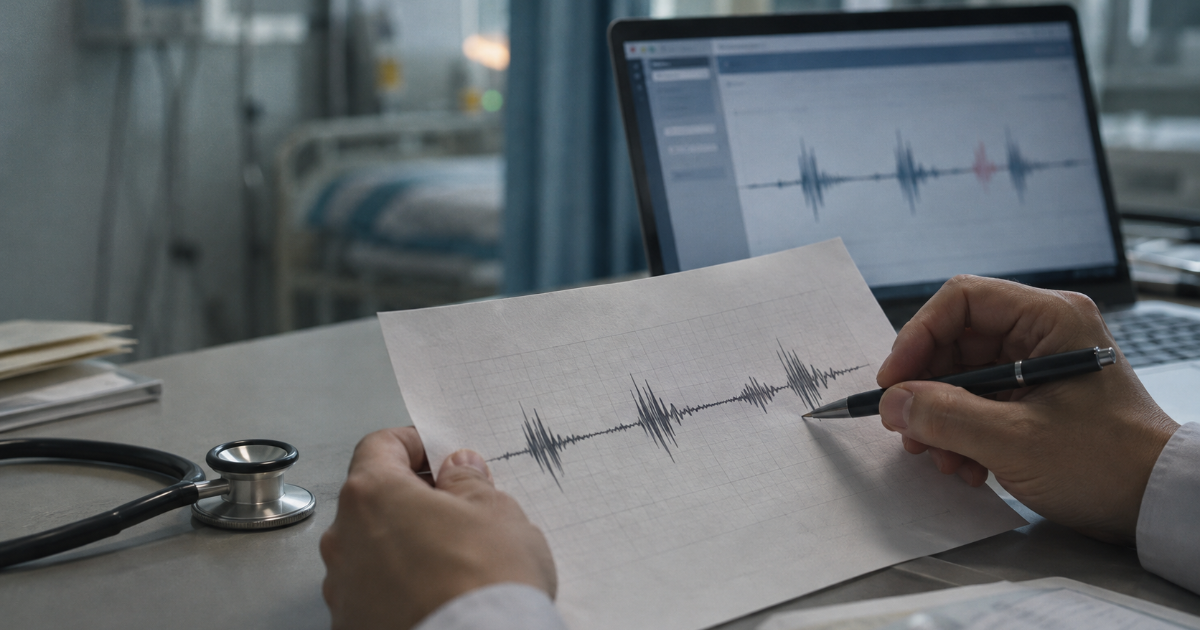
When AI is introduced into medical practice, a familiar reassurance usually follows: the system supports the decision, but a clinician makes the final call. If the AI gets something wrong, an expert can check its answer and correct it.
That sounds like a sensible safeguard. But it depends on the person reviewing the AI being able to recognize a problem. What if a system that has been working well gradually becomes less reliable? Would its users notice? And would asking them to form their own judgment before seeing the AI’s recommendation make a difference?
A study published in npj Digital Medicine in November 2026 examined those questions through a heart sound classification task.
A reliable system began giving worse answers
The experiment involved 48 participants, including 18 final year medical students, resident physicians and experienced physicians. They listened to 40 recorded heart sounds and classified each one as normal or abnormal. Before starting, they were told that the AI system had achieved 96% accuracy during validation.
The recommendations they encountered during the experiment followed a different pattern. The researchers divided the task into four blocks of ten recordings and reduced the accuracy of the AI recommendations from 90% to 60%, then 50% and finally 0%. In the last block, every AI recommendation was wrong. The audio and visual information were also deliberately mismatched, giving participants an additional sign that something was wrong with the system.
The researchers wanted to know more than whether an incorrect AI answer could lead to an incorrect human answer. They examined whether people would detect the decline in the system’s performance and how effectively they would correct its recommendations.
Would an independent judgment help?
Participants were assigned to one of two groups. In the first, they saw the AI recommendation before classifying a heart sound. In the second, they listened and recorded their own classification and confidence first. They then saw the AI recommendation and could revise their answer.
There was a clear reason to test the second approach. An AI answer presented first might become the reference point for a person’s decision. Forming an independent opinion beforehand could make a conflicting recommendation easier to question. The researchers expected this procedure to help participants catch errors.
It did not improve final performance in this experiment. As the AI became less reliable, participants’ final classifications also became less accurate. Across both groups, average accuracy fell from 81.45% in the first block to 58.33% in the last.
That finding needs careful reading. Participants did not simply accept every AI recommendation. When the system became unreliable, their combined decisions were more accurate than the AI recommendations alone, which means they corrected some errors. But the corrections were not enough. In the group that made an independent judgment first, final performance after seeing the AI fell below the performance of their judgments before seeing it.
Most participants did not identify the decline
After the experiment, 12.5% of participants spontaneously mentioned that the AI had become less reliable. When asked directly whether anything about the system had changed, 37.5% said its accuracy had declined.
In the final block, the AI was wrong on every trial, and the sound did not match the visual information on screen. Many participants still did not clearly identify the malfunction. Catching an individual wrong answer and recognizing that the system itself is failing appear to be different tasks.
The researchers also found that participants’ confidence in their own classifications declined faster than their trust in the AI. One possible explanation is that, when the AI disagreed with them, participants began to doubt their own judgment before questioning the system. The authors present this as a tentative interpretation, not a proven account of what participants were thinking.
Human oversight needs more than a final reviewer
The study does not show that human review has no value. Participants did correct some of the AI’s mistakes. Nor does it establish that making an independent judgment first will never help in another setting.
It does show a weakness in a common promise about AI safety. Naming a person as the final decision-maker does not automatically give that person the means to detect a decline in system performance. Effective oversight also depends on what the user can see, how a malfunction is signaled and who monitors patterns of error across many cases.
The researchers suggest that AI systems could provide information about uncertainty or possible malfunctions. They also point to a role for hospitals and system providers in monitoring performance over time. That work cannot rest entirely on the person making one decision in front of one screen.
The experiment has limits. Participants classified recordings in a controlled setting rather than caring for patients. The AI’s accuracy fell sharply to 0% over a short task, and the final block included a deliberate mismatch between audio and visual information. Problems in clinical use may emerge more subtly or fluctuate over time.
Even with those limits, the study raises a practical question for anyone deploying AI: when a system starts behaving differently, what will the person checking its answers be able to see?