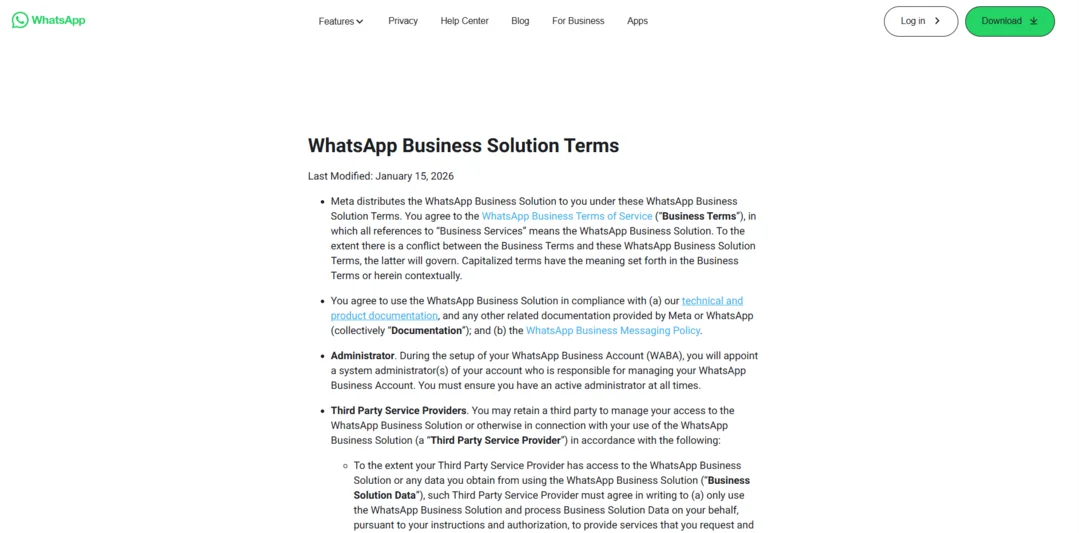
On January 15, 2026, Meta fully revised WhatsApp Business Solution Terms: "General-purpose AI platforms, large language models (LLMs), and generative AI chatbots cannot use the WhatsApp platform directly or indirectly." ChatGPT, Claude, Gemini, Copilot, Perplexity and similar "general-purpose conversational AI" operating on WhatsApp are banned. Meta codified this as "AI Provider Restrictions," explicitly stating account termination and access revocation for violations.
The ban is not simply because "AI became too powerful" — the more fundamental motive is Data Sovereignty. Technically, generative AI's core competitiveness lies in data quantity and quality, and WhatsApp's conversation data is a "gold mine" most reflective of human language, emotion, and relationships — if used for external AI model training, Meta would be handing its greatest asset to competitors. Economically, Meta cannot afford WhatsApp becoming a "subordinate interface to AI." This move is close to a declaration: "WhatsApp is not a platform for AI, but a competitor to AI."
The ban also contains the rule: "Business Solution Data cannot be used in any form for AI model development, training, or improvement." Also paradoxically, Meta itself embeds LLaMA-based generative AI chatbot "Meta AI" on Facebook, Instagram, and WhatsApp — creating a dual structure where external AI chatbots are banned while only Meta's own AI is permitted. This creates a market restructuring toward "conversations controlled by Meta" rather than "conversations created by AI."
Experts characterize this as an "AI platform cold war." Three future debate points: (1) The legitimacy of AI access restriction — Meta frames it as user protection and privacy, but critics see it as market protectionism raising AI ecosystem entry barriers; (2) Privatization of data — banning WhatsApp conversation data from external AI training essentially declares "proprietary ownership of conversation data," directly clashing with open data philosophy; (3) Impact on AI chatbot industry — especially devastating for businesses in Latin America, India, and Southeast Asia where WhatsApp-based business chatbots were primary customer touchpoints. The decision on "who owns conversation" — humans or algorithms — represents the prelude to a new debate about conversation sovereignty.