Anthropic has reportedly begun operating a real biology laboratory in the San Francisco Bay Area. It is a so-called “wet lab,” a space where researchers work directly with biological and chemical materials such as cells, proteins, and compounds. Anthropic is said to conduct some research there itself while also collaborating with external research partners.
The combination of AI and laboratories is not new in itself. In chemistry, materials science, and the life sciences, “self-driving labs” have already been developing, with AI proposing experimental conditions, robotic equipment carrying them out, and the results then being analyzed again. “Cloud labs,” which allow researchers to remotely operate real laboratory equipment, also already exist.
Until now, however, the usual pattern has been for research institutions or biotech and chemical companies to introduce AI into existing laboratories. Anthropic is moving in the opposite direction. A company that develops general-purpose generative AI models is beginning to build out its own physical experimental environment.
That difference means more than simply adding another research facility. Anthropic’s move deserves attention because an AI company that has primarily built models and software is now beginning to bring the environment where real experiments take place into its own research structure.
Why Does a Model Company Need a Real Laboratory?
Anthropic’s path toward operating a wet lab suggests that this move did not come out of nowhere. Over the past several months, the company has been expanding Claude from an AI that simply answers questions into a tool that can play a deeper role in the research process.
One starting point was “Claude Science,” introduced in June. Rather than a separate AI model built specifically for science, it is closer to a research environment where scientists can use Claude across tasks such as finding papers, running code, and analyzing data within a continuous workflow. Anthropic describes it as an “AI workbench” for scientists.
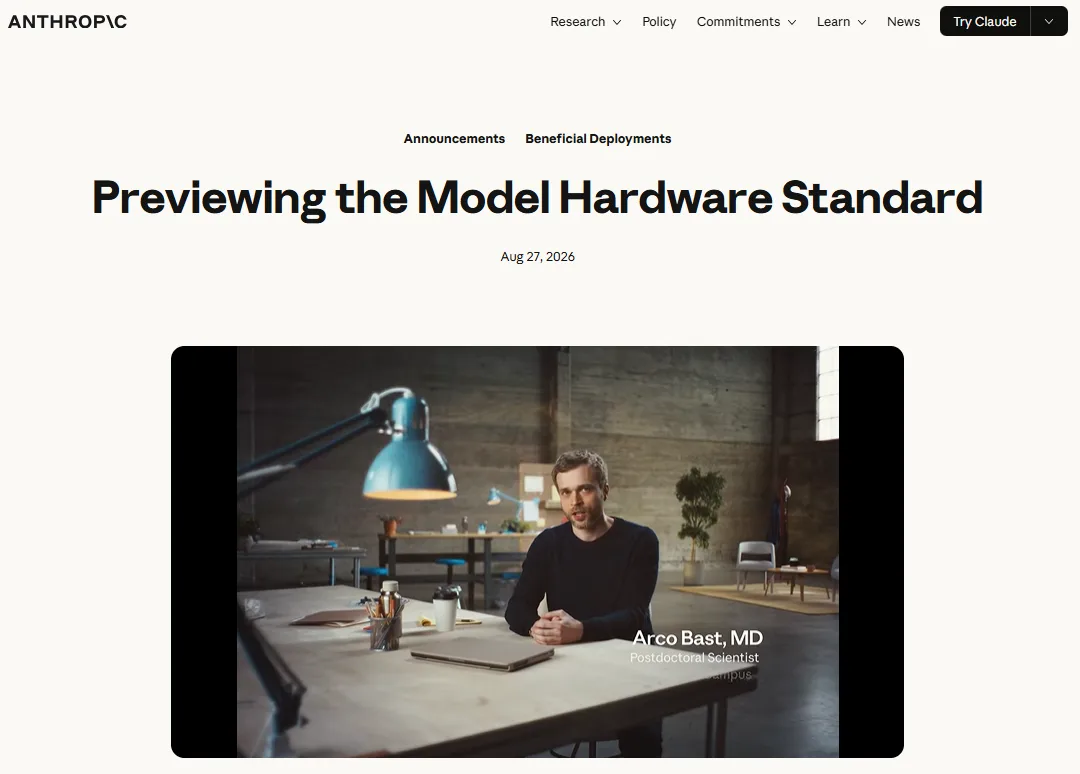
Then, in August, Anthropic introduced the “Model Hardware Standard,” a specification designed to let AI agents interact with research equipment such as microscopes, liquid-handling systems, and robotic arms through a common interface. In other words, it creates a path for Claude to move beyond analysis on a screen and connect with the actual experimental process.
In September, Anthropic also introduced the “Life Sciences Verification Program” for life-science researchers. The program gives research institutions and teams that meet certain qualification, security, and ethical oversight requirements access to Claude with fewer biology-related restrictions than ordinary users. It is intended for real life-science work ranging from drug discovery and research biology to clinical development and manufacturing.
Seen in this sequence, the emergence of a wet lab becomes easier to understand. Anthropic first built an environment in which researchers could use Claude, then created a way for AI to connect with physical research equipment, and is now beginning to operate a space where those ideas can be tested in the real world.
A key concept here is “closed-loop research.”
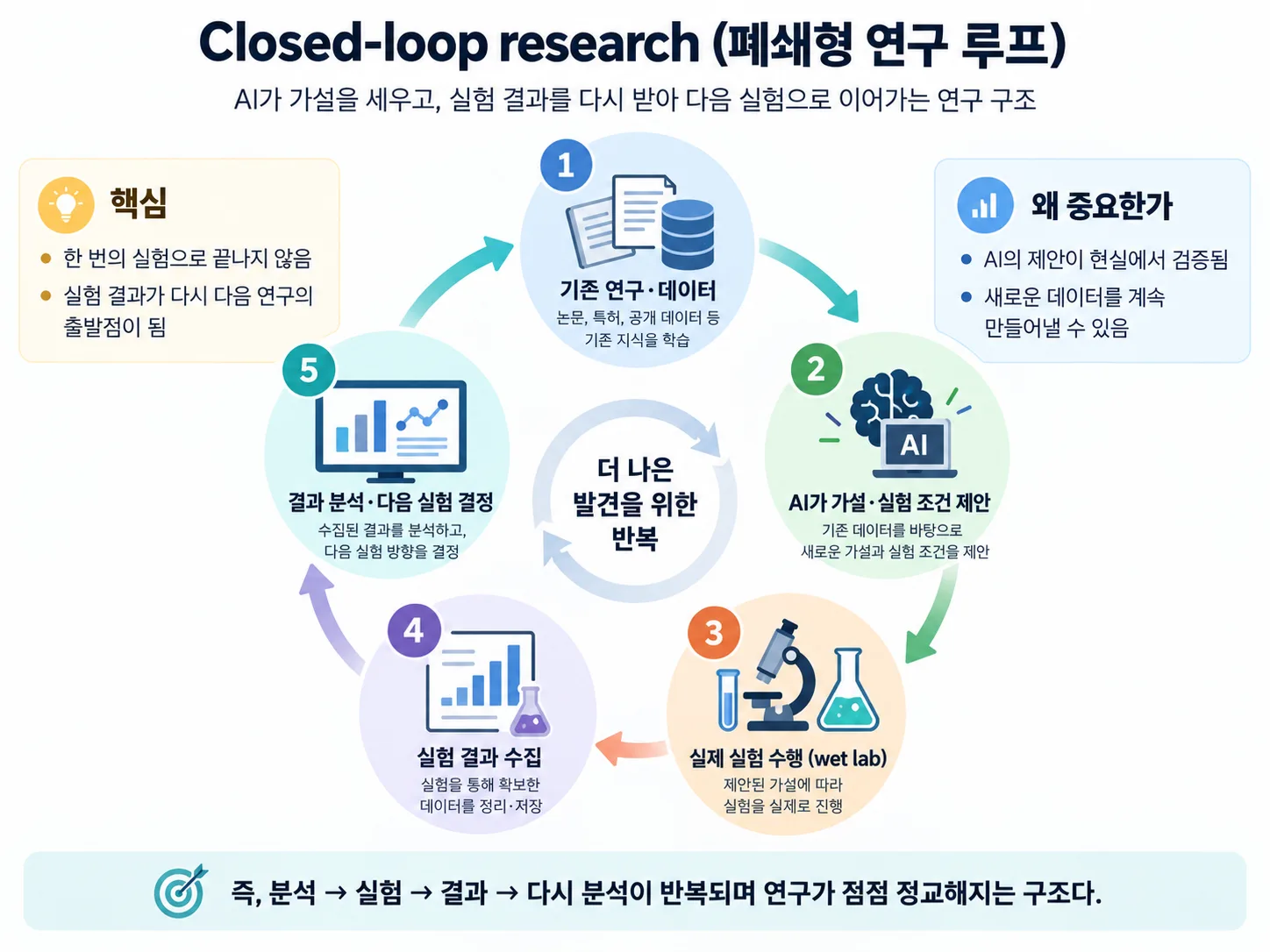
The name may sound complicated, but the structure is simple. AI proposes a hypothesis or the conditions for the next experiment based on existing research, receives and analyzes the results of a real experiment, and then uses those results to decide what should be tested next. Instead of ending with a single analysis or experiment, the experimental result becomes the starting point for the next round of research. Self-driving labs are also built around this kind of closed-loop experimental structure.
For such a system to work properly, model performance alone is not enough. No matter how plausible a hypothesis may sound, biology still requires researchers to check whether cells or proteins actually behave as expected. What is needed, then, is an environment where ideas proposed by AI can be tested in the real world and the results can be fed back into the research process.
Of course, this does not mean Anthropic’s wet lab is already a fully autonomous laboratory in which AI independently generates hypotheses and conducts experiments from start to finish. Human researchers and external partners still play important roles.
The change, then, is not that AI has begun doing research entirely on its own, but that AI and real-world experimentation are moving increasingly closer together.
From AI That Reads Data to AI That Helps Create It
The significance of operating a laboratory lies less in the physical space or equipment itself than in the fact that the nature of the data AI encounters could begin to change.
Large language models have so far learned primarily from data that already exists: papers, patents, databases, code, and the results of previous experiments—records that someone else has already produced. But scientific research cannot advance simply by reading what is already known. It also depends on asking questions that do not yet have answers and producing new data through real experiments.
If AI repeatedly proposes hypotheses based on existing research, receives experimental results, and adjusts the next set of conditions, something changes. AI no longer merely reads and analyzes existing data. It begins to participate in the process through which new research data is created.
Another important point is the data that accumulates during the research process itself.
Published papers tend to preserve organized, finalized results. Inside a real laboratory, however, much more information accumulates: failed experiments, unexpected reactions, and changes made to conditions along the way—details that often never become public. Scientists have long pointed out that null results and failed experiments are underrepresented in the published literature. These records can be extremely valuable when designing the next experiment, because knowing what does not work can matter just as much as knowing what does.
As AI companies move closer to the actual research process, they may also come closer to forms of research data that are different from what can be found in public papers alone.
That means the value of an AI company may not always be explained simply by how much data its models have been trained on. How quickly it can help generate new data and put that data back to work in research may also become increasingly important.
How Far Can an AI Company Expand?
At this point, it becomes harder to describe Anthropic simply as a model developer.
It builds Claude, provides research environments for scientists, creates standards that connect AI with laboratory equipment, offers specialized access to professional researchers, and now operates a real laboratory.
That does not mean Anthropic has become a pharmaceutical company. It remains distinct from drugmakers that directly conduct commercial clinical trials, and its approach is closer to working with established pharmaceutical and biotech companies.
Still, the range of roles taken on by AI companies is clearly expanding. In the past, the division was relatively straightforward: AI companies built models, and research institutions adopted them. Now AI companies are beginning to deal not only with the models themselves, but also with research tools, hardware interfaces, and even the physical environments where experiments take place.
As that happens, the basis of competition may broaden as well.
Until now, AI competition has often been described in terms of larger models, more GPUs, and higher benchmark scores. But as AI moves closer to fields such as science, medicine, and robotics, the value of environments where real experiments and validation can take place is likely to grow.
These spaces are not simply places where AI is used. They can become places where AI observes outcomes and gains new data.
That is what makes Anthropic’s wet lab notable. It is not that AI is being used in experiments for the first time, but that a general-purpose AI company is beginning to bring experimental environments outside the model itself directly into its own research structure.
The next phase of AI competition may not end with building a smarter model.
The next contest may be over who can first build the “world” in which that AI can ask questions, run tests, and generate new answers.