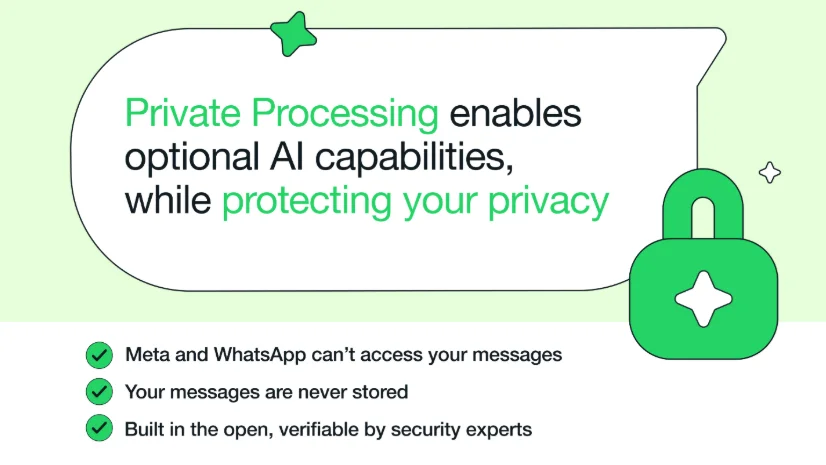
AI Processes User Messages in TEE-Based Invisible Environment
No One Including Meta Can Access the Data
Can you maintain complete end-to-end encryption while also enjoying the benefits of AI? Meta and WhatsApp designed a new security architecture to find the answer -- "Private Processing." The AI and privacy collision: AI features (message summarization, email drafting, task automation) run on cloud servers -- meaning user requests are transmitted to servers for processing. For WhatsApp whose core principle is end-to-end encryption (only the communicating parties can read messages), this creates a fundamental conflict. The Private Processing solution uses TEE (Trusted Execution Environment) -- specialized hardware where code and data are processed in an isolated and encrypted environment; even the hardware operator (Meta) cannot see the data being processed inside the TEE. The process flow: (1) user requests AI assistance; (2) message encrypted and sent to TEE server; (3) AI processes the message inside TEE without exposure; (4) result returned encrypted; (5) no log retained after processing. Verifiability: Meta publishes the TEE code as open source -- security researchers can verify the code matches what Meta claims; this "verifiable privacy" is distinct from "trust us" privacy claims; independent security auditors have confirmed the architecture behaves as described. Limitations: TEE security depends on hardware manufacturer not having vulnerabilities in the secure enclave implementation; side-channel attacks theoretically possible; the approach cannot guarantee privacy if the device itself is compromised before data reaches the TEE. The competitive significance: Signal does not offer cloud-based AI features at all; Private Processing enables WhatsApp to offer AI features while maintaining the privacy brand that differentiates it from standard messaging apps.