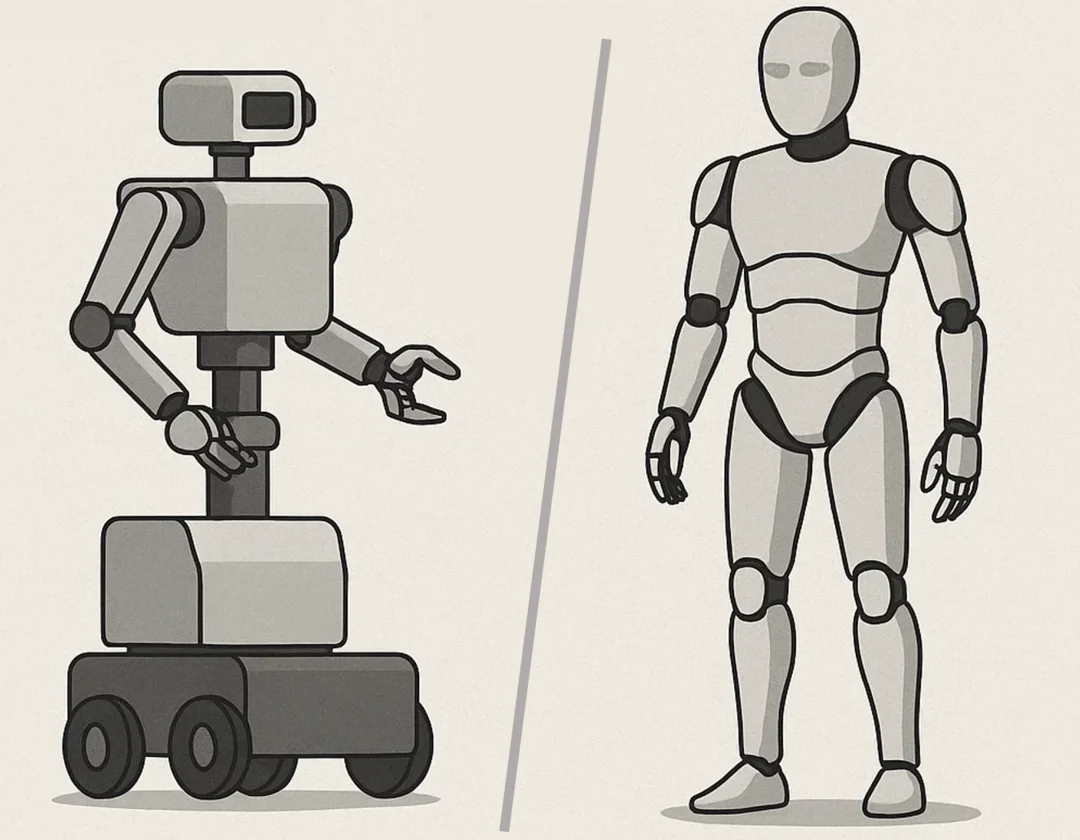
In Q1 2025, global robotics investment of approximately $2.26 billion concentrated 70%+ in specialized robots (logistics, medical delivery, facility inspection) focused on single tasks — while humanoid robots received a significantly lower investment share. This reflects growing skepticism about humanoid commercialization timelines. Technical barriers preventing laboratory escape: humanoid robots require dozens of actuators and sensor types to approximate human movement, but the complexity creates barriers to simultaneously meeting the speed, stability, and durability requirements of factory/logistics/service environments. Agility Robotics'' Digit: demonstrated successful repetitive box-picking in warehouses, but only 1-2 hours continuous operation per full charge — requiring battery exchange infrastructure. Safety certification gaps: ISO 13482:2014 (personal care/service robot safety) established, but specific certification processes for highly autonomous humanoids remain incomplete — delaying commercial deployment decisions. R&D costs vs. revenue: Figure AI raised $675M (Microsoft, NVIDIA, 2024); Beyond Imagination $100M Series B; Apptronik $350M — but per-unit manufacturing cost estimated at hundreds of thousands of dollars, making ROI timelines unpredictable for customers. The strategic pivot: investors and customers are moving toward "specialized autonomy" — robots doing one or two things very well in constrained environments (warehouse picking, hospital delivery, construction site inspection) rather than general-purpose humanoids that struggle in unstructured environments. Humanoid robots'' path to commercialization likely runs through specific high-value use cases (surgical assistance, elderly care, hazardous environment work) rather than the "universal factory worker" vision originally driving investment.
Why Humanoid Robots Can't Break Into Reality
From symbol of universal automation to strategy reduction toward highly specialized equipment. The dream of 'universal worker' humanoid robots is changing from a technology symbol to an investor-avoided subject.
Source: META-X metax.kr
From Symbol of Universal Automation to Narrowing to High-Difficulty Specialized Equipment
ⓒ META-X metax.kr
All rights reserved.
Free to share with attribution.
All rights reserved.
Free to share with attribution.