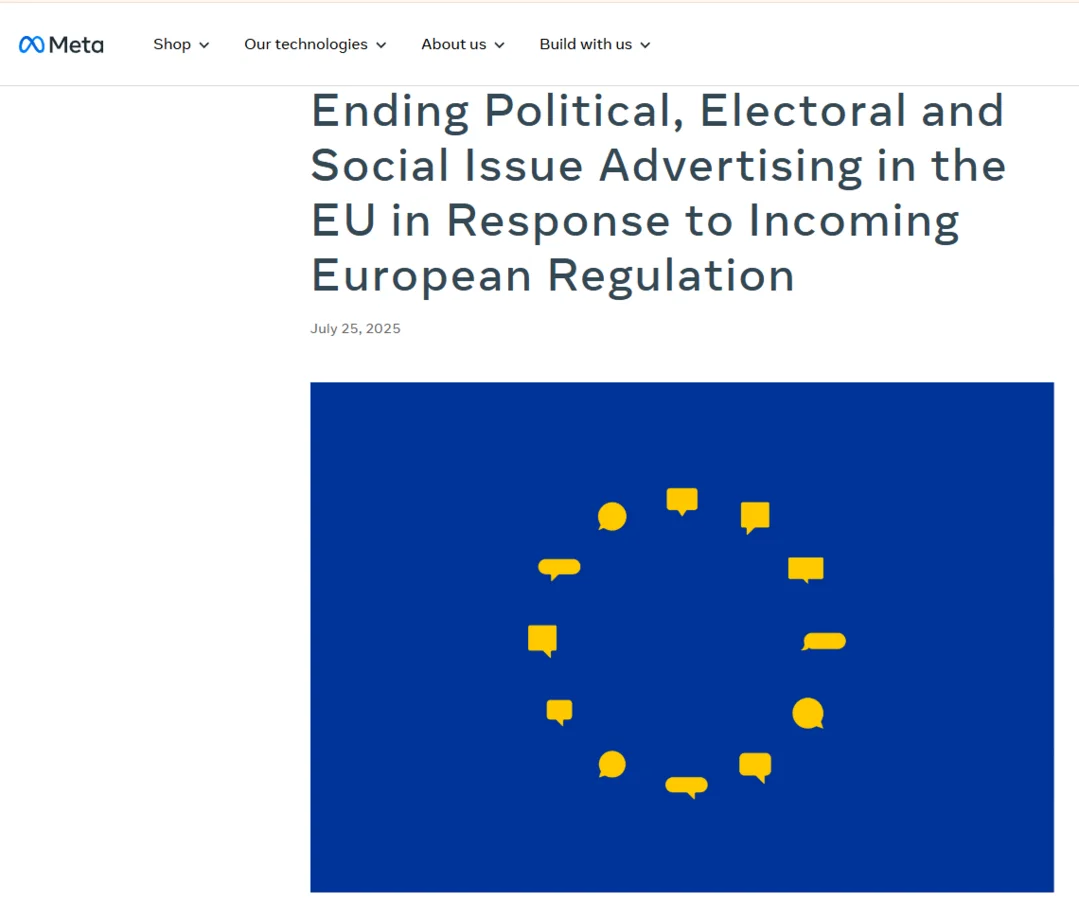
Meta has decided to fully suspend political, election, and social issue-related advertising across the European Union. This is a response to the EU''s political advertising transparency regulation (TTPA: Transparency and Targeting of Political Advertising) taking effect in October, citing "legal uncertainty and prohibitive complexity." With SNS paid advertising — a major channel for digital political expression — disappearing, fundamental discussions about the EU''s new political advertising environment are inevitable.
On July 25, 2025, Meta officially announced: "From October 2025, paid advertising related to politics, elections, and social issues will be fully suspended on Meta platforms including Facebook and Instagram in the EU." The TTPA regulation''s three key provisions: (1) Advertising targeting scope restrictions — prohibiting targeting based on detailed attributes beyond age, location, and language; limiting personalization algorithm use; (2) Enhanced pre-registration and reporting obligations for political advertising — advertisers must prove nationality/address/affiliation and "official registration"; (3) Expanded interpretation of what constitutes political advertising — even simple social issue campaigns can be deemed political, with platforms bearing risk of arbitrary judgment each time.
Meta has operated what it calls "the world''s most transparent political advertising system" since 2018 (advertiser verification, "who paid" display, 7-year ad library, targeting criteria/budget/exposure information) — yet criticizes TTPA for rendering this system powerless and imposing excessive legal liability. Politicians and parties can still post political content for free on Meta platforms, but the ability to efficiently deliver messages to voters is effectively blocked. This particularly harms small parties, new politicians, and non-profit campaign organizations. Google, TikTok, and others may make similar decisions, potentially creating a digital void in the European political advertising market. The question of "what role does advertising play in digital democracy" is being raised anew — this is not simply a business strategy change but a declaration about the nature of political expression itself.