Fusion of Prompt-Based + Workflow Structure
Google has started testing "Opal," an AI-based mini web app creation tool, in the US. In the new creative flow called "Vibe-Coding," tools capable of creating apps with just prompts are rapidly spreading. The era where anyone with just an idea can create apps without knowing coding has arrived, and Google has seriously entered this space.
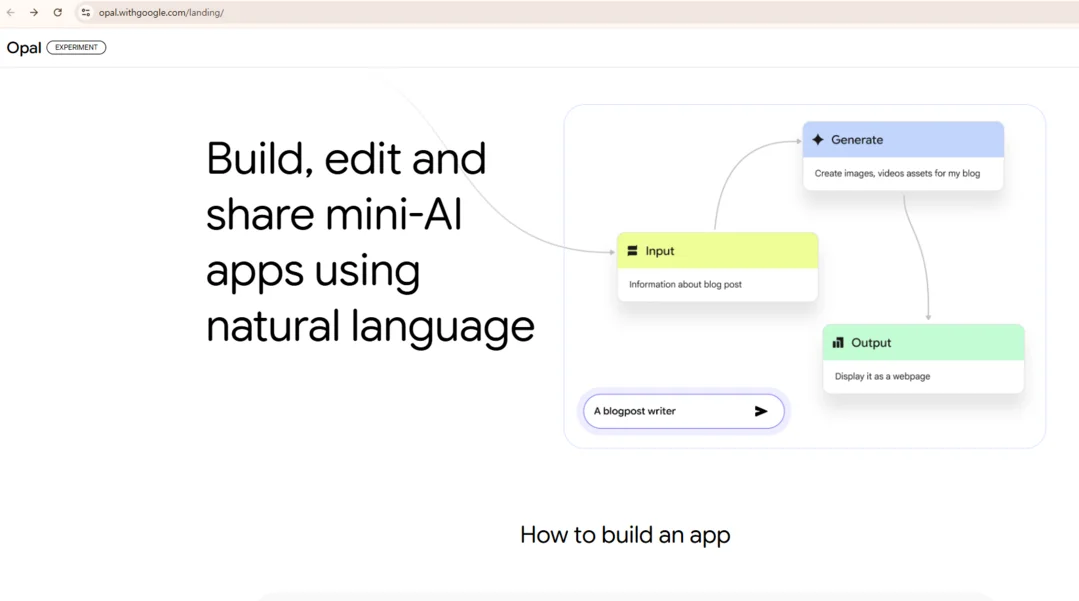
Opal is a new generative AI service being tested in limited capacity through Google Labs. Users simply input text describing an app concept or function, and multiple Google AI models generate a mini web app based on this. Key features: text-based app creation (auto-generating initial structure from descriptions like "To-do list app"); App Gallery "Remix" (loading and editing/extending other users'' apps); visual workflow editor (visualizing input → processing → output flow with per-step prompt modification capability); toolbar for step addition; app publishing and sharing (publishing completed apps to the web for external users with Google accounts to test). What sets Opal apart is combining AI prompt-based generation with visual workflows — enabling visual "debugging" and adjustment of AI pipelines without coding, creating a new frontier in generative UI/UX.
The generative dev tools market is rapidly expanding with competitors including Cursor (GPT-based code editor with real-time auto-completion), Lovable (mobile app design via text), Figma (AI-combined interface design automation), Replit (generative coding for developers, strong in educational platforms), and Canva (AI-based UX automation). Opal''s clear differentiator is integration potential with the Google Workspace ecosystem (Gmail, Drive, Sheets, etc.) — logging in with a Google account and connecting to existing documents to immediately create and share apps is a strength competitors cannot easily match. Vibe-Coding is establishing itself as a new concept: describing the "feeling" or purpose you want to create in writing, and AI reads this to interpret and implement needed functions. Technical commands are being replaced by emotional language and everyday expressions. "Coding without knowing how to code" is no longer an experiment — it''s becoming reality, and Opal is a window showing that future.