I was in my second year of middle school when I first held a pager in my hand.
Back then, “012” felt like a password connected to the future. When the small device in my pocket suddenly beeped, a number appeared on its tiny screen. It meant someone was looking for me.
Of course, looking back now, it was a rather inconvenient form of communication. The other person could not speak to me directly. When a number appeared on the pager, I had to find a nearby public telephone. I inserted coins and dialed the number. Only when the other person picked up did the conversation finally begin.
But at the time, even that felt astonishing.
The very fact that someone could “call” me wherever I was, as long as they knew my number, felt remarkable.
Wireless paging services in Korea began in the 1980s. In 1991, a nationwide dedicated paging network was established, and the identifier “012” began to be used in earnest. Later, 015 service providers appeared as well, and pagers became something close to an essential item for young people in the 1990s. By 1997, when I was in my first year of high school, the number of wireless paging subscribers in Korea had exceeded 14 million.
In the age of pagers, numbers had their own language.
8282 meant “quickly, quickly.”
1004 meant “angel.”
486 meant “I love you.”
Because people had to deliver feelings with only a few digits, they placed emotions inside numbers.
It is funny when I think about it.
Today, we speak with generative AI in natural language. We can explain what we want at length, and AI understands not only meaning but context. Yet just over 30 years ago, we compressed our feelings into a handful of numbers.
Looking back, perhaps that was when it began.
The age in which human beings started keeping a communication device close to the body.
The pager could not speak. It could not let me hear the other person’s voice. Still, it was an important change. Until then, communication devices belonged to places such as homes or offices. The pager was different. When I went to school, when I met friends, when I walked down the street, it was in my pocket.
The machine had begun to follow me.
When Carrying a Phone Itself Was the Future
If pagers belonged to middle and high school students of that time, mobile phones belonged to adults.
The mobile phones I saw in television dramas and movies as a child were completely different from the phones we imagine today. They were big and heavy. They had black bodies and long antennas. People could hold them in one hand, but just looking at them made it seem as if one needed strength in the forearm.
We commonly called them “brick phones.”
In dramas and movies, the people holding brick phones were rarely ordinary people. They were usually corporate chairmen, successful businesspeople or powerful figures. Phones also appeared inside cars. These were car phones.
In Korea, analog vehicle-phone service began in 1984, and mobile phone service began in earnest around the 1988 Seoul Olympics. The phone slowly moved from being a machine attached to a car to an object a person could directly carry.
At the time, the phrase “mobile phone” was literal.
The very act of carrying a telephone was technology.
It sounds strange now because it is so obvious, but telephones originally belonged to places. The home phone was at home. The office phone was at the office. To call someone was not really to call that person directly. It was closer to calling the place where that person was likely to be.
If I wanted to call a friend, I called my friend’s house. If I wanted to reach an office worker, I called the company’s main number or a department phone.
“Hello. Is this so-and-so’s house? Could I speak to so-and-so?”
Only when the person who answered handed over the receiver could I finally be connected to the person I was looking for. A phone number was not yet attached to an individual. It was attached to a place: a home, an office, a shop.
But when mobile phones arrived, that relationship was reversed.
For the first time, the phone number separated itself from place and began following the person.
Looking back, I think the essence of the mobile communication revolution was right there.
Communication moved from place to the human being.
A Phone That Once Cost Almost as Much as a Car Fell to the 200,000-Won Range
If the pager was the symbol of the future for me in middle school, another fascinating device appeared when I entered high school in 1997.
It was the Cityphone.
On March 20, 1997, Korea Telecom, Naray Mobile Telecom and Seoul Mobile Telecom began commercial CT-2 Cityphone service in Seoul, Gwangmyeong and Gwacheon.
I still vaguely remember the scenes from that time. People standing near Korea Telecom phone booths and making calls with Cityphones. Signs and advertisements around the city showing where Cityphones could be used. Newspaper ads that presented those scenes in a highly futuristic way. They may look unfamiliar now, but at the time they seemed quite stylish.
To someone like me, who had spent middle school running to find a public phone whenever the pager beeped, the Cityphone felt like a new world that removed that inconvenience at once. As long as I was near a base station, I could make a call without looking for a phone booth.
“When I enter university, I must buy a Cityphone.”
That is how much I wanted one.
If the pager was a device that told me someone was looking for me, the Cityphone was a device that allowed me to respond immediately.
Of course, by today’s standards, its limits were obvious. I could make calls, but I could not receive them. Even so, the Cityphone was attractive enough at the time.
Above all, it was cheap.
The Cityphone handsets introduced in 1997 cost roughly around 200,000 won. The subscription and call charges were also lower than those of mobile phones. To understand how radical that price was, one only needs to remember mobile phones from just 10 years earlier.
A Motorola mobile phone introduced in Korea in 1987 cost about 2.4 million won. At the time, a Hyundai Excel passenger car cost around 4 million won. A single phone was already well over half the price of a car. Around 1988, when mobile phone service began to spread, some records suggest that brick phones cost around 4 million won. Including installation fees, the cost was not very different from that of a Pony Excel car.
Car phones were similar. When subscription fees, installation fees and handset prices were combined, they exceeded 4 million won. Considering that the monthly salary of a new college graduate at a large corporation was around 300,000 won, this was not something an ordinary office worker could easily afford.
So mobile phones at the time were not simply communication devices.
A car with a car phone installed, or a person taking out a Motorola brick phone with a long antenna on the street, was a scene that displayed economic status. It was not a coincidence that childhood television dramas repeatedly showed company chairmen or successful businesspeople answering phones inside cars.
A mobile phone was, quite literally, a symbol of success and wealth before it was a tool of connection.
Compared with that age, the arrival of the Cityphone was impressive.
If one compares it simply with early brick phones that cost around 4 million won, the nominal handset price was about one twentieth. At least in terms of price, mobile communication was being pulled down to a level where many more people could realistically hold it in their hands.
Of course, there was about a decade between those products, and ordinary mobile phone prices had also fallen significantly in the meantime. So they cannot be compared as if they were competing products at the same point in time.
Even so, the meaning of that shift was clear.
A device that had once seemed like something only “successful adults” could own was becoming an object that students and ordinary office workers could at least imagine buying. Cityphone was a symbolic device showing that mobile communication was beginning to move from the possession of the wealthy into the everyday lives of ordinary people.
What made Cityphone particularly interesting was how it worked together with pagers.
You received a message on your pager.
You checked the number on the screen.
Then you took out your Cityphone and made the call.
Explained to today’s generation, it might sound like this: an age when the device that received the notification and the device that responded to it were separate.
It seems rather cumbersome now, but for people who had run around looking for a public telephone every time their pager beeped, it was clearly a major change.
Still, the age of Cityphone did not last long.
There were limitations in service areas and base-station coverage. Use while moving was limited. Above all, it could not receive calls.
While Cityphone failed to overcome those limits, the world was already moving to the next stage. In the mid-1990s, mobile communication began shifting from analog to digital, and changes that would alter the price, size and performance of mobile phones were already underway.
In 1996, Korea became the first country in the world to commercialize CDMA-based digital mobile communication. This also accelerated the localization of mobile communication equipment and handsets. Domestic manufacturers such as Samsung Electronics and LG Electronics entered the mobile phone market, and the market, which had relied heavily on foreign handsets, began to reorganize quickly.
Advances in semiconductors and electronic components changed the appearance of mobile phones dramatically. Internal parts became smaller, integration increased, and battery, display and communication-chip technologies advanced together. Mobile phones gradually became smaller and lighter.
A device once called a brick began to fit inside the palm.
Technology was not the only thing that changed.
In 1997, Korea Telecom Freetel, Hansol PCS and LG Telecom entered the PCS market, and Korea’s mobile communication market moved into full competition. Telecom companies competed to secure subscribers, while manufacturers competed to make smaller, lighter and cheaper handsets.
As a result, mobile phones became smaller, prices fell and choices increased. A device that once seemed almost as expensive as a car and reserved for a few people began to become something ordinary people could realistically own.
In this environment, the space in which a Cityphone that could only make calls could survive quickly narrowed. Mobile phones and PCS soon began to spread, and Cityphone disappeared into history after leaving a short but vivid trace.
Failed Technologies Also Reveal the Direction of the Future
When we look back at the history of technology, there are interesting moments.
Some technologies appear to be the future itself when they first emerge, only to disappear from the market within a few years. But that does not mean failed technologies leave behind no meaning. In fact, some technologies reveal more clearly, precisely because they failed, what people wanted and what conditions must be met before technology can become everyday life.
Cityphone was such a case.
It did not survive for long, but it identified one desire accurately.
People wanted to be connected anywhere, without being tied to a place.
The pager told me someone was looking for me.
Cityphone allowed me to respond from that place.
But that was as far as it went. I still had to find a place where communication was possible. Use while moving was limited. Most importantly, I could not receive calls.
What people wanted was not merely “a device that lets me make a call outside.”
They wanted communication that could reach the person directly, wherever that person was.
That difference matters.
Technology often presents functions first, but markets choose experience over functions.
Cityphone offered the function of portability, but users still had to be aware of base stations and available areas. One more step remained before it could be called truly free mobile communication.
The mobile phone completed that final step.
As mobile phones became popular, phone numbers were no longer numbers belonging to homes or offices. They became numbers attached to people. An age opened in which a person could be reached wherever they were, and connected through the same number wherever they moved.
Looking back, this change was far bigger than simply making phones smaller.
It was the moment when the unit of communication changed from “place” to “individual.”
From that point, mobile phones quickly became personal objects. People began choosing phones, changing ringtones and decorating wallpapers. The way a folder phone opened and closed, the color, the design — all of these became matters of taste. For the first time, a communication device began to express personal identity.
And mobile phones did not stop there.
Cameras were added. Electronic organizer functions were added. MP3 players were added. Mobile internet was added. At first, these were additional functions.
But as one function after another accumulated, the phone began absorbing other devices around it. There was less need to carry a separate camera. There was less reason to bring an MP3 player. Address books and schedules moved from paper planners into mobile phones.
At that point, an important change began.
The mobile phone was no longer just a communication device.
A single portable device began replacing multiple human behaviors.
Calling, remembering, recording, listening, searching, storing.
As a device that once performed one function absorbed many roles, portable devices became more deeply integrated into human life. Even so, the center was still the “phone.”
We still called the machine a mobile phone.
The camera, the MP3 player and the internet were all accepted as functions attached to the phone. The phone was the body. Everything else was an add-on.
But the moment that completely reversed this relationship soon arrived.
It was the moment we moved from the stage where the phone gradually absorbed computer functions to the stage where the computer embraced the phone.
November 28, 2009: The Day the Phone Became a Computer
November 28, 2009.
KT officially launched Apple’s iPhone in Korea. A launch event was held at Jamsil Indoor Stadium, and people gathered to be among the first in Korea to get their hands on the iPhone. I see this moment as one of the symbolic dates of Korea’s smartphone revolution.
Of course, smartphones existed before the iPhone.
I remember them too. Samsung had the Omnia. At the time, Samsung called the Omnia a “PC in the hand,” and with its successor, the Omnia 2, declared the age of popular smartphones. In terms of specifications alone, the device was powerful for its time, with a camera, AMOLED display and mobile office functions. Samsung positioned the Omnia 2 as a rival to the iPhone, and sales in Korea climbed quickly.
But a different name remained in users’ memories.
“Omregi.”
A harsh nickname combining Omnia and trash.
Looking back now, the nickname did not arise because the Omnia could do nothing technically. In terms of hardware specifications, it was rather impressive.
The problem was the user experience.
The Windows Mobile-based Omnia had many parts that felt cumbersome to use naturally with a finger on a small screen. Menus and settings were complicated. At times, users had to take out a stylus.
Again, the Omnia was clearly a flashy device for its time. Samsung described it as a “PC in the hand” and emphasized its AMOLED display, mobile office functions and multimedia performance. In the fall of 2009, Samsung even unveiled five Omnia family models at once and declared the arrival of the popular smartphone era.
The Omnia focused on putting as many PC functions as possible into a small mobile phone.
A better screen.
Higher specifications.
More functions.
It was the approach the Korean mobile phone industry had long been good at.
The specification sheet was certainly impressive, and the device could do many things. But how humans would actually use those things had been pushed aside.
Looking back, perhaps the phrase “PC in the hand” itself contained the limitation of the Omnia.
The iPhone, however, had been asking a different question from the start.
Existing mobile phones asked, “What more can we put into this machine?”
The iPhone first asked, “How can a person use this machine naturally?”
It placed the center of technology not on functions, but on user experience.
Apple had already introduced the first iPhone in 2007, and Samsung was also watching that change in the global market. Yet in Korea, the smartphone strategy continued around the old approach, centered on the T Omnia in 2008 and the Omnia 2 in 2009.
That is why the shock of the iPhone was even greater for Korean consumers.
On November 28, 2009, when KT officially launched the iPhone 3G and 3GS in Korea, consumers were finally able to compare two kinds of “smartphones” directly.
On one side was the “PC in the hand,” built around functions and specifications.
On the other was a computer designed from the beginning around the experience of touching and using it with fingers.
The difference was harsher than expected.
With Samsung’s Omnia, one first had to understand the menu structure in order to do something. Users had to learn where each function was and move according to the sequence defined by the machine. With Apple’s iPhone, one swiped, pinched and tapped. Instead of learning separate instructions, one touched it as the hand naturally moved.
In the end, the difference between the two products was not the number of functions. It was about who had to adapt to whom.
The Omnia asked humans to learn the machine’s way.
The iPhone adjusted the machine’s way to human behavior.
Eventually, among Korean users, the Omnia received the harsh nickname “Omregi.” I do not think that nickname was merely a bad review of one product. It may have been closer to a consumer verdict that raising hardware specifications and creating a new user experience are entirely different things.
We had used devices called smartphones before.
But only after touching the iPhone did we realize that what we had been using may have been closer to mobile phones loaded with strong hardware and many PC functions.
A smartphone was not simply a mobile phone with many functions.
It was a computer redesigned around the human hand, human behavior and the very way people use technology.
The market reacted immediately.
In June 2010, only about half a year after the iPhone’s Korean launch, Samsung Electronics released the Android-based Galaxy S in Korea as its global strategic smartphone.
Looking back at this flow, the arrival of the iPhone in Korea was not simply the entry of one powerful foreign mobile phone into the market.
It changed the question being asked by the Korean mobile phone industry.
The center of technology moved from specifications to experience.
From “How many functions can we put in?” to “How naturally can people use it?”
That is why I do not see November 28, 2009 merely as the day the iPhone was launched in Korea. Around that day, the meaning of the word “smartphone” itself changed in Korea.
It was not that the phone had gained internet functions.
It was that the internet computer had gained phone functions.
The relationship had been completely reversed. The phone became just one of the many functions performed by that computer. It became a camera, a map, a newspaper, a television, a bank, a wallet, a game console and a company office.
This change was not merely the moment when mobile phones became smarter.
It was another migration in the location of computing.
In the PC era, if one wanted to use a computer, one had to go to the place where the computer was. One had to sit at a desk. The laptop made it possible to carry that computer. Then the smartphone arrived, and the computer finally entered the pocket.
If pagers and mobile phones attached “connection” to the person, smartphones began attaching the entire digital world to the person.
Now we could search, find directions, send money, take photos, watch videos and work from wherever we were. Computing was no longer an action performed in a specific place. It became an action that seeped into every moment of daily life.
At some point, we began checking for our smartphones before our wallets when leaving home. When we got lost, we looked at the smartphone. Instead of going to the bank, we opened the smartphone. While waiting for a friend, we looked at the smartphone. We looked at it while working, while eating, and until just before falling asleep.
The smartphone moved beyond a tool we briefly used when needed. It became the closest computer following our day.
But this enormous change also created a new behavior.
We began lowering our heads.
We lower our heads on the subway. We lower our heads when finding directions. We lower our heads in restaurants. Even while sitting face to face with a friend, when a notification rings, our gaze drops to the screen. Even while playing with a child, when the smartphone screen lights up, we briefly take our eyes off reality.
For more than 15 years, smartphones have given humans tremendous abilities.
But to use those abilities, we had to pay one price.
We had to withdraw our gaze from the reality in front of us and enter the small screen in our palm.
The smartphone placed the world in our hands.
But paradoxically, to see that world, we kept taking our eyes off reality and looking at the screen.
And in 2026, Now It Is Glasses
Watching the Meta Connect 2026 keynote, I suddenly thought back on that long period.
The 012 pager.
The Motorola mobile phone that looked like a brick, and the car phone.
The public phones I had to run to find whenever my pager beeped.
The Cityphone of 1997.
The era of PCS and mobile phones symbolized by 011 and 016.
Folder phones.
And the smartphone era that began in earnest with the iPhone in 2009.
Over the past 30 years, I have watched countless portable devices appear and disappear.
But when I looked at the AI glasses Meta showed this time, I felt something similar for the first time in a long while.
Like the moment in my second year of middle school when I placed a pager in my palm and stared at it.
“Will this small object really change our lives?”
Perhaps people have asked similar questions every time a new technology emerged. They may have asked it while looking at car phones, Cityphones and the first iPhone.
And now we are standing before that question again.
This time, it is glasses.
But in this change, I see something more important than the object called glasses itself.
The distance between humans and computers is about to shrink once again.
At Meta Connect 2026, Mark Zuckerberg presented glasses as the core device for communicating with the personal AI agent Muse. In Meta’s future, Muse is not simply a chatbot that answers questions. It is a personal agent that understands the user’s goals, performs work in the background and handles actions across schedules, shopping, travel and work. During the keynote, Meta presented a vision in which Muse develops into a personal agent available around the clock, helping with relationships, time, money, creativity and careers.
And Meta wants to put that AI into glasses.
Why glasses?
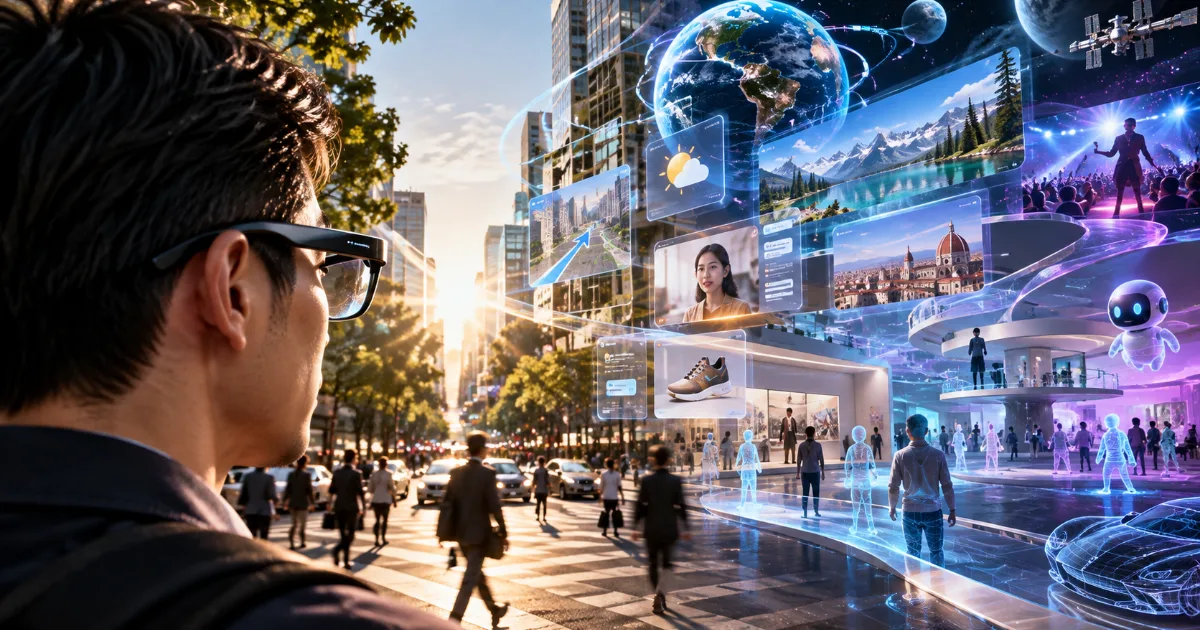
Because glasses are a form factor that lets AI see what the user sees, hear what the user hears, converse throughout the day and eventually display necessary information directly in the user’s field of view.
I think this point is important.
The story is not simply that AI has become smarter.
It is that AI is beginning to look in the same direction as human senses.
Until now, to ask AI something, I had to explain the situation.
“What is this flower in the picture?”
I had to take a photo, open an app, attach the image and type the question.
But if AI can see what I see, the story changes.
I can simply look at the flower and ask:
“What flower is this?”
I can open the refrigerator door and say:
“What can I make for dinner with this?”
AI can understand what I mean by “this.”
I can go on a business trip, look at an unfamiliar building and ask, “What is that building?”
After a meeting, I can say, “Schedule what we just discussed.”
If AI can understand our field of view and context together, the process of humans translating situations for computers becomes shorter.
That is the important difference between smartphones and AI glasses.
If the smartphone was a computer in the hand, AI glasses are a computer of context.
The smartphone is an excellent device. But fundamentally, the smartphone requires me to act first.
I take it out of my pocket.
I unlock it.
I open an app.
I search for something.
Then I look at the result.
The direction AI glasses are aiming for is different.
AI can understand the space I am in, the object I am looking at, the conversation I am hearing, my schedule and my past context together. The role of the computer shifts from processing an entered command to understanding a situation.
I see this as a move from command-based computing to context-based computing.
The examples introduced in the keynote show this well.
When Muse handled travel planning, it checked in advance that it would rain on the booked day and changed the schedule. It also helped reduce insurance costs, find refunds and negotiate with customer service to lower monthly bills.
What matters here is not how plausible AI’s answers sounded.
What matters is that AI began carrying out the next action, even when the user did not request every step one by one.
In the age of search, humans looked for information.
In the age of generative AI, humans asked questions.
In the age of agents, AI understands human goals and continues the work.
The next question naturally follows.
Where will that AI meet humans?
Meta’s answer is glasses.
The Computer May No Longer Be a “Device”
Another direction unveiled at Meta Connect 2026 was also interesting.
Meta VR Glasses weigh around 100 grams. Meta described the device as a personal cinema, a multi-monitor computer and a game console.
Meta also presented interaction methods using eyes, hands and voice, as well as turning flat surfaces into virtual keyboards and trackpads. The AI agent is integrated at the operating-system level so that users can give spoken instructions instead of searching through menus.
Watching this scene, I thought less about glasses and more about desks.
Our current workspaces are designed around computers. There is a desk, a monitor, a keyboard and a mouse.
But if the display moves into glasses, the story changes.
The moment I sit at a hotel desk, three 32-inch monitors could unfold in front of my eyes.
An airplane seat could become a movie theater.
An empty table could become a keyboard and trackpad.
Someday, the question “Where is the computer?” itself may sound strange.
In the PC era, people went to where the computer was.
In the laptop era, people carried the computer.
In the smartphone era, the computer entered the pocket.
In the age of spatial computing, perhaps the space we occupy itself can become the computer.
The Metaverse Has Not Disappeared. It Is Becoming Transparent
From this perspective, one of the most interesting parts of Meta Connect was the fact that Meta said it would reduce its focus on the metaverse.
Reality Labs is now more focused on building Muse and glasses for AI, will make fewer VR devices for the time being than before, and will release VR devices only when there is genuine innovation.
Some may interpret this as Meta finally giving up on the metaverse.
But as someone who studies virtual convergence, I see it somewhat differently.
What Meta may be giving up is not the metaverse itself, but the idea that humans must necessarily enter the metaverse.
The metaverse we once imagined was closer to creating a new world. We put on headsets, briefly left reality and entered a virtual world.
But the direction Meta presented in this keynote is the opposite.
Zuckerberg explained that in the early days he expected the metaverse, which connects the physical and digital worlds, to come first and advanced AI to arrive later. Now, however, he sees personal superintelligence coming first and becoming even more important.
It is not that humans enter the digital world.
It is that the digital world comes out into the reality where humans live.
I think this is an important change in virtual convergence.
The future of virtual convergence may not be “another world.”
It may be a layer placed on top of reality.
You walk down the street. Directions appear in front of you.
You meet a foreigner. Their words are translated in real time.
You look at an unfamiliar building. Information about the building appears in your field of view.
You cook. AI understands the ingredients you are looking at and tells you the next step.
You hold a meeting. AI understands the context of the conversation and organizes schedules and tasks.
At this point, distinguishing what is real from what is digital may no longer matter very much.
Reality remains as it is.
But a layer of digital information is placed on top of it. A layer of AI judgment is placed on top of that. If needed, a layer of virtual objects is added as well.
I want to call this the layering of reality.
The future of virtual convergence is likely to develop not by creating one enormous virtual world, but by overlapping countless digital layers on top of reality. And when the technology becomes natural enough, we may no longer consciously notice those layers.
Just as we no longer say we are “entering the internet world” when we use the internet.
The same may be true of the metaverse.
The moment the word metaverse disappears may actually be the moment when the metaverse has succeeded most completely.
Because the technology has become invisible.
But What If AI Sees the World With Me?
Here, a very difficult issue begins.
Privacy.
Smartphone privacy has largely been discussed around “my data.” My photos, my location, my search history, my contacts — how far can companies use them?
AI glasses are different.
If AI sees what I see, it also sees the other people I look at.
If AI hears what I hear, it also hears the voices of the people speaking with me.
Therefore, privacy in the age of AI glasses no longer ends with the question, “Who owns my data?”
It expands to the question, “Who owns the data of others that I look at?”
Meta is aware of this.
The keynote described plans to store Muse information in dedicated Secure VMs and later provide Confidential VMs that would prevent even Meta from accessing that information. Meta also said its glasses include an indicator light showing whether recording is taking place, and that tampering with the indicator disables recording.
But technical safeguards alone will not solve every problem.
If someone is wearing AI glasses in a meeting room, can I speak as I normally would?
What about a classroom?
What about an exam room?
What about a hospital or a bank?
For AI glasses to become common, camera performance and battery life will not be enough. Society will need new norms about how far it will allow the gaze of AI.
The future of virtual convergence is not only a technical issue.
Ultimately, it is a matter of redesigning trust among humans.
The Real Competitor of Glasses Is Not the Smartphone, but Habit
There is another important question.
Will people actually wear them?
Not every wearable succeeds simply because it is technically excellent.
Glasses are especially difficult.
If you do not like a smartphone, you can put it in your pocket.
But glasses are on the face. They change a person’s appearance. They become fashion. Sometimes they become part of identity.
That is why I think Meta emphasized design and style so strongly in this keynote.
Meta presented a strategy of expanding various styles and frames, including Ray-Ban, while emphasizing that the product must first be good glasses people want to wear all day.
This is an important philosophy.
Humans should not have to adapt to technology.
Technology must adapt to human daily life.
The moment we stop thinking of the smartwatch as a “computer on the wrist” and simply use it like a watch, the technology has entered daily life.
AI glasses will likely be the same.
One day, just as we check before leaving home, “Did I bring my phone?” we may check, “Am I wearing my glasses?”
At that point, AI glasses will no longer be a new technology.
They will become a daily object.
In the End, Machines Keep Moving Closer to Humans
Let us return to the beginning.
In my second year of middle school, I carried a pager in my pocket. It was a small device that told me someone was looking for me.
When I became a high school student, Cityphone appeared. I could now make a call outside.
A little later, mobile phones became popular. People could now be reached wherever they were.
With the arrival of the iPhone in 2009, the mobile phone became a computer. And we began living all day with that computer in our hands.
Looking back, one thing is clear in the direction of the past several decades.
Machines have continued moving closer to humans.
The phone used to be in a place.
The pager entered the pocket.
The mobile phone began following the person.
The smartphone occupied our hands and our gaze.
And now AI glasses are trying to share our eyes and ears.
That is why what I noticed at Meta Connect 2026 was not the new glasses themselves.
It was the fact that the relationship between humans and computers is about to change once again.
Until now, to use a computer, we had to approach the computer.
We sat in front of a PC.
We opened a laptop.
We took a smartphone out of our pocket and looked at the screen.
But if AI glasses develop in the direction Meta is drawing, that relationship will reverse.
Now we may not go to the computer.
The computer may walk with us.
It will see what we see, hear what we hear and understand the situations in which we live.
The Future After Smartphones May Begin by Looking Up
The smartphone put the world in our hands.
In return, for more than 15 years, we have lowered our heads countless times.
On the subway.
On the street.
At the dining table.
In meeting rooms.
Even when sitting across from people we love.
But the future AI glasses imagine is slightly different.
Instead of taking our eyes away from reality to use a computer, looking at reality itself becomes computing.
We receive directions while looking at the road.
We hear translation while looking at a person.
We receive AI help while cooking.
We record the moment while playing with a child.
If so, the biggest change AI glasses bring may not be that they show more information.
It may be that they remove the screen.
And if that truly succeeds, children in the future may one day ask us:
“Did people really take out phones to find directions?”
And we may smile a little and answer:
“Yes. Back then, to use a computer, we had to lower our heads.”
Perhaps post-smartphone computing will begin like that.
By looking up again.
From that moment, the convergence of virtual and reality may no longer be a world we enter.
The world we live in itself may become virtual convergence reality.
It may become the metaverse.
— Written by Gwanghwamundeok, September 24, 2026