Elon Musk has launched a direct attack on Mukesh Ambani.
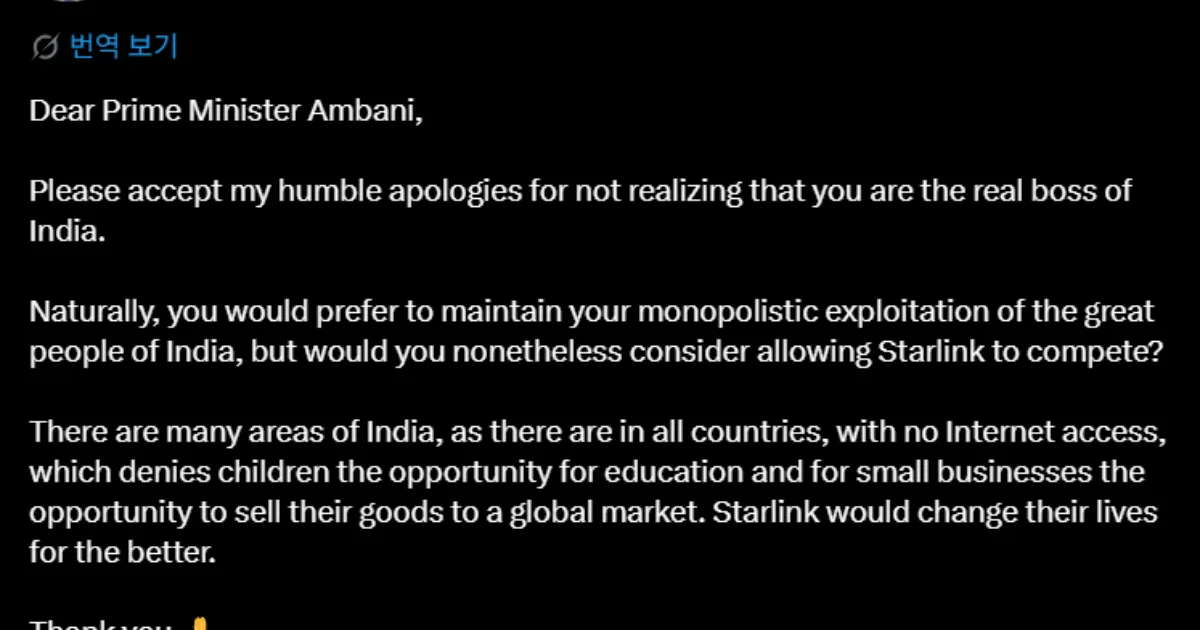
In a post on X, Musk wrote, “Dear Prime Minister Ambani,” then sarcastically apologized for not realizing that Ambani was “the real boss of India.” He went on to ask whether Ambani would allow Starlink to compete, even though he might want to maintain what Musk described as monopolistic exploitation of the Indian people.
The language was deliberately provocative.
But Musk was not targeting only one individual. He was reframing the delay in Starlink’s entry into the Indian satellite internet market as a problem of telecom market power held by Reliance Jio and Mukesh Ambani. In other words, he turned what could have looked like a regulatory approval process for a technology company into a story about a local telecom giant blocking competition.
Reuters reported that Musk said he would price Starlink affordably in India in order to take on Ambani’s low-cost Reliance Jio, escalating his attack on the rival billionaire ahead of Jio’s parent company’s major IPO. The same report noted that Musk mocked Ambani as “Prime Minister Ambani” and asked whether Starlink would be allowed to compete.
This is not merely an online feud.
India is one of the world’s most important internet markets. It has a massive population, hundreds of millions of mobile internet users, and persistent connectivity gaps in rural and remote areas. At the same time, its telecom market is heavily shaped by major players such as Reliance Jio and Bharti Airtel. Reuters reported that India’s telecom market is dominated by Mukesh Ambani’s Reliance Jio and Sunil Mittal’s Bharti Airtel.
Starlink is trying to enter precisely this market.
Starlink is a low-Earth-orbit satellite internet service. It can provide internet access through satellite terminals in regions where terrestrial base stations and fiber networks are limited. Musk argues that many regions in India still lack internet access, causing children to lose educational opportunities and small businesses to lose access to global markets. His argument is that Starlink can improve their lives.
On the surface, this is a question of universal internet access.
But the real issue is far more complex.
If Starlink enters India, it will not merely serve places with no internet. It will also intersect with incumbent mobile operators, satellite communications firms, the government’s spectrum policy, national security, data sovereignty, pricing competition, and rural connectivity strategy. Satellite internet can complement terrestrial networks, but over time it can also compete with them in certain markets.
That is why spectrum assignment is a central issue.
How should satellite internet providers receive spectrum?
Should it be auctioned or administratively assigned?
Should satellite operators be treated like terrestrial mobile operators, or should they be subject to a different framework because satellite communications have different technical characteristics?
The answer to these questions can significantly reshape market-entry costs and the competitive landscape.
India’s regulators have been dealing with this issue. The Telecom Regulatory Authority of India, or TRAI, has conducted consultations on the framework for satellite communication network authorization and spectrum assignment for satellite communication network providers. The consultation record includes submissions from both Starlink and Reliance Jio.
Musk’s remarks are therefore the political expression of an already ongoing regulatory dispute.
Musk says: allow competition.
The Indian government is dealing with procedures, licensing, and spectrum assignment.
Reliance Jio has interests in existing telecom infrastructure and the domestic market.
Starlink is demanding entry with a global satellite network.
The key question is who defines fair competition.
Musk’s frame is simple. Starlink is a competitor trying to provide connectivity to regions without internet access, while Ambani and Reliance Jio represent incumbent power seeking to protect monopolistic benefits. Musk foregrounds the Indian people, especially children deprived of educational opportunity and small businesses excluded from global markets.
This frame is powerful.
Internet access today is connected to the right to education, economic participation, and access to information. If rural children cannot attend online classes, small merchants cannot participate in e-commerce, and local hospitals are excluded from telemedicine and digital administration, then the problem is not merely a lack of telecom service. It is an opportunity gap in the digital age.
Musk presents Starlink as a technology that can close this gap.
But from India’s perspective, there are other questions as well.
Starlink is a satellite internet network operated by a foreign company. The Indian government does not view telecom infrastructure merely as a commercial service. It is also a matter of national security and sovereignty. Satellite internet operates across borders and is connected to data flows, lawful interception, emergency shutdown capabilities, security rules, local gateway requirements, and cooperation with law enforcement.
Therefore, Starlink’s entry is not simply a matter of “providing internet.”
Who operates India’s communications infrastructure?
Who receives spectrum?
Who controls data flows?
How should the rules governing foreign satellite networks and domestic telecom networks be aligned?
If a service enters under the banner of rural connectivity but later expands into higher-value urban customer markets, how should competition with existing telecom operators be managed?
These questions remain.
The Indian government has responded defensively to Musk’s claims. Reuters reported that India denied bias in satellite internet approvals and said that Starlink, Reliance Jio, and Bharti Airtel’s satellite ventures had secured early approvals but were awaiting spectrum assignment and final clearances. Reuters also reported that India’s telecom ministry said the three entities were broadly at the same regulatory stage, with security assessments under way for each.
This shows the gap between Musk’s claim and the government’s explanation.
Musk talks about political-economic obstruction.
The government talks about procedure and remaining approval stages.
The market interprets what lies between them.
Musk’s description of Ambani as “the real boss of India” is therefore more than mockery. It is a political accusation suggesting that India’s telecom policy decisions may be shaped more by major corporate interests than by the government itself. To be clear, this is Musk’s claim. The Indian government has denied bias in the process. That distinction matters.
Another background to this confrontation is Jio.
Reliance Jio transformed India’s telecom market. Through low prices and aggressive expansion, it helped drive explosive growth in mobile data usage and became a core infrastructure player in India’s digital economy. Musk’s promise to offer Starlink “affordably” can therefore be read as a direct challenge to Jio’s low-cost telecom model. Reuters framed Musk’s low-price Starlink comments as an escalation against Ambani’s low-cost Reliance Jio.
But low-price competition is not simple.
Starlink requires satellite launches, terminals, ground gateways, spectrum access, and customer installation costs. India’s mass telecom market is highly price-sensitive. The cost structure of Jio’s low-cost mobile data model is different from the cost structure of satellite internet. Even if Musk promises affordable Starlink, the actual pricing, subsidy structure, terminal costs, and rural rollout model remain separate questions.
Still, Starlink has clear differentiators.
It can provide connectivity where terrestrial networks are limited.
It can serve as a backup when ground networks fail during disasters.
It can create access points for education and commerce in mountainous, rural, and remote regions.
It can also be used by governments, enterprises, military users, maritime operators, and aviation sectors.
For this reason, India cannot easily dismiss Starlink entirely.
At the same time, the interests of incumbent operators such as Reliance Jio and Airtel cannot be ignored. These companies have already made large investments in telecom networks and are also preparing satellite communications services. According to Reuters, Starlink, Reliance Jio, and Bharti Airtel’s satellite internet ventures have all secured early approvals but are still waiting for spectrum assignment and final clearances.
This means the competition cannot be reduced to a simple story of a foreign innovator versus a domestic monopolist.
Starlink is also a giant global company.
Reliance Jio is a core player in India’s digital infrastructure.
Airtel is also a powerful telecom operator.
The government must balance connectivity expansion, security, competition policy, and domestic industrial interests.
Musk’s statement is powerful because it compresses this complex issue into a single moral question:
Will India give opportunities to children and small businesses without internet, or will it protect monopolistic interests?
That sentence is politically effective. But it is not enough as policy. Actual decisions must include spectrum assignment, pricing, security requirements, local infrastructure, competitive conditions among operators, regulatory compliance capacity, and consumer-protection mechanisms.
Nevertheless, Musk’s way of fighting is familiar.
He attacks market-entry barriers using the language of technological innovation and consumer benefit. He casts incumbents as symbols of monopoly or bureaucracy, while positioning his own service as a symbol of competition, innovation, and universal access. In electric vehicles, space launch, satellite internet, and social media, he has often used this method to turn technical disputes into public battles.
The same is happening here.
What had been a debate over regulatory documents and spectrum policy became, through one Musk post on X, a global political-economic argument. TechCrunch also reported that Musk publicly questioned Ambani’s influence in connection with delays in Starlink’s India launch.
This strategy can be effective.
It can move public opinion, pressure governments and regulators, and position Starlink as a solution to rural connectivity in India. But it also carries risks. In a market like India, where sovereignty, domestic industrial protection, and regulation of foreign platforms are highly sensitive, public mockery can provoke backlash. The phrase “Prime Minister Ambani” can be received not only as an attack on Ambani, but also as an insult to the Indian government and democratic system.
Indeed, Musk’s comments generated debate in Indian politics and public opinion. TechCrunch reported that India rejected Musk’s claim of discrimination over Starlink’s launch, and Reuters reported that the Indian government defended the approval process as fair and non-discriminatory.
This reaction points to an important issue.
When the CEO of a foreign company demands entry into the Indian market while mocking the relationship between local business power and government decision-making, the issue can quickly become a sovereignty debate. Musk is talking about competition and connectivity, but inside India, the response may be: is a foreign company insulting the decision-making process of the Indian state?
Musk’s remarks are therefore a double-edged sword.
They raise public awareness of Starlink.
They turn India’s rural connectivity problem into an international issue.
They publicly challenge the market influence of Reliance Jio and Ambani.
But they can also provoke the Indian government, regulators, and domestic public opinion.
Starlink’s entry into India will ultimately be decided less by political provocation than by regulatory design.
How should spectrum be assigned?
What security obligations should apply to satellite internet providers?
How should competitive conditions be aligned between domestic telecom firms and global satellite operators?
How should rural and remote-area rollout be encouraged?
How can pricing become affordable for consumers?
These questions must be answered.
Musk emphasizes only part of the issue: the need to provide opportunity to people without internet access. That is an important claim. But policy must also consider market fairness, data security, domestic industry, and long-term price structure alongside connectivity expansion.
Still, Musk’s post changed the nature of the Starlink India debate.
It is no longer only about the delayed launch of a technology service. It is about the collision between India’s telecom power structure and a global satellite internet company. It is no longer only about a regulatory process. It is about who guards the gate to digital infrastructure. It is no longer only about rural internet access. It is about platform power, national sovereignty, billionaire influence, and global competition.
That is the real meaning of this statement.
Musk is not selling Starlink merely as an internet service. He presents it as a symbol of educational opportunity, small-business access to global markets, the dismantling of monopoly, and competition. By contrast, Ambani and Reliance Jio are positioned in his framing as symbols of incumbent market power and monopolistic extraction.
Whether this frame is accurate or exaggerated, its political effect is significant.
If India approves Starlink, it will be seen as opening the door to a foreign satellite internet company. If it delays approval, Musk’s “monopoly protection” frame may grow stronger. Reliance Jio, too, now faces Starlink not only in a business contest, but also in an international public-relations battle.
Satellite internet competition is no longer only a technological contest in the sky.
On the ground, it intersects with telecom conglomerates and government regulation.
In the market, low-cost mobile data and satellite internet collide.
In politics, domestic industrial protection and openness to global competition confront each other.
Socially, educational and economic opportunities for unconnected regions are at stake.
Musk’s “Prime Minister Ambani” remark exploded all of these tensions in a single sentence.
But whether Starlink can actually improve the lives of Indians will be tested not by words, but by execution.
Will the price truly be affordable?
Will service actually reach remote areas?
Will schools and small businesses be able to access it?
Will Starlink meet regulatory and security requirements?
Will it complement existing telecom networks, or will it mainly target high-value markets?
Only if these questions are answered can Starlink’s public-interest case become stronger.
Ultimately, this dispute may look like a clash between two billionaires, but the real issue is much larger.
Who will build India’s next internet?
Will it be terrestrial or satellite-based?
Who will set the price and conditions of access?
Will the state control it, will domestic conglomerates lead it, or will global satellite companies enter the field?
Musk posed the question provocatively:
Will Starlink be allowed to compete?
India’s government and telecom market now have to answer in the language of institutions and markets.