A YouTube Short stopped me mid-scroll.
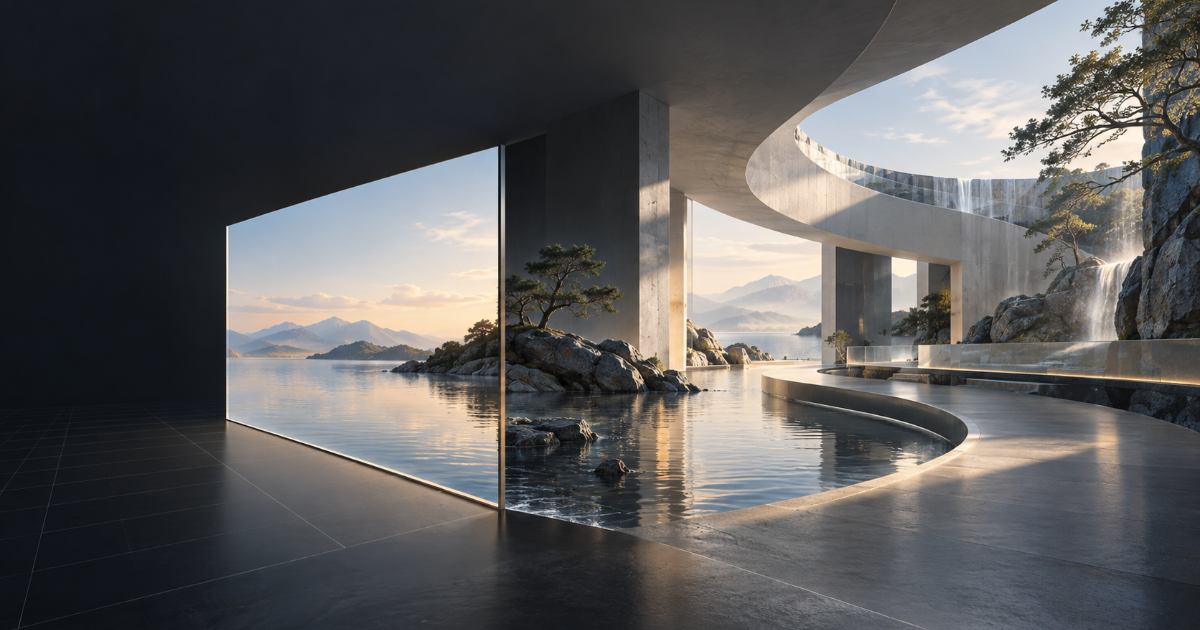
The camera moved sideways from a single source image, revealing a space that had never appeared in the original frame. Buildings and objects remained where they were supposed to be even as the viewpoint changed dramatically. It looked less like a sequence of generated frames and more like a camera moving through a world that already existed.
The model behind the video was Atlas, developed by World Labs.
The first question was an obvious one:
“Can a few words really generate a video like this?”
After reviewing the company’s official materials, the answer turned out to be only partly yes. Atlas can generate images and 360-degree panoramas from text, but the high-quality videos released by World Labs were not created from a single prompt alone.
What makes Atlas interesting lies elsewhere.
The model does not stop at generating a scene. It constructs a space in which a camera can move.
Building the Space Beyond the Frame
World Labs was co-founded by Stanford professor Fei-Fei Li, widely known as one of the pioneers of modern AI. On September 1, 2026, the company introduced Atlas as an “omni world model” that handles text, images, video and 3D within a shared spatial context.
How is a world model different from a conventional video-generation model?
A single image contains only what the camera captured. If a photograph shows the front of a person, their back remains unseen. If a building is photographed from the front, its sides and the surrounding area may not exist anywhere in the source material.
Moving the camera requires all of those missing areas to be created.
This is where generated video often loses consistency. An object may shift position, a building may change shape or something visible in one frame may disappear when the viewpoint changes.
Atlas approaches the problem differently. It places each input image at a specific position within a 3D space and combines those images into a shared spatial context. The model then infers what should exist outside the original frame and generates the views that a moving camera would encounter.
The world continues beyond the edge of the image.
More Than a Prompt: Reference Images and Camera Paths
In the examples released by World Labs, Atlas uses between one and six reference images to produce video from new viewpoints. The creator also defines the camera’s position, angle and trajectory.
The one-minute, 1440p video featured on the official Atlas page was generated from a small number of reference images and a manually designed camera path. A human decided where the camera would begin, how it would move and which parts of the environment it would reveal. Atlas generated the visual sequence along that route.
Describing the result as “a one-minute video made from a few words” leaves out an important part of the process. Text input is available, but Atlas is not defined by prompt length.
Its distinctive feature is camera control.
Existing video models can respond to prompts that mention pans, tilts, dollies and crane movements. Yet a written instruction does not always translate into the intended camera motion. The subject may rotate instead of the camera, or the background may stretch while the viewpoint remains almost unchanged.
Atlas accepts camera positions and trajectories as native spatial inputs. Instead of merely describing a movement in words, the creator can specify the path that the camera should follow.
This suggests a shift away from repeatedly generating clips until one happens to work and toward a process that more closely resembles directing a shot.
How Much of a World Can One Image Create?
Atlas can generate new viewpoints from a single photograph. If the source image shows only the front of a robot, the model can infer its back. If only part of a swimming pool is visible, it can create a plausible surrounding environment outside the frame.
These results should not be mistaken for exact reconstructions of real places. When the source material contains no information about an area, Atlas fills the gap using patterns learned during training.
World Labs explains that adding more input images reduces how much the model needs to imagine. Two or three views may be sufficient for a relatively faithful reconstruction, while more than 100 images can be used when richer spatial context is required.
A world generated from one photograph therefore contains both reconstruction and invention. What was actually present and what the model inferred may appear within the same seamless environment.
That distinction matters for production. In a fictional setting, the model’s ability to invent unseen space can be an advantage. In documentary, archival or location-based work, the same feature requires careful verification.
Beyond Video Output
Atlas does not limit its output to images and video. It can also produce 3D point clouds and 3D Gaussian splats from generated or reconstructed environments.
Those outputs can move into game development, virtual reality, design and visual-effects workflows. World Labs also presents Atlas as a tool for turning recordings of real locations into simulated environments where robots can practice navigation and physical tasks.
Another demonstration uses footage captured with a small number of smartphones to reconstruct an event from viewpoints where no camera was originally placed. The result resembles a bullet-time setup, in which time appears to freeze as the viewpoint moves around the subject.
Producing that kind of shot has traditionally required an array of cameras and specialized equipment. Atlas suggests that similar spatial effects could eventually be created from much lighter capture setups.
Video generation, 3D world creation and simulation are beginning to converge within a single model.
Access and Pricing Remain Undisclosed
Atlas is not currently available as an open service that anyone can sign up for. World Labs says the model is entering early access with select partners and invites interested companies and developers to apply.
The company has not publicly limited access to US businesses. Its official announcement refers only to select partners and does not disclose geographic restrictions or detailed eligibility criteria.
Pricing is also unknown. World Labs has not announced subscription plans or a per-video generation cost.
Generating a one-minute 1440p video while maintaining a coherent 3D environment is likely to require substantial computing resources. That alone, however, does not reveal what customers will eventually pay. The cost of training and operating a model is not the same as the commercial price of a service.
For now, Atlas is best understood as an early-access model whose broader availability and pricing have yet to be announced.
When AI Understands the Camera, What Remains for the Creator?
The most interesting question raised by Atlas is not whether video creators will disappear. It is how their decisions may change.
Even without holding a physical camera, someone still has to choose where the shot begins. What should the audience see first? In which direction should the camera move? Should the environment feel expansive or confined?
AI may generate the world, but it does not automatically determine the most meaningful way to look at it.
The same reference images and model can produce very different results depending on camera height, distance, angle and speed. A low angle can make a subject appear powerful. A slow pullback can reveal the relationship between a person and their surroundings. A rapid push-in may create tension.
What remains is visual grammar.
Much of the discussion around AI video has focused on prompt-writing skills. The direction suggested by Atlas requires something more: an understanding of space and the ability to assign meaning to camera movement.
There are still reasons for caution. The public has seen only demonstrations selected by World Labs. Generation speed, consistency, editing flexibility and production costs will need to be evaluated once the model is used in broader real-world workflows.
The central question, however, is already changing.
It is no longer simply:
“What kind of video can AI generate?”
It may soon become:
“What kind of world should we build, and how should the camera move through it?”
The significance of Atlas is not limited to a collection of visually impressive clips. It points to a broader shift in AI video—from generating isolated scenes to designing spatial environments and directing cameras within them.
As AI begins to create what exists beyond the frame, the creator’s role may be to decide how that world should be seen.