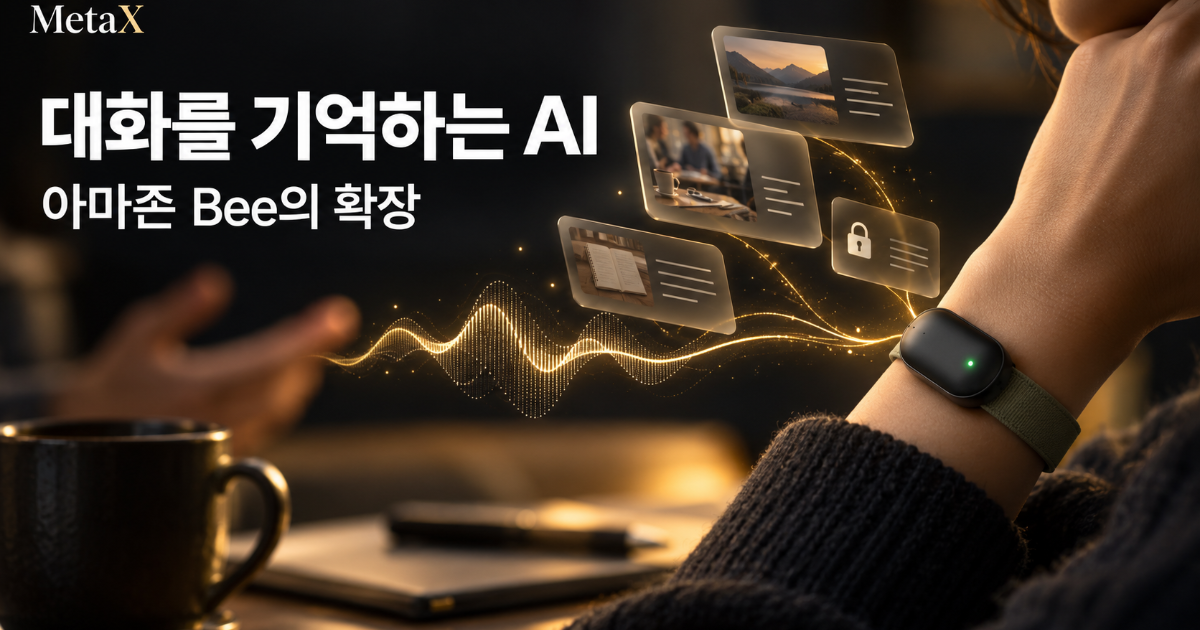
From conversation summaries to suggested tasks and shopping recommendations, personal AI is expanding the scope of digital memory.
People forget commitments made in meetings and struggle to recall the title of a book a friend recommended. Amazon’s personal AI brand, Bee, targets these gaps in everyday memory. Its devices process conversations and organize information that users can revisit later.
On October 15, 2026, Amazon introduced Bee Frontier and Bee Eclipse. A wearable device and a magnetic phone attachment offer different ways to bring conversation-based AI into everyday routines.
The significance extends beyond their physical design. Bee connects information gathered from conversations with other services, including tools for organizing work and recommending products. These capabilities suggest a broader direction for personal AI: helping people act on the context of their lives, alongside answering their questions.
Personal AI on Your Wrist or Phone
Bee Frontier can be worn on the wrist or clipped to clothing. According to its official product information, the $74.99 device features dual microphones, noise filtering, IP67 protection, USB-C charging, and up to seven days of battery life. These are manufacturer specifications; real-world battery performance and transcription accuracy require independent testing.
Bee Eclipse attaches magnetically to the back of a smartphone. Its product page emphasizes processing both sides of phone calls, as well as in-person conversations, to generate summaries and action items when the user activates the device.
Availability differs. Amazon’s announcement lists Frontier as available for $74.99 and Eclipse as coming soon, starting at $99.99. The announcement therefore should not be described as the simultaneous retail release of both devices.
What “Listening All Day” Actually Means
Descriptions of Bee as an AI that listens throughout the day can obscure how its data is handled. Amazon says audio is transcribed and processed in real time, then discarded. The service retains derived information, such as transcripts and summaries, rather than an archive of audio files.
Frontier also provides controls over capture. Users can start and stop processing with a button, while an LED indicates that the device is active. Settings allow the microphones to turn off after a selected period of silence.
Deleting audio, however, does not erase all the information contained in a conversation. Commitments, work details, and relationship information may survive in text or summaries. Assessing these products therefore requires looking beyond whether audio files are stored. What information is generated, how long it remains available, and which services can use it are equally relevant questions.
The Hardware Price Is Only Part of the Cost
Bee’s $74.99 entry price does not include permanent access to every advertised feature. Its basic service includes conversation processing, summaries, and 14 days of history. Longer-term history, suggested to-dos, the desktop application, and integrations with other services are offered through Bee Pro.
Bee Pro costs $11.99 per month or $99.99 per year. New device customers receive a 30-day trial.
The distinction matters when evaluating the product’s value. Users need to identify which features they actually require and whether those features involve recurring charges. A low hardware price alone does not describe the cost of the complete experience.
This structure also illustrates the business model behind personal AI. A physical device creates an ongoing relationship with an AI service. For that relationship to remain worthwhile, the product must deliver repeated practical benefits: retrieving a useful detail, recovering a forgotten commitment, or helping someone decide what to do next. Accumulating records is only the first step toward making them useful.
When Conversation Context Becomes a Shopping Recommendation
Amazon introduced connections that let users ask Alexa+ for Bee summaries and to-dos. An optional Amazon.com connection can also turn items mentioned in conversations into shopping recommendations. Bee’s own website presents shopping suggestions as one application of the insights it gathers.
These features could make an everyday statement—such as mentioning that a household item has run out—a starting point for considering a purchase. Remembering that need may be helpful. How a service selects and presents a recommended product raises a separate question about the experience it creates for the user.
This is an interpretation of the announced integrations, not evidence that Bee uses every conversation for advertising without permission. The documented change is that users can choose connections through which conversational context informs product recommendations.
As these services develop, users will need clear explanations of what information is shared, what a connection enables, and how to disconnect it. Those decisions are part of the product experience, alongside the accuracy of its summaries.
Security Architecture and the Other Person in the Conversation
Amazon says Bee Private Compute processes conversation data in an isolated environment. It describes transcripts and related information as encrypted using keys created and controlled by the user’s device. According to the company, Amazon and Bee cannot access private conversation content unless the user chooses to share it.
These statements describe the company’s published architecture. They should not be treated as a guarantee that every deployment or use case is free of risk.
Security also leaves a separate issue to address: whether everyone in a conversation understands that an AI device is processing their words. The person wearing a device knows it is active; the person across the table may not.
Amazon says Eclipse prompts users to obtain permission from call participants whenever a recording is started. A permission prompt and the process of establishing informed agreement remain distinct considerations.
As personal AI moves closer to daily life, control must become practical and understandable. Choosing when to activate the device, reviewing and deleting generated records, and deciding which services to connect are all central to its usefulness.
Bee’s expansion shows how AI can become an aid to personal memory. Turning that possibility into lasting trust will require making the decisions around remembering just as clear as the technology that makes remembering possible.