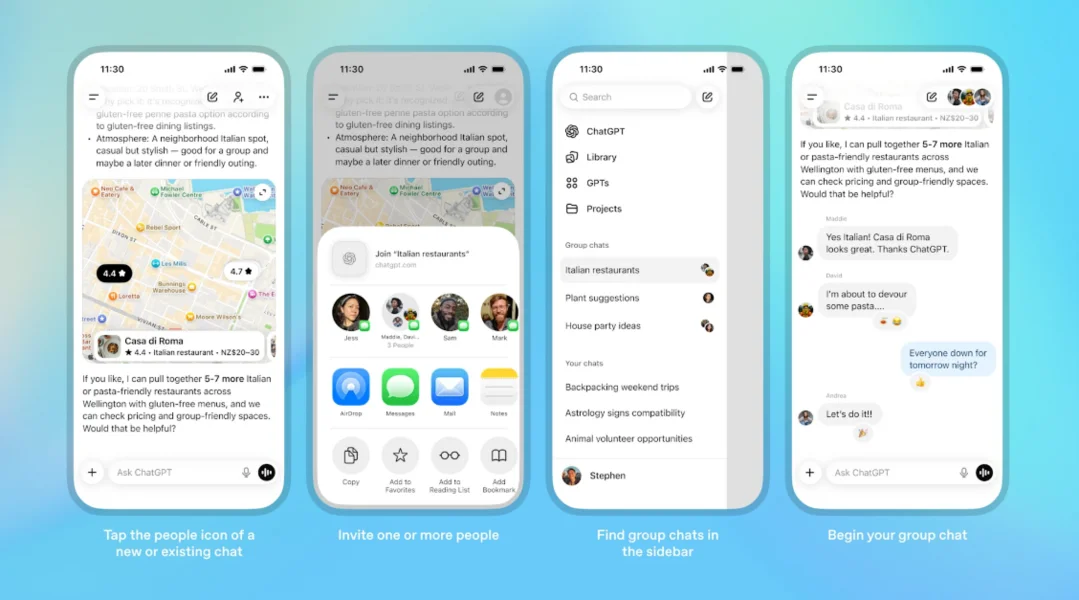
OpenAI has unveiled a new feature "Group Chat," taking the first step in expanding generative AI from a personal assistant into a "collaborative workspace." This update is not a simple convenience feature but signals a structural change where AI enters directly into the communication, decision-making, and collaboration processes between humans.
Key changes: up to 20 people can converse with ChatGPT in one room simultaneously; anyone can join via link invitation; adding people to an existing conversation creates a copy from that point while the original conversation is maintained; mobile and web both supported with initial rollout in Japan, New Zealand, Korea, and Taiwan; open to all Free, Go, Plus, and Pro plans.
Structural implications: (1) AI enters human decision-making processes — when planning travel with friends, brainstorming projects with colleagues, or deciding dinner menus with family, ChatGPT becomes not one person's assistant but a participant in joint decision-making. AI's role shifts from "a tool helping me" to "an entity that organizes, mediates, and proposes in our discussion" — the first signal of an "AI-based collaborative OS." (2) AI as an opinion-provider that may speak instead of humans — OpenAI designed ChatGPT to read conversational context, intervene only when necessary, stay quiet when not needed, and respond immediately when addressed. AI beginning to determine "when to intervene" is a major change toward AI becoming an entity that co-creates conversational norms and order. (3) Personal data is strictly separated — group chats are separated from individual conversations, personal ChatGPT account "memory" is not shared, and group chat conversations are not saved to individual memory. Under-18 users trigger automatic "sensitive content filter" strengthening.
GPT-5.1 Auto serves as the group chat's brain, automatically selecting the optimal model among GPT-5.1, GPT-4.1, or free user models based on user situations. Quota is only deducted when AI answers — people-to-people conversations have unlimited allowance. OpenAI views group chat as "the starting point of Shared Experience technology" — with applications including daily collaboration (travel planning, meal decisions), lifestyle collaboration (roommate interior ideas, couple furniture selection), and workplace/academic collaborative work (report drafts, research organization, meeting summaries). The latter is effectively "mini Slack + AI summarizer + meeting secretary in one form" — interpreted as the first foundation stone for future enterprise product release.