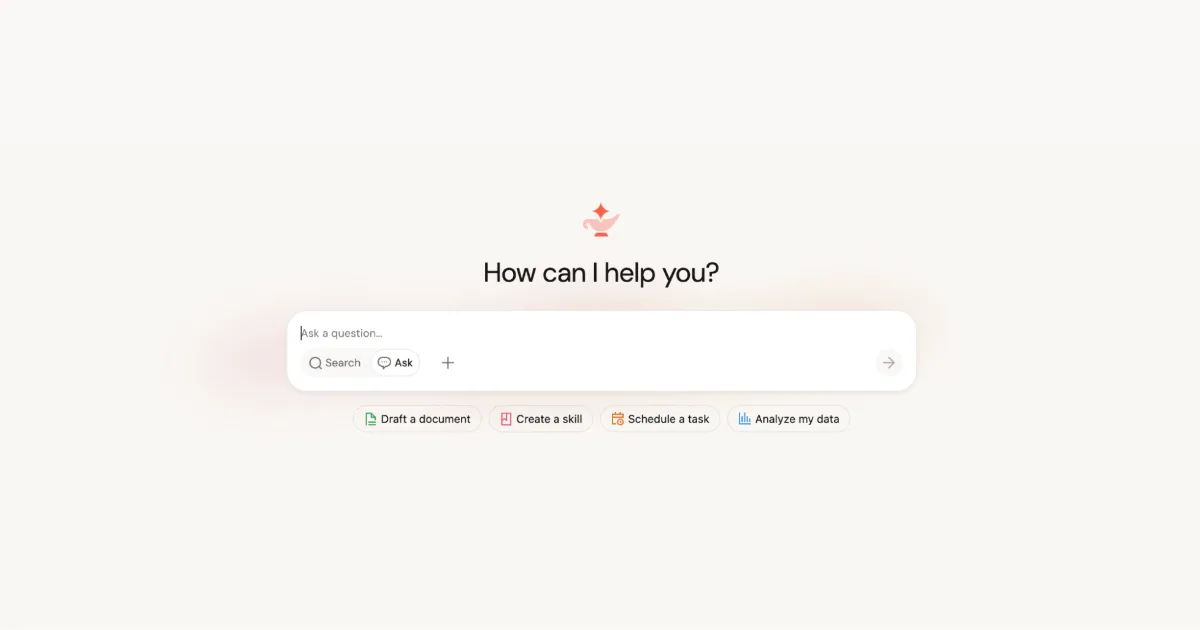
When Databricks introduced Genie One, the most important announcement was not simply the new AI coworker.
The real center of gravity was Genie Ontology.
On the surface, Genie One is an agentic AI product for business teams. Marketing, finance, sales and operations teams can ask questions, generate reports, interact with dashboards and automate work using company data. Databricks describes Genie One as a simplified interface for business users — a single entry point for interacting with data and AI without needing to navigate technical concepts such as compute resources, queries, models or notebooks.
But for that product to work, it needs something deeper.
It needs a layer that connects the scattered context of the enterprise: data, documents, apps, tickets, chats, meetings, dashboards and people.
Databricks calls that layer Genie Ontology.
The business meaning is clear.
Databricks no longer wants to remain only a platform for storing and analyzing data. It wants to move up the stack into the layer that defines how a company understands its own data, which metrics are official, what business concepts mean and how AI should answer and act within that context.
The center of gravity in data-platform competition is shifting.
In the past, the question was where data should be stored, how fast it could be analyzed and how cheaply it could be processed.
Now the question is moving higher.
When AI uses enterprise data, who explains what that data means?
Who standardizes the different metrics and business languages used across departments?
Who connects documents, conversations, tickets, meeting notes and data tables into one living context layer?
Databricks Ontology is aimed directly at that market.
The Enterprise AI Bottleneck Is Not a Lack of Data. It Is a Lack of Meaning.
Enterprises have plenty of data.
They have revenue data, customer data, contract data, inventory data, service logs and product telemetry. Conversations live in Slack and Teams. Tickets live in Jira and ServiceNow. Documents sit in Google Drive and SharePoint. Meeting notes, dashboards, reports and spreadsheets accumulate across the organization.
Yet AI still struggles to use that data well.
The reason is not that data is missing.
It is that meaning is not organized.
The same word can mean different things in different departments. “Revenue” may mean one thing to sales, another to finance and another to product. Booked revenue, recognized revenue, net revenue and usage-based revenue may all matter, but they are not interchangeable.
The same problem applies to active customers, churn, margin, pipeline, conversion rate and net revenue retention.
AI appears to understand words.
But it does not automatically understand the company’s internal meaning system.
When a user asks, “Why did margin fall this quarter?” the AI must know which margin definition to use. Should the answer be broken down by region, product or customer segment? Should discounts be included? Should one-time costs be excluded? Which data source is official?
If those questions are not answered, AI can only produce plausible language.
That is the core of the “context gap” Databricks is trying to solve.
The problem with enterprise AI is not that models cannot speak.
It is that they do not know the company’s language.
Genie Ontology is Databricks’ attempt to solve that problem.
Ontology Is the Enterprise Dictionary of the AI Era
The word “ontology” can sound technical.
But from a business perspective, it is simple.
An ontology is the way a company defines and organizes meaning.
It describes what data means, how metrics relate to business processes, which concepts live in which systems, who owns that information and how different pieces of knowledge connect.
In plain language, it is the enterprise dictionary of the AI era.
But it is not merely a static dictionary.
Databricks’ idea of Genie Ontology is a living context layer. It is meant to draw from Databricks data as well as connected business applications, files, tickets, chats and meetings, so that business knowledge can be continuously extracted, updated and used by AI systems.
That matters because enterprise knowledge is never fixed.
Products change.
Teams reorganize.
Pricing policies shift.
Sales strategies evolve.
KPI definitions are revised.
New data sources are added.
Yesterday’s official knowledge may not be fully correct today.
If AI is going to work inside the enterprise, it must keep up with that changing context.
Genie Ontology is designed to capture this dynamic business context. It connects the company’s data and business language so that AI can use that context when answering questions or performing work.
In the enterprise market, AI advantage may increasingly depend less on the model alone and more on the company-specific meaning layer built around it.
A Strategy to Move Beyond Document-Search AI
Many enterprise AI systems so far have been built around document search.
They vectorize internal documents, retrieve relevant snippets and use those snippets to answer user questions. That approach is useful. It can be deployed quickly. It works well for policy documents, manuals and knowledge bases.
But it has limits in business decision-making.
Documents can be outdated.
Documents often do not contain the latest numbers.
Different documents may define the same metric differently.
A decision made in a meeting may not yet be reflected in a document.
The actual value may live in a database, while the document only describes it.
Databricks is attacking this gap.
The company emphasizes that Genie answers are grounded in the organization’s data and governed through Unity Catalog. Its documentation also describes Genie as a way for users to ask natural-language questions about data and receive answers based on governed enterprise sources.
This is a meaningful distinction.
A business answer should not always be inferred from fragments scattered across documents. In many cases, it should come from curated, permissioned and governed data.
When AI answers “Why did revenue decline?” it must do more than read a report. It must examine actual revenue data, customer segments, regional performance, pricing changes, discount rates, inventory, costs and sales pipeline. It must also follow the metric definitions the company officially uses.
Databricks Ontology is designed to build the link between business metrics and the data that supports them.
That could become an important differentiator in enterprise AI.
A basic retrieval-based chatbot may remain a tool for finding internal documents.
An ontology-based AI system can become a layer that understands the company’s actual data model and business meaning.
Databricks Is Not Really Chasing the Chatbot Market
To view Genie One only as a chatbot product is to underestimate the strategy.
Databricks is aiming at a much larger market.
It is targeting control over the enterprise meaning system.
Companies will use many AI tools. They may use Microsoft Copilot, ChatGPT Enterprise, Salesforce Agentforce, Google Gemini, internal models and open-source models. Each tool may offer a different interface and a different model.
But all of them need something in common.
They need official enterprise data and context.
Which customers matter most?
How is revenue calculated?
Which data explains margin changes?
How are sales pipeline stages defined?
Which document is current?
Who has permission to access which information?
The company that controls this context layer can remain central even if models change.
That is where Databricks wants to stand.
AI applications can change.
Models can change.
But the enterprise meaning system and governance layer are far harder to replace.
If Databricks Ontology begins to define a company’s metrics, data relationships and business context, Databricks becomes more than a data platform.
It becomes a reference point for enterprise AI.
That is the real market impact.
The Front Line With Snowflake, Microsoft and Salesforce Is Changing
The rise of Databricks Ontology changes the competitive map.
Databricks’ most obvious historical rival has been Snowflake. Both companies compete in data infrastructure: lakehouse, data warehouse, data cloud, governance and analytics performance.
But once ontology becomes central, the competitive field expands.
Microsoft is trying to control work context through Microsoft 365, Teams, Outlook, SharePoint, Fabric and Copilot.
Salesforce is trying to control customer and sales context through CRM and Agentforce.
ServiceNow controls ticketing and workflow context.
Google connects Workspace, BigQuery and Gemini.
Snowflake is strengthening its AI data layer through Cortex and its data cloud.
The question is no longer only who stores the most data.
The question is who models the meaning of enterprise work most accurately.
Databricks Ontology is a declaration that Databricks wants to compete in this context-platform war.
It does not want to manage only data tables.
It wants to manage what those data tables mean in business terms.
That is also a challenge to Microsoft and Salesforce.
Microsoft is strong in documents and collaboration context. Salesforce is strong in customer and sales context. Databricks is strong in data and governance. Ontology is its attempt to use that strength to pull context from other business applications into its own platform.
Enterprise AI is becoming a competition among context platforms.
Three Changes in the Enterprise AI Feature Market
If Databricks Ontology spreads, the enterprise AI feature market will change in at least three ways.
First, simple chatbot functionality will lose value.
Many enterprise AI products still emphasize natural-language Q&A. But the ability to answer a question is becoming common. The important question is no longer whether the AI can answer.
It is whether the AI answers from the right context, based on official data, under the right permissions.
The chatbot interface becomes commoditized.
The context layer behind it becomes the differentiator.
Second, data governance and AI governance merge.
Historically, data governance focused on quality, catalogs, access controls and lineage. AI governance focused on model use, prompts, security, cost and output validation.
Ontology makes those categories harder to separate.
For AI to answer correctly, it must know data definitions, permissions and metric meanings. That means AI governance must operate on top of data governance.
This is why Databricks emphasizes Genie alongside Unity Catalog.
Third, workflow automation may be absorbed into the data platform.
Genie Agents and Genie App Builder are not minor add-ons. They allow teams to create repeatable agents and internal applications on top of an ontology-driven context layer. That overlaps with no-code, low-code, BI, workflow automation and internal-tool markets.
A business user may eventually say:
“Using this metric definition, create a weekly report, alert me when there is an anomaly and update the related customer list.”
Databricks wants to handle that chain from data query to report generation, app creation, alerting and action.
If that happens, market boundaries blur.
BI, data catalog, AI chatbot, workflow automation and app builder markets could be pulled into a single ontology-based enterprise AI platform.
Ontology Can Become an Enterprise Lock-In Mechanism
Databricks Ontology can create real value for customers.
It can also become a powerful lock-in mechanism.
Moving data storage is already difficult.
Moving meaning is even harder.
If a company’s metric definitions, data relationships, business rules, reusable agents, internal applications, permission structures, alerts and report formats are built on Databricks Ontology, the switching cost rises dramatically.
That is strategically attractive for Databricks.
Using Databricks as a place to store and analyze data is one thing.
Using Databricks as the system that defines the company’s official context is another.
In the second case, Databricks becomes a core system for enterprise AI operations.
Customers must be careful.
The stronger the ontology, the more important transparency and portability become.
Can metric definitions be exported?
Can the ontology interoperate with other systems?
Can permissions and lineage be audited?
Does the company remain model-neutral?
How will costs grow as usage increases?
The core question in enterprise AI infrastructure is not only convenience.
It is who receives control.
Korean Companies Should Rethink Internal AI Chatbots
Databricks Ontology has important implications for Korean enterprises.
Many companies are building internal AI chatbots. They want services that can search policy documents, summarize reports, answer employee questions and query company data.
But the same problems appear again and again.
Data is scattered.
Metric definitions are inconsistent.
Official data conflicts with personal spreadsheets.
Documents are outdated.
Meeting decisions are not reflected in systems.
Permissions are complicated.
It is hard to explain the basis of an AI answer.
If a chatbot is built on top of that environment, it may look useful at first. But the limits appear quickly. The AI gives wrong answers, lacks evidence, contradicts another department’s answer or creates security concerns.
The message of Databricks Ontology is clear.
Do not build the AI chatbot first.
Organize the company’s meaning system first.
Korean enterprises need to standardize key metrics, define authoritative data sources, clarify data ownership and access rights, and connect business context from documents and meetings to the data model.
Only then can AI give answers the company can recognize as legitimate.
Consulting and SI Markets Will Also Change
If ontology-based AI becomes common, consulting and systems-integration markets will also change.
Many enterprise AI projects today focus on model adoption, chatbot construction, retrieval-augmented generation, data pipelines and cloud infrastructure.
An ontology-centered approach changes the core work.
Companies must define metrics.
They must model business processes and data relationships.
They must reconcile terminology differences across departments.
They must distinguish official data from informal knowledge.
They must design the scope of authority and responsibility for AI actions.
This is not simply a development project.
It combines business consulting, data governance, organizational change management and AI operations policy.
That means systems integrators and consulting firms cannot compete only by connecting models to data.
They must help customers structure their business language and data meaning.
The high-value area of AI implementation may not be prompt engineering.
It may be ontology design.
The Risk: Who Defines the Company’s Official Context?
Ontology is powerful.
But it is also political.
Deciding which metric definition is official is not merely a technical task. Departments have different incentives. Sales and finance may disagree on revenue. Product and marketing may define active users differently. Executives may track one KPI while operations teams rely on another.
To build an ontology, someone must decide.
Who defines the official metric?
Which department’s data is authoritative?
How are alternative interpretations preserved?
Which viewpoint does AI use by default?
Who fixes the ontology when it is wrong?
Without answers to those questions, ontology can become another source of confusion.
If AI uses an incorrect official context, the error becomes stronger. In the past, people may have known that different departments had different numbers. But if AI confidently provides one answer, that answer can harden into organizational fact.
Ontology-based AI therefore requires strong governance.
Automatic extraction is not enough.
Human review, data ownership, metric approval, change management and audit logs are essential.
Databricks Ontology Turns Enterprise AI Into a Context Competition
The launch of Genie Ontology is an important signal for the enterprise AI market.
The value of AI products is no longer only the ability to answer questions.
The more important issue is whether AI understands what company data means, whether that meaning stays current and whether AI can act within permissions and governance.
Databricks is trying to build a business context layer on top of its data platform.
If that layer works, Genie One becomes more than an AI chatbot. It becomes an AI coworker that understands official company data and acts on business meaning. Genie Agents and Genie App Builder can then create repeatable workflows and internal applications on top of that context.
The market implications are clear.
Simple retrieval chatbots lose differentiation.
Data governance and AI governance converge.
BI, workflow automation and app-builder markets may be pulled into the data platform.
Consulting and SI firms will need ontology-design capability.
Companies must organize their metrics and business meanings before adopting AI at scale.
Databricks Ontology is not just a technical feature.
It is a new battlefield in enterprise AI.
Who defines the company’s official context?
Who connects the meaning of its data?
Who provides the knowledge base that AI can trust and act upon?
AI models may continue to change.
But a platform that controls the enterprise meaning system is much harder to replace.
That is the position Databricks is targeting with Genie Ontology.