Age has long been a sensitive subject in the game industry. It is no longer unusual to see developers approaching forty wondering how much longer they can continue working in this field. The idea that making games is a young person’s job has settled into industry common sense without much scrutiny, and growing older has come to be treated less as the accumulation of experience than as a possible weakening of competitiveness.
Yet the actual changes taking place in the industry are more complicated than this assumption suggests. The game industry is no longer a young sector driven only by short bursts of passion and quick instincts. Projects have grown larger, development cycles have become longer, and long-term judgment now matters more than ever, including post-launch operations and continuous updates. As a result, the experience of people who have worked in the industry for many years has been accumulating, and the presence of mid-career and older developers is becoming more visible in major overseas game companies and developer surveys. As an industry matures, it is only natural that the people working within it age as well.
The question, then, is not simply whether the game industry is getting older. The more important question is how that aging is being understood and handled. A rise in the average age of an industry can mean that experience, organizational memory, lessons from failure, and the instincts needed for long-term operation are being accumulated. On the other hand, it can also be treated only as a matter of higher labor costs, stalled promotions, generational gaps, or failed reskilling. Even when the same word, aging, is used, whether it becomes a source of industrial depth or an organizational burden depends on the structure around it.
This question is especially important for the Korean game industry. For a long time, Korea’s game industry was seen as a symbolic field of youth employment. It carried the image of a fast-growing industry entered by younger generations familiar with information technology, and driven by late nights, speed, immersion, and passion. In fact, many of those who entered the field during the explosive growth of the 2000s were in their twenties at the time. The problem is that the working methods and organizational culture formed during that period have remained, for a long time, the industry’s default setting.
That generation has now become the industry’s mid-career workforce, and the industry itself can no longer be explained by youth alone. At the same time, the entry of new generations no longer seems as natural as it once did. The game industry, once seen as a symbol of youth, now quietly faces a different set of questions. Is it still an industry where young workers can enter and stay for the long term? Does it have a structure that can turn the experience of older workers into an asset? And although revenue and market size have grown, have the working lives of the people inside the industry grown longer as well?
Aging itself is not a sign of decline
The longer an industry survives, the less simple its age structure becomes. In fields that have continued across more than one generation, such as architecture or film, the instincts of newcomers, the judgment of mid-career professionals, and the insight of those who have worked for decades coexist in different layers. For an industry to continue does not simply mean that its market remains alive. It also means that people within it can continue working as they age, and that this time can accumulate as the industry’s memory.

This diversity of age has practical value, not just emotional value. The ability to avoid repeating the same failures, to sense where a project is likely to falter, and to judge not only the speed but also the order of decision-making usually comes with time. This is especially true in the game industry, where development cycles are long and service periods after launch are often even longer. In a structure where a single title is built over several years and then operated and revised for several more, the judgment of people who have lived through long projects can have a significant effect on stability.
For that reason, the presence of more older workers does not, by itself, tell us whether an industry is healthy or stagnant. What matters is what that aging means inside the organization. If experienced workers’ knowledge is passed on to the next generation, if memories of failure are translated into better development practices, and if people who have worked for a long time help newer workers grow, aging can be closer to maturity than decline. But if that experience does not remain within the organization and is treated only as cost or managerial burden, the same aging can lead to very different results.
Industries where people stay, and industries where people scatter
Whether aging becomes a strength or a burden for an industry depends on one difference: are people aging because they have stayed for a long time, or is the average age rising because fewer new people are entering? The contrast between Japan and North America shows this difference relatively clearly.
Japan’s game industry is closer to a pattern of aging created by people who stay. Nintendo, for example, disclosed in its 2025 annual report that the average age of employees at its headquarters was 40.2, with an average length of service of 14.4 years. Nintendo’s separately published CSR and ESG data sheet also shows that turnover in Japan remains low, at 1.9 percent. Although Nintendo is only one company, these figures can be read as a symbolic indicator of the long-term employment culture found in parts of Japan’s game industry.
These figures also align with the broader characteristics of Japan’s labor market. According to material from the Japan Institute for Labour Policy and Training introducing the National Tax Agency’s 2024 statistical survey of private-sector salaries, the average length of service among private-sector salaried workers employed throughout the year was 12.6 years. In other words, staying at one workplace for a long time remains a relatively familiar part of Japan’s labor culture, and game development may have been able to take root within that environment as a long-term profession.
In this kind of environment, experienced workers are not simply “older employees.” Development know-how can accumulate inside the organization, past trial and error can become a reference point for the next project, and intergenerational transfer can return as higher product quality. Of course, long tenure does not automatically guarantee creativity. Organizations where people stay for a long time can also become more vulnerable to inertia. Even so, the important point is that this form of aging is at least oriented toward the accumulation of experience.
The picture in North America is different. According to The Economics Daily, published by the U.S. Bureau of Labor Statistics in October 2024, the median tenure of U.S. wage and salary workers with their current employer was 3.9 years as of January 2024. Japan’s figure refers to average tenure, while the U.S. figure refers to median tenure, so the two numbers cannot be compared one-to-one. Still, the data suggests that workers in the U.S. labor market tend to stay with a single employer for a relatively shorter period. In the game industry, this is further shaped by project-based mobility and studio restructuring. When a title is completed, teams may disperse. When a company changes its investment priorities, projects may be canceled. Developers’ careers can also be interrupted or redirected along the way.
The large-scale layoffs of recent years have made this instability more visible. The 2023 Developer Satisfaction Survey, published by the International Game Developers Association, IGDA, and Western University, reported that around 10,500 game workers lost their jobs through layoffs in 2023, and that 4.8 percent of respondents were unemployed in the industry at the time of the survey. Since the survey was based on 777 self-reported responses, it should not be treated as fully representative of the entire industry. Even so, it is meaningful as a sign that the continuity of careers was shaken as the game industry, after expanding rapidly during the pandemic, entered a period of adjustment.
Both cases share the broad result of an aging workforce structure. But the forces behind that result are different. If Japan’s pattern is closer to accumulation-based aging, where people remain and experience builds over time, North America’s pattern is closer to mobility-based aging, where careers thicken across movement, layoffs, and project-based reorganization. In one case, time remains inside the organization. In the other, people continue moving through the industry.
Korea’s aging has a different character
The starting point for understanding the workforce structure of Korea’s game industry is something of a paradox. The industry is not aging because the workforce is shrinking. Rather, the age structure is shifting upward even as the size of the workforce grows again.
The number of people who actually make games, in other words those employed in game development and publishing, has recovered in recent years. According to the Korea Game White Paper, the number of workers in game development and publishing rose to around 52,000 in 2012, fell to around 34,000 in 2016, and then increased again to around 54,000 in 2024. Compared with the low point, that is an increase of more than 60 percent.
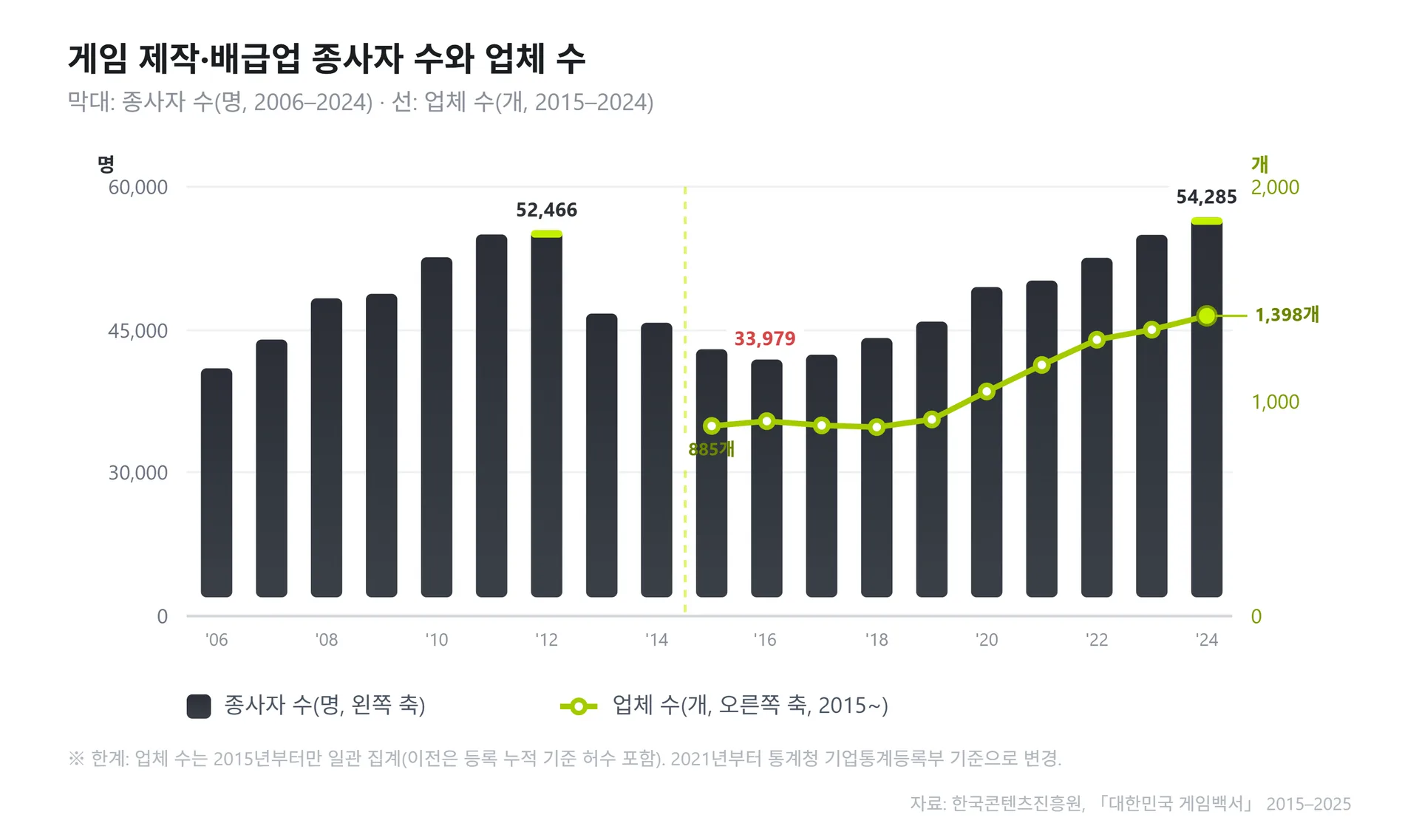
This makes it difficult to explain the aging of Korea’s game industry simply as an unavoidable consequence of a shrinking workforce.
The more important question is which age groups filled those newly added positions. Looking at the age composition of development workers, the share of those aged 29 or younger declined from 27.3 percent in 2014 to 13.2 percent in 2024. During the pandemic period of 2019 and 2020, it briefly rebounded to the low 20-percent range. But it then fell again, to 16.9 percent in 2022, 15.9 percent in 2023, and 13.2 percent in 2024. By contrast, the share of workers aged 35 to 39 rose from 22.6 percent to 34.5 percent over the same period, making it the largest age group within the development workforce.
What stands out in this trend is that the change cannot be explained simply as a sharp increase in older workers. The share of workers aged 50 or older remained in the 5 to 7 percent range throughout the survey period. In other words, the upper end of the age structure did not suddenly become much thicker. Rather, the space once occupied by workers in their twenties appears to have been filled by workers in their late thirties, gradually shifting the center of gravity of the workforce upward.
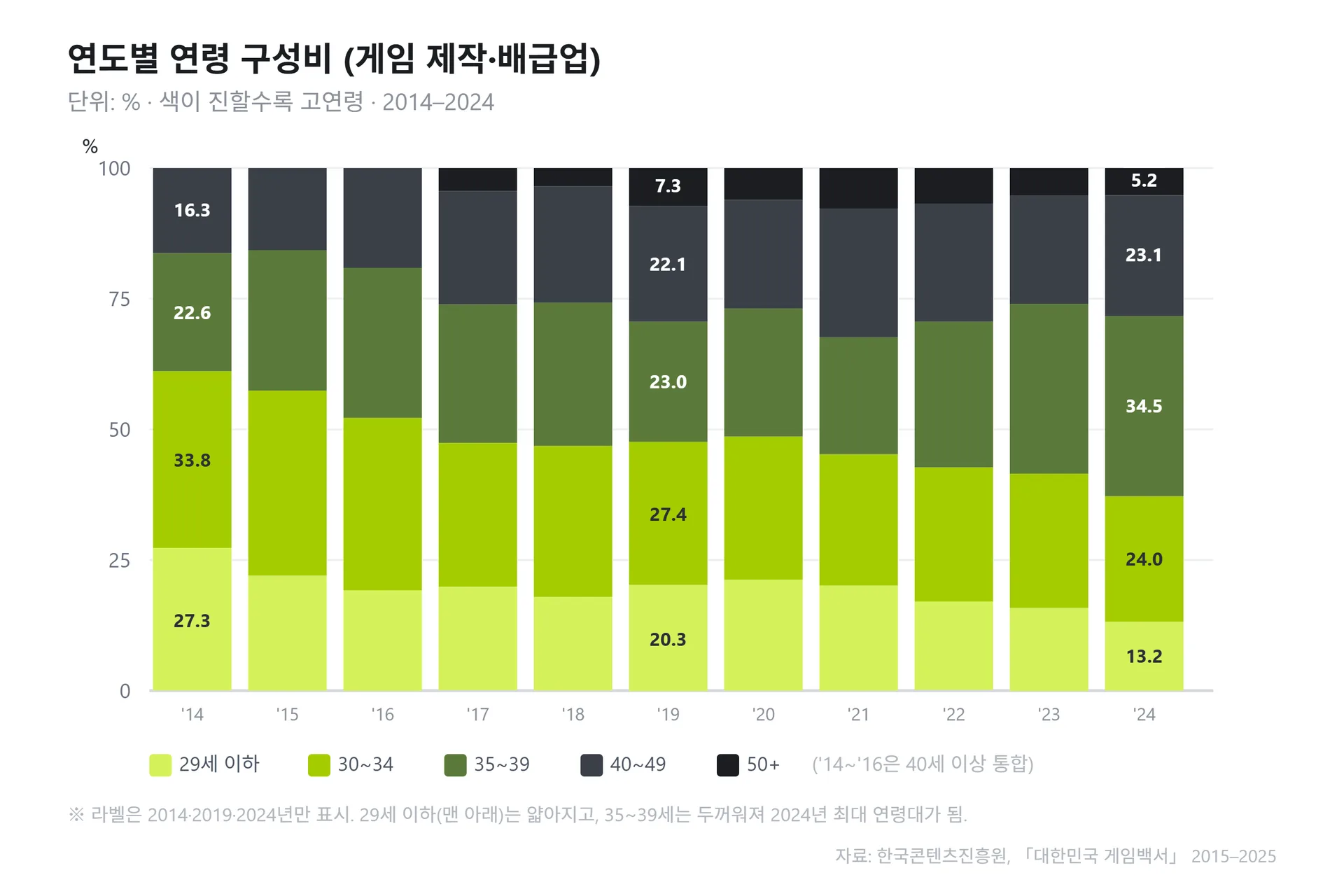
This is different from Japan, where people tend to age while remaining within the same organization, and also different from North America, where layoffs and mobility can leave certain cohorts relatively thicker. Korea is aging in a way that expands the overall workforce while filling much of that expansion through workers in their thirties and older.
What increased was not only people, but companies
If the workforce has grown, why has the share of young workers fallen? One clue lies not only in the number of workers, but also in the number of companies.
During the same period, the number of game development and publishing companies grew even faster than the number of workers. According to the Korea Game White Paper, the number of development and publishing companies increased from 885 in 2015 to 1,398 in 2024. That is about 1.6 times larger over nine years. The number of workers also grew, but because the number of companies increased more quickly, the average number of workers per company moved downward. The industry’s total workforce grew, but that workforce was spread across a larger number of companies, many of them smaller in scale.
This change is also connected to the issue of youth entry. According to the White Paper’s age data by company size, the smaller the company, the lower the share of workers aged 29 or younger. Among companies with 5 to 9 employees, the share of workers aged 29 or younger fell from 22.1 percent in 2016 to 15.5 percent in 2024. Among companies with fewer than 5 employees, it declined from 10.1 percent to 4.2 percent over the same period. In companies of the smallest size, workers aged 29 or younger remain very rare.
The important point here is not company size itself. It is that when industry growth takes place through the spread of smaller companies, the function of accepting and training newcomers can become relatively weaker.
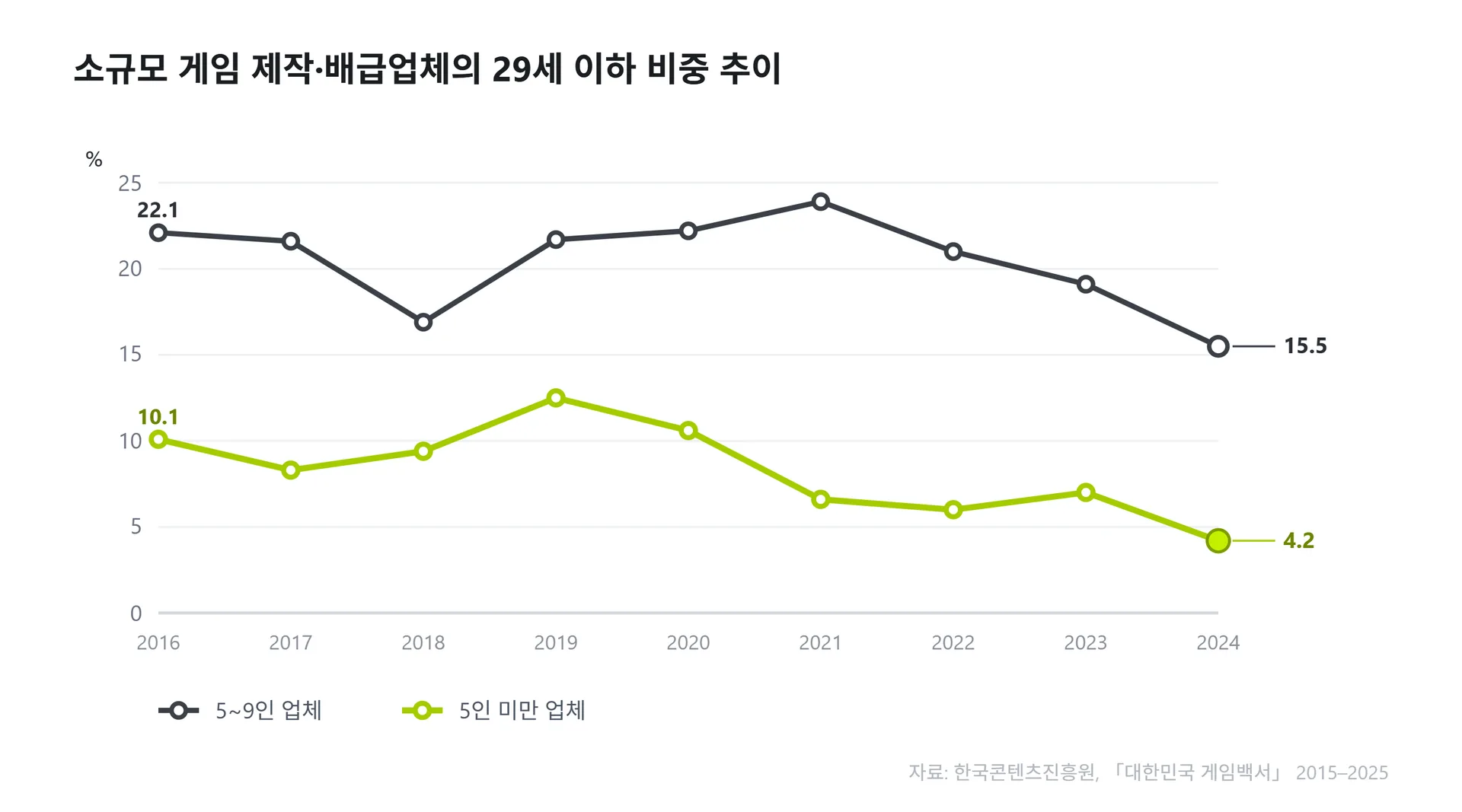
The reason cannot be stated with certainty, but the structure is not hard to infer. The smaller a company is, the more limited its capacity tends to be for hiring newcomers and training them over a long period of time. In small organizations that must keep projects moving immediately, experienced workers who can take on their roles right away are often more urgently needed than beginners who must be trained from the start. As the industry grows through a larger number of smaller organizations, the path through which newcomers enter, learn, and develop into mid-career professionals can become narrower. Even if the total number of workers grows, if that growth comes through the expansion of small companies, the share available to younger workers may not grow as much as expected.
Of course, this interpretation requires caution. Since 2021, the counting of companies has been based on Statistics Korea’s business register, so differences in statistical methodology must be considered when comparing figures before and after that point. Some of the increase in the number of companies may reflect changes in counting methods rather than actual growth in new businesses. Even so, the decline in workers per company and the especially low share of young workers in small companies are trends that appear repeatedly across multiple years.
A shift in the center of gravity, not diversification
Taken together, the aging of Korea’s game industry is somewhat different from a diversification in which age groups spread out evenly. The industry’s workforce has grown, but much of that growth has been filled by workers in their thirties and older. At the same time, many of the companies that increased in number were smaller firms that may find it difficult to hire and train newcomers in sufficient numbers. As a result, the center of gravity of the development workforce has shifted toward the late thirties, while the lower layer once occupied by workers in their twenties has become relatively thinner.
A common counterargument arises here. Games are highly sensitive to trends, and youthful sensibility itself can be a real source of competitiveness. There is some truth to this. Games need to respond quickly to changing user tastes, and sensitivity to new platforms and new forms of play matters. But saying that youth matters does not mean that older workers are less necessary. The issue is not age itself, but whether the sensibilities and experiences of different age groups can work together.
A mature industry needs both new instincts and accumulated judgment. Younger workers bring unfamiliar tastes and new forms of change, while experienced workers can sense where a project may begin to falter and carry forward organizational memory. If only one side remains, the industry can easily lose balance. What Korea’s game industry should pay closer attention to is not the mere fact that older workers are increasing, but whether the entry and growth of the younger layer that will form the next generation are being sufficiently supported.
The cost of this divide
Changes in the age structure are not confined to production sites. Similar signals can also be seen on the user side. The digital environment itself continues to expand. According to the 2024 Survey on Internet Usage, conducted by the Ministry of Science and ICT and the National Information Society Agency, the internet usage rate among people aged three and older reached 94.5 percent in 2024. In effect, most of the population is already connected online.
Game usage, however, did not move in the same direction. According to the 2024 Survey on Game Users, 59.9 percent of respondents said they had played games in the past year. The game usage rate had risen to 74.4 percent in 2022, but fell to 62.9 percent in 2023. In 2024, it dropped below 60 percent for the first time since the survey began.
These two indicators should not be tied together as a simple cause-and-effect relationship. The drop in game usage may involve several factors, including changes in daily life after COVID-19, the spread of alternative forms of leisure such as online video services, and fatigue with certain genres. Even so, the fact that these two movements are appearing around the same time is worth noting. On the production side, the inflow of younger workers is thinning. On the user side, overall game usage is falling. The digital base has expanded, but if games no longer capture that expanded time and attention as naturally as before, the industry may find that the channels through which new sensibilities enter, both internally and externally, are weakening.
At this point, the contrast with Japan becomes meaningful again. In a structure where long-staying workers support continuity in development, the know-how accumulated by one generation can become the starting point for the next. By contrast, in a structure where youth entry weakens and mid-career movement or departure is frequent, experience remains inside organizations for a shorter time. When that happens, similar trial and error can repeat whenever projects change, and organizations may spend energy relearning what they had already learned.
The issue is not aging, but how the industry ages
The answer to the question of whether game companies are allowed to age is simple. Aging itself is not the problem. In an industry that has survived for a long time, a rise in the average age of its workers is natural, and the experience of people who have worked for many years is an asset the industry should preserve. The problem is not the fact of aging, but the structure within which that aging takes place.
If young workers continue to enter, mid-career workers form the core, and long-serving workers pass their judgment and memory on to the next generation, aging can become another name for maturity. But if the workforce grows without being sufficiently filled by younger generations, and if the companies that increase in number do not have enough capacity to train young workers, the same aging carries a very different meaning. It becomes less a diversification of age and more a shift in the industry’s center of gravity, narrowing the space where the next generation can stand.
This distinction goes beyond the personnel policies of individual companies. It is tied to the sustainability of the industry as a whole. Hiring newcomers is not simply about increasing the number of jobs. It is an indicator of whether the industry can continue producing its next generation of workers by itself. For a while, the industry may be able to rely on skilled workers already in place. But if the inflow remains weak for too long, there may eventually be too few people to inherit that skill. If the total workforce grows while younger generations do not enter at a similar pace, the question of whether the game industry remains an attractive point of entry for new talent will become increasingly important.
What deserves concern, then, is not an industry that ages. It is an industry that ages while old experience and young sensibility fail to flow together. It is natural for game companies to grow older. But whether that aging becomes an accumulation of experience or another name for generational disconnection will depend greatly on the structures now being formed.
Companies and industries are allowed to age.
What matters is whether that time carries the next generation along with it.