Game technology and defense are moving closer together. Krafton and Hanwha Aerospace are pursuing joint R&D and the establishment of a joint venture in the field of physical AI, while NC AI and Hyundai Rotem are connected through a national defense physical AI project involving world models, digital twin simulators, and modular robotic systems.
At first glance, this may look like a new expansion of game technology. After all, the virtual environment development, real-time simulation, AI, 3D generation, and UI/UX capabilities accumulated by game companies are moving into defense and robotics. Games originally built fictional worlds, but the technologies that make those worlds function can also be used as infrastructure for training and validating reality.
However, it is not enough to describe this shift simply as “game technology moving into defense.” The more important change is not the movement of the technology itself, but the industrial logic of the field it enters. Game technology can connect with defense. But once it enters defense, it no longer operates only by the rules of the game industry. It is redefined within contracts, cost structures, verification, security, intellectual property, export controls, and responsibility structures.
This is the key point to watch. The more important question is not whether game companies can enter defense, but how the technologies they possess can operate within defense, an entirely different institutional industry.
Games and Defense Move at Different Speeds
The game industry moves quickly. It builds, launches, fixes, and updates. It adjusts balance based on user reactions, adds content, and changes direction during live operation. In live-service games, the ability to keep improving a service often matters more than releasing a finished product once.
Defense is different. Defense prioritizes verification over rapid iteration. It is connected to real equipment, national security, and operational risks that can have serious consequences. A faulty feature in a game can be fixed with a patch, but an unverified function in a defense system does not end as a simple error.
That is why the difference between the game industry and the defense industry appears first not in technological capability, but in their sense of time. Games are built quickly, tested through user response, and improved along the way. Defense moves through long reviews, procedures, and documented responsibility. When game companies collaborate with defense, the first barrier they face is not a lack of technology, but the difference in speed and verification methods.
If this difference is not understood, the expansion of game technology into defense can easily be overstated. The important point is not that game companies are making weapons. It is that their virtual environment and AI software capabilities are being combined with defense companies, manufacturing infrastructure, and national R&D systems.
Krafton and Hanwha Aerospace: Combining Software with Physical Infrastructure
The collaboration between Krafton and Hanwha Aerospace shows how game technology and defense infrastructure can be connected. The two companies announced a partnership to jointly develop core physical AI technologies, review demonstration and application scenarios, and gradually build related technologies and operating systems. They also plan to establish a joint venture for physical AI.

What matters in this collaboration is the combination of roles. Krafton has strengths in game development, AI research, and software development. Hanwha Aerospace has physical industrial foundations in defense, manufacturing, and unmanned systems. One side is strong in virtual environments and AI software, while the other is strong in real-world equipment and defense infrastructure.
This case, therefore, does not mean that a game company is transforming into a defense company. It is closer to a model in which the virtual world-building capabilities and AI technologies accumulated by a game company are combined with the physical infrastructure of a defense company. Here, game technology is not read as content production technology, but as foundational technology for training and validating physical AI.
NC AI and Hyundai Rotem: How Game AI Enters Defense Simulation
The case of NC AI and Hyundai Rotem more directly shows how game-based AI technology can connect to defense simulation. Hyundai Rotem announced that it had been selected as the final contractor for unmanned robot-related national R&D projects commissioned by the Ministry of Trade, Industry and Energy and the Agency for Defense Development. The core areas include a natural language command-based integrated control system for heterogeneous and multiple robots, as well as a physical AI-based integrated simulator and modular robotic system.
Among these, the Agency for Defense Development project involves developing a digital twin simulator and modular unmanned robot platform that can verify the performance of unmanned robots in a virtual environment modeled after reality. The structure allows various environments and mission conditions to be repeatedly tested in simulation before real equipment is deployed.
NC AI’s role makes this trend readable from the perspective of the game industry. NC AI has developed technologies such as VARCO 3D, which can generate and modify 3D assets based on text or images. Capabilities in 3D generation, virtual environment construction, and AI modeling can be connected to the creation of virtual environments where robots can learn and be validated.
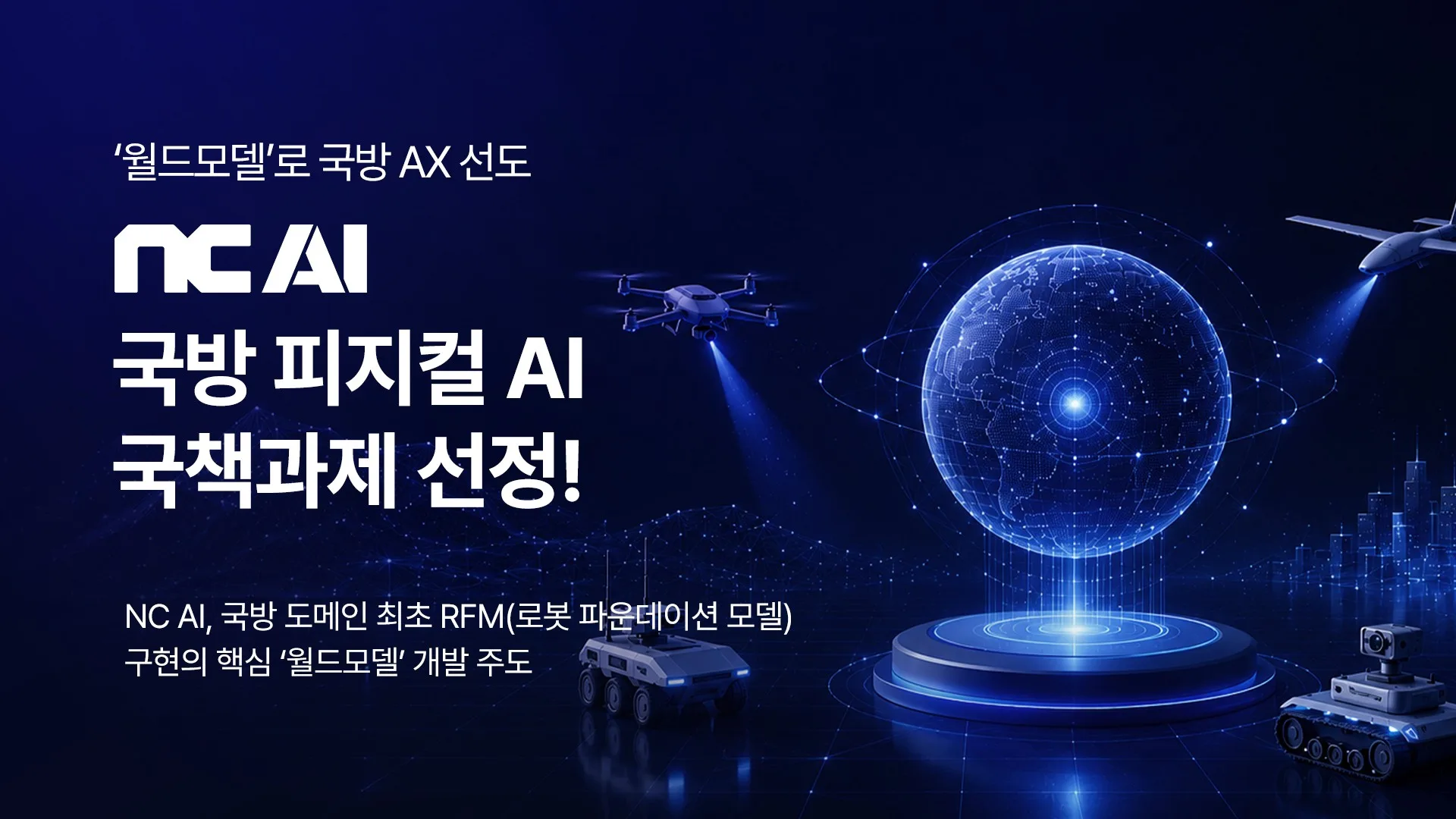
This case also does not mean that a game company is directly producing defense equipment. More precisely, it is a case in which game-based AI and virtual world-building technologies are expanding into learning and validation environments for unmanned robots. The 3D virtual environments, simulations, and synthetic data technologies accumulated in games are being repositioned as a foundation for training real-world robots and defense platforms.
However, just because technologies can be connected does not mean that the logic of the industry transfers as it is. The game industry is accustomed to building quickly, launching, fixing after release, and continuing operation based on user response. Defense, by contrast, operates within verification, contracts, security, responsibility, and national procurement systems.
Therefore, when game technology meets defense, the important issue is not only technological potential. It is also necessary to examine what contractual structure the technology is developed under, who owns the results, and how far the data and software can be used. At this point, the differences between the game industry and the defense industry begin to emerge more clearly.
The Logic of Revenue Changes
When a game company meets defense, the first thing that changes is the logic of revenue.
The game industry generates revenue through IP, live services, updates, item sales, platform expansion, and fandom operations. A successful game continues to be updated after release, and new content and business models can be designed in response to user reactions and market conditions. In the game industry, revenue depends heavily on the longevity of content and the ability to operate it.
Defense is different. Defense materials and national defense R&D operate within national budgets, procurement systems, cost estimation, and contract settlement structures. Rather than prices and profits increasing simply because a product sells well in the market, contracts, costs, appropriate margins, settlement procedures, and government review become important.
Another difference lies in how outputs are viewed. In the game industry, technology becomes a living asset that continues to operate alongside the service. Even after launch, updates, events, balance adjustments, and new content sustain revenue and user experience. In defense R&D, however, the goals of a specific project, deliverables, acceptance criteria, and operating conditions become more important. The key question is not only whether good technology was created, but whether it satisfies the performance and conditions required by the contract.
This difference is significant for game companies. In the game industry, it is natural to create good content, receive user response, and expand through operation. In defense, however, making good technology is not enough. A company must also be able to explain what cost structure the technology was developed under, how it was verified, and under what conditions it will be delivered and settled.
Entering defense may open a new market, but it also means moving away from the monetization methods familiar to game companies. In this field, understanding contract structures becomes as important as technical capability.
The Logic of IP Also Changes
The second difference concerns IP and development outcomes.
For game companies, IP is the starting point of business. Characters, worlds, engines, art resources, data, and service operation know-how all become long-term assets. A single game IP can expand into sequels, animation, merchandise, esports, communities, and collaborations. In the game industry, IP is not merely an output. It is the core axis that drives the entire business.
In national defense R&D, however, the ownership and use of outputs operate differently. The outcomes of defense R&D are connected to national security, the burden of R&D funding, contract terms, and whether joint ownership is permitted. Under certain conditions, research institutions or companies may jointly own intellectual property rights, but even then, ownership is determined within a contractual structure different from ordinary game IP operations.
This difference raises important questions for game companies. Who owns the simulator, AI model, dataset, 3D environment, or control software created through a defense collaboration? Can it be reused in civilian markets? Can it expand into follow-up businesses? Can it be reused in other projects?
In the game industry, technologies and resources created once often become the foundation for future projects. Character production pipelines, 3D assets, AI tools, and world-building technologies can be expanded into other games, follow-up content, or external collaborations. But outputs created through defense collaboration may have limited use depending on the nature of the project, contract terms, and security level. The sense of reuse and expansion that game companies are familiar with may not apply in the same way.
For game companies, “creating” often means “operating and expanding.” In defense, however, creating something does not necessarily mean that it can be freely expanded. When game companies collaborate with defense, they must design not only what they will build, but also what they will own afterward and how far it can be used.
Technology Cannot Move Freely Either
The third difference is security and export control.
Game technology basically looks like civilian software. But once it is combined with simulation, digital twins, robot control, AI training data, sensor processing, and integrated control of unmanned systems, the situation changes. The same technology can become not just content technology, but strategic technology depending on how it is used.
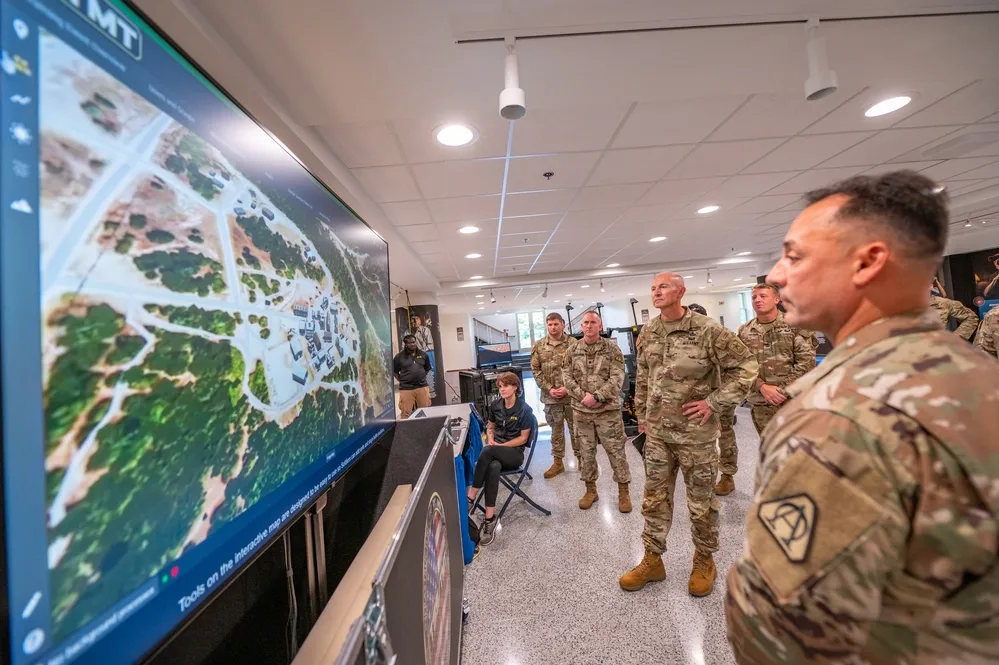
At this point, the boundary between civilian and military technology also becomes blurred. 3D simulation, robot training data, digital twins, and integrated control software can be used in both civilian industries and defense. The issue is not the technology itself, but the context of its use. The same virtual environment technology is subject to different management standards when it is used for game development and when it is used for unmanned system training. This is why game companies working with defense must examine not only technological potential, but also the scope of use and the possibility of technology transfer.
In games, virtual environments are stages for entertainment. In defense, virtual environments become spaces for training unmanned systems, verifying equipment performance, and checking real mission conditions in advance. The terrain, equipment, mission conditions, and behavioral data embedded in those environments can be directly tied to security.
Synthetic data works in a similar way. In the game industry, data may be used to create more natural character movement or richer content. In defense, however, virtual data can supplement situations where real data is difficult to obtain and can be used to train unmanned systems or AI models. In this case, data is not merely a development resource. It becomes a strategic asset that must be managed.
Ultimately, when game technology meets defense, it can become not freely distributed content technology, but an object of control and review. As the potential uses of the technology expand, the demands for security and responsibility also grow.
Collaboration Comes Before Direct Entry
Considering these differences, game companies are more likely to begin their entry into defense through collaboration models than through independent industrial transformation.
The Krafton–Hanwha Aerospace case is structured around joint R&D and the establishment of a joint venture. The NC AI–Hyundai Rotem case is closer to a model in which game-based AI technology and defense platforms are combined within a national R&D project. In both cases, one company is not opening a new industry alone. Rather, capabilities from different industries are being combined within a collaborative structure.
This more accurately shows the role of game companies. Rather than directly solving every defense-related problem, game companies can become partners that provide specific capabilities such as virtual environment construction, simulation, AI training environments, data generation, and UI/UX design.
Defense companies have equipment, manufacturing, operating systems, procurement structures, and defense networks. Game companies have strengths in virtual worlds, real-time interaction, simulation, content production, and AI software. Collaboration between the two industries is likely to proceed not by one side fully moving into the other, but by each side complementing what the other lacks.
Technology That Built Virtual Worlds Now Faces the Rules of Defense
Game technology no longer remains only within entertainment. The ability to build virtual worlds, design behavior within them, generate data, and verify interactions is expanding into physical AI, defense, and robotics.
But this change should not be understood simply as industrial entry. Rather than saying that game companies are moving into defense, it is more accurate to say that the virtual world-building capabilities accumulated by game companies are being repositioned as part of defense, manufacturing, robotics, and AI infrastructure.
What matters is to look at both technological potential and industrial logic. Game technology can simulate real-world battlefields. But once that technology meets defense, it no longer moves according to the logic of games alone.
The game industry is accustomed to building quickly, observing user reactions, and continuously improving. The defense industry operates by verifying, documenting, taking responsibility, and controlling. Ultimately, the expansion of game technology into defense is not only a matter of proving technological potential. It is also a process of testing whether that technology can bear the rules of an entirely different industry.