Online shopping often leaves consumers with shopping carts scattered across multiple websites.
They might browse sneakers on Nike, compare cosmetics at Sephora, explore furniture on Wayfair, and check household products at Walmart. Items they like are saved in open browser tabs or screenshots. When they return a few days later to make a purchase, prices may have changed or products may have sold out.
Google wants to change this familiar shopping experience.
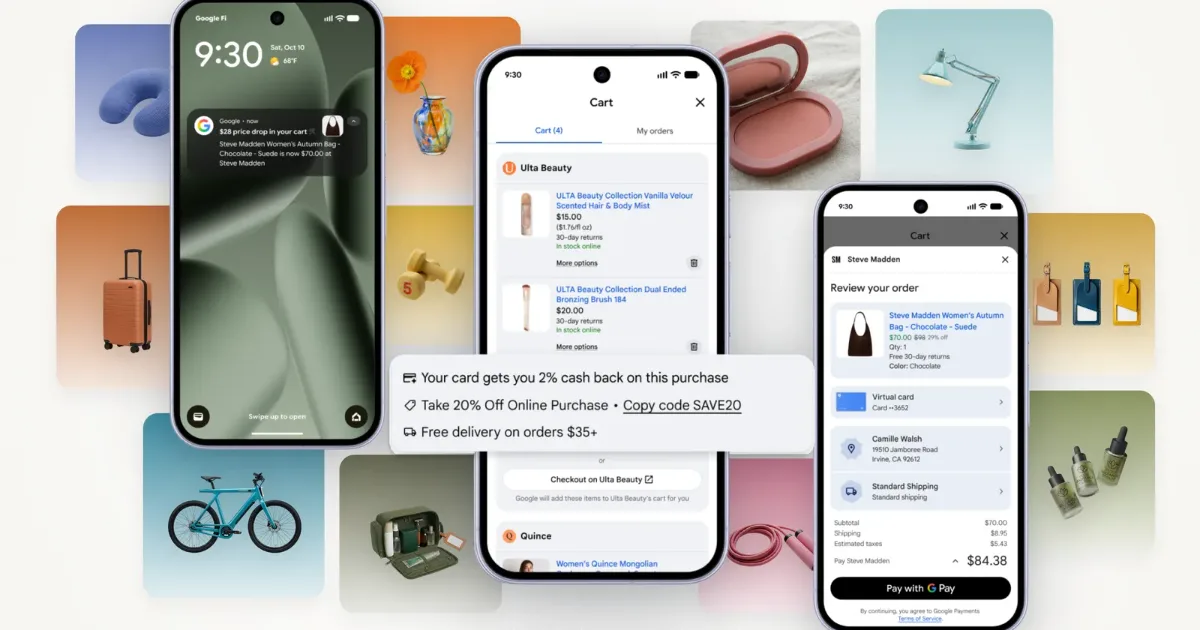
On October 15, 2026, Google launched Universal Cart in the United States. The service allows users to save products from multiple retailers in a single shopping cart across Google Search and the Gemini app, receive price-drop and restock alerts, compare promotional offers, and explore payment benefits.
Google describes it not simply as a shopping cart, but as a new central space for managing shopping across its services.
On the surface, Universal Cart looks like a convenience feature that consolidates shopping carts from different retailers.
But a larger transformation lies underneath.
Google has traditionally been a search platform that directs consumers to online stores. Users searched for products on Google, visited retailer websites, compared options, and completed purchases. Google facilitated product discovery, while much of the shopping-cart and checkout experience remained within retailers' own platforms.
Universal Cart attempts to change that boundary.
Products discovered through Google Search and Gemini can be collected in one cart, where users can track prices, evaluate savings, and move toward checkout.
This means Google is seeking to manage not only where consumers find products, but also how they make purchasing decisions.
Products Discovered in Search Can Be Revisited in Gemini
The first defining feature of Universal Cart is continuity.
Google recognizes that consumers move between multiple retailers and services while shopping.
For example, a user might add a Steve Madden bag to Universal Cart from AI Mode in Google Search, then later save a Quince sweater and an Ulta Beauty lip gloss through the Gemini app.
All three products remain in the same Universal Cart.
The user does not need to start shopping again.
There is no need to keep browser tabs open or separately organize screenshots of interesting products.
Whether an item was discovered through Search or a conversation with Gemini, the list of potential purchases remains unified.
This matters because shopping no longer takes place within a single website.
In the past, online shopping largely involved visiting a particular retailer, searching for a product, and completing a purchase there.
Today, consumers discover products through search engines, videos, social media, AI chatbots, and price-comparison services.
As discovery channels multiply, managing potential purchases becomes more complicated.
Google wants to reduce that complexity through a single shopping cart.
However, the launch is currently limited to Google Search and the Gemini app in the United States. This does not mean that the previously announced integrations with YouTube and Gmail are already available.
More Than 60 Billion Product Listings Power the Cart
The second defining feature of Universal Cart is continuous price and inventory tracking.
Google says the service is powered by its Shopping Graph, which contains information on more than 60 billion products.
Shopping Graph is Google's system for collecting, connecting, and updating product information from multiple retailers. It brings together shopping-related data such as product characteristics, prices, sellers, and inventory availability.
According to Google, Universal Cart uses this information to notify users when an item in their cart drops in price or when an out-of-stock product becomes available again.
This is where it differs from a conventional shopping cart.
A traditional cart is primarily a place to store products before purchasing them. Users generally need to return to the retailer to check prices and decide whether to buy.
Universal Cart continues monitoring relevant information even when users are not actively viewing the cart.
AI and data infrastructure begin performing part of the shopping process on the consumer's behalf.
This may change how consumers make purchasing decisions.
Someone waiting for a lower price may no longer need to revisit multiple shopping websites repeatedly. Someone waiting for an item to be restocked may no longer need to check inventory manually.
The shopping cart evolves from a temporary storage space into a continuously updated shopping-management tool.
Google argues that these capabilities can help consumers make purchasing decisions with greater confidence.
From a platform perspective, however, there is another implication.
The longer consumers keep products in Universal Cart, the longer Google remains connected to their interests through prices, inventory, retailers, and potential purchasing moments.
If Search traditionally captured product discovery at a particular moment, Universal Cart manages consumer interest throughout the period leading up to purchase.
Google's shopping platform is expanding from one-time searches toward continuous purchasing assistance.
Comparing Credit Card Benefits, Not Just Discount Codes
The third feature involves comparing benefits associated with payment methods.
Google says Universal Cart is built on Google Wallet.
Consider a consumer who owns several credit cards but cannot remember the discounts, rewards, or points offered by each one.
Universal Cart helps users identify advantageous payment options by considering benefits associated with payment methods connected to Google Wallet. It also displays applicable promotional codes.
This means the cart does more than calculate the combined prices of products.
The actual cost to consumers is not determined by listed prices alone.
Coupons, credit card benefits, rewards, and promotional offers can produce different final purchasing conditions for the same product.
But checking every available benefit manually is difficult.
Google has designed Universal Cart to use AI-powered reasoning to help surface these otherwise overlooked benefits.
The connection between Google Wallet and shopping services is particularly important.
When Google's product information is combined with payment-method benefits, the platform can recommend not only what consumers might want to buy, but also which payment option could be more advantageous.
AI's role in supporting purchasing decisions becomes broader.
Of course, the accuracy and availability of benefits may depend on the payment method, retailer, promotional conditions, and how frequently relevant information is updated.
Nevertheless, Google's decision to emphasize payment-benefit comparisons as a core shopping-cart feature is significant.
Search, shopping, and payment services are being integrated into a single user experience.
Why the Universal Commerce Protocol Matters
The fourth feature is checkout.
Google uses the Universal Commerce Protocol, or UCP, to simplify the process of completing purchases from Universal Cart.
UCP is an open commerce standard designed to allow AI agents, retailers, and payment services to interact through a common framework.
In January 2026, Google announced that it had developed the standard with partners including Shopify, Etsy, Wayfair, Target, and Walmart.
The essential idea is to create a common language between different commerce systems.
Every online retailer has its own product-data structures, shopping carts, inventory systems, ordering processes, and payment infrastructure.
For AI to search across retailers and support purchases, it must understand and navigate these differences.
If each retailer requires a separate integration, agent-based commerce becomes difficult to scale.
UCP is intended to provide a technical foundation for addressing this problem.
Google says Universal Cart allows users to complete purchases using Google Pay or transfer products into the relevant retailer's cart to complete checkout on the retailer's website.
Early participating retailers include Nike, Sephora, Target, Ulta Beauty, Walmart, Wayfair, and merchants using Shopify.
An important distinction is that Google is not necessarily becoming the merchant in these transactions.
Google emphasizes that retailers remain the sellers of record regardless of where checkout takes place. Retailers are also responsible for order confirmations and customer support.
In other words, Google is not trying to become an online store that directly sells every product.
It is attempting to create a higher-level shopping interface connecting products and payment processes across multiple retailers.
This distinction matters.
Retailers continue to sell products and fulfill orders.
But Google's influence may increase over the processes through which consumers compare products, add items to carts, and select payment methods.
It suggests that competition in AI commerce may move beyond the question of who sells products toward the question of who organizes the purchasing process.
Why Google Is Emphasizing User Control Rather Than Fully Automated Shopping
One aspect of Google's announcement deserves particular attention.
Google describes two directions for the future of commerce.
One involves agentic capabilities that take actions on behalf of users.
The other involves practical tools that help consumers shop with confidence while maintaining control.
Google explicitly places Universal Cart in the second category.
This is an important distinction.
AI shopping agents are evolving toward systems that understand user preferences, select products, and potentially execute purchases.
But Universal Cart's current core experience is not about allowing AI to make every decision independently.
Users select products and add them to the cart themselves.
AI tracks prices and inventory, identifies potential savings, and simplifies checkout.
The final purchasing decision remains under the user's control.
Google appears to be seeking a combination of automation convenience and consumer choice.
This approach illustrates one of the central challenges that AI commerce must overcome before becoming widely adopted.
Recommending a product is different from spending someone's money.
If a recommendation is wrong, the consumer can choose another product.
But if an AI agent purchases the wrong product, completes a transaction at an unexpectedly high price, or sends an order to the wrong address, the result can be actual financial or practical harm.
AI commerce therefore requires not only convenience but also control and trust.
Through Universal Cart, Google is making the pre-purchase process more intelligent while preserving consumer authority over the transaction.
It can be understood as a practical intermediate step toward more autonomous shopping agents.
How Much of the Shopping Journey Can a Search Platform Capture?
Universal Cart matters because of its connection to Google's existing business.
Google is one of the world's dominant search platforms.
Search is an important starting point when consumers look for products. Historically, however, much of what happened after product discovery was handled by online retailers and payment platforms.
Universal Cart has the potential to change that division of responsibilities.
Google Search becomes the place where consumers discover products.
Gemini becomes the place where they compare options through AI conversations.
Universal Cart becomes the place where potential purchases are organized.
Shopping Graph provides the underlying price and inventory information.
Google Wallet connects payment benefits.
UCP and Google Pay support the purchase process.
If this structure becomes established, Google may retain its role in the consumer experience much longer after the initial product search.
This also has important implications for advertising.
Traditional search advertising has relied heavily on consumers clicking search results and visiting retailer websites.
But as AI increasingly compares products and manages purchasing options, the way consumers select products may change.
Retailers may need to do more than compete for high rankings in search results.
They may also need to provide structured data that enables AI systems to accurately understand and compare their products.
Information about prices, inventory, shipping conditions, product specifications, and discounts could become increasingly important.
This is why Shopping Graph and UCP matter.
As commerce becomes more AI-centered, structured product data and standardized transaction interfaces can become part of competitive advantage.
What Do Retailers Gain, and What Might They Lose?
Universal Cart could provide retailers with another sales channel.
If consumers can discover products through Google Search or Gemini, add them to a shared cart, and complete purchases with less friction, retailers may benefit from a smoother purchasing process.
The experience could be especially useful for consumers comparing products across multiple sellers.
But retailers also face difficult questions.
Consumers may be able to compare products and make purchasing decisions without visiting the retailer's own website.
A retailer's website is more than a place where transactions occur.
It is a space for communicating brand identity, recommending related products, encouraging account creation, and developing long-term customer relationships.
As Google integrates more of the pre-purchase experience, retailers may gain access to new customers while becoming more dependent on Google for some of their direct consumer interactions.
This is a central tension in platform competition.
Google emphasizes that it is not the seller.
Orders, customer support, and sales responsibilities remain with retailers.
But Google provides the system that helps consumers decide which products to discover, what to save, which benefits to compare, and when to purchase.
The party responsible for selling a product becomes increasingly distinct from the party organizing the buying experience.
In the future, cooperation and tension between these two roles may increase simultaneously.
The Next AI Commerce Competition May Begin in the Shopping Cart
Google first introduced Universal Cart at Google I/O in May 2026.
At that time, the company presented a broader vision that included adding products to the cart from YouTube and Gmail, in addition to Search and Gemini.
It also outlined features such as product compatibility checks and alternative recommendations.
For example, if a consumer adds PC components from multiple retailers to the cart, AI could identify compatibility problems and suggest alternative components.
That goes beyond simple price comparison.
It involves understanding relationships between products and helping consumers make more informed decisions.
However, the October 15 launch announcement primarily emphasized consolidated products, price and inventory tracking, discounts and credit card benefits, and checkout support.
It should not be assumed that every feature previewed earlier is currently available.
Even so, the direction is clear.
Today, consumers select products while AI assists with purchasing.
In the future, AI may analyze differences between products, compare purchasing conditions, synthesize offers from multiple retailers, and support transaction execution within boundaries defined by users.
As these capabilities expand, individual retailer shopping carts may no longer be the only centers of the purchasing process.
Instead of visiting multiple online stores and managing separate carts, consumers may increasingly organize products from different sellers through a single AI-powered shopping interface.
With Universal Cart, Google has begun turning that possibility into an actual service.
Google Is Not Just Changing the Cart. It Is Changing the Center of Shopping.
Viewing Universal Cart merely as a shopping convenience feature risks missing the larger transformation.
Google began by bringing products from different retailers into one place.
But it has connected that cart to Search, AI, product data, price monitoring, payment benefits, and commerce protocols.
Each of these technologies already existed.
What changes is the consumer experience when they are connected within a single shopping journey.
Search was where consumers found products.
Gemini was where they asked questions about products.
Google Wallet was where payment methods were managed.
Shopping Graph provided the underlying product information.
Universal Cart brings these elements together into one purchasing process.
This development also reflects the broader direction of platform competition in the AI era.
As AI becomes more capable, consumers may increasingly prefer interfaces that understand their goals and connect the services needed to accomplish them, rather than manually moving between multiple applications and websites.
Shopping is no exception.
Consumers want to buy products.
They do not necessarily want to manage shopping carts across multiple stores, repeatedly check prices, or compare every discount condition themselves.
Google is trying to reduce these inconveniences by creating a new central shopping touchpoint.
Success, of course, is not guaranteed.
Much will depend on how willing consumers are to entrust Google with information about potential purchases and payment benefits, how actively retailers participate in Google-centered purchasing flows, and how accurately AI provides relevant information.
As Google's influence between retailers and consumers increases, questions about platform dependence, data use, and competitive fairness may also become more important.
Nevertheless, the launch reveals one clear change.
Google no longer wants to remain only the platform that sends consumers to online stores.
It is building a central shopping environment that collects products from different retailers, monitors prices and inventory, identifies potential savings, and connects consumers to checkout.
In the age of AI commerce, competition is expanding beyond who sells the most products to who can organize the consumer's purchasing journey most conveniently.
Google's Universal Cart is a new shopping cart at the center of that competition.