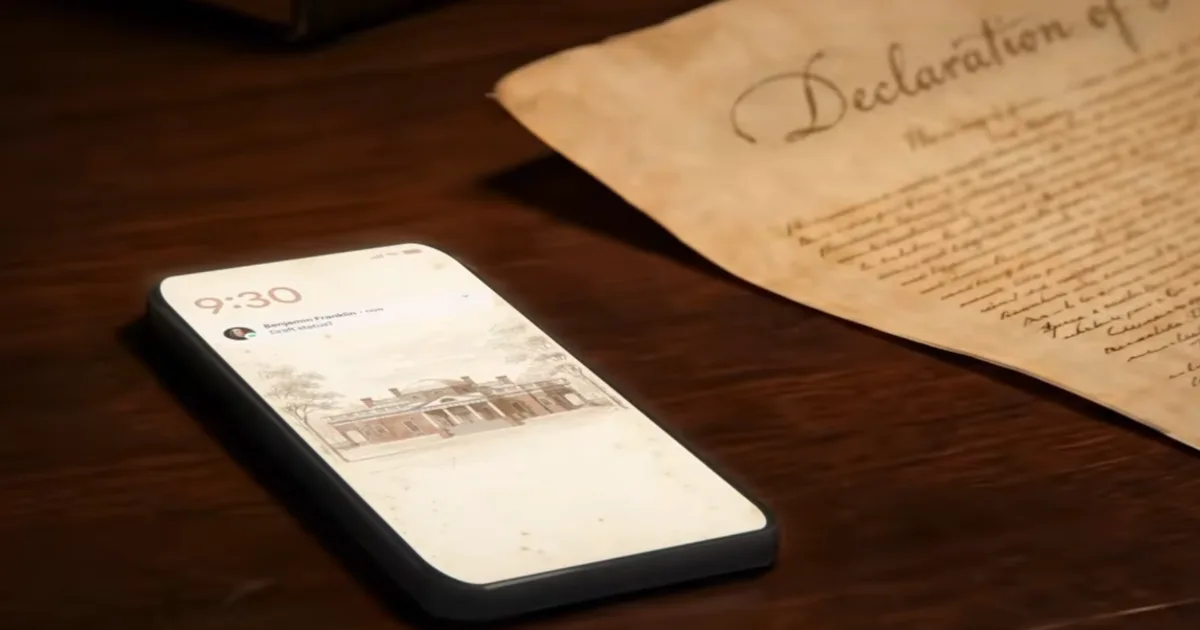
What would the drafting of the U.S. Declaration of Independence have looked like if Google Docs, Gmail, video meetings and AI assistants had existed in 1776?
One person might write a sentence while another leaves a comment in real time. Someone else could schedule a meeting, coordinate the order of signatures or suggest revisions to a sensitive paragraph. When King George III requests access to the document, an AI assistant might flag the request as a security concern and advise against granting permission.
The Declaration of Independence would no longer be created only with parchment and quill pens. It would become a modern collaborative document, shaped through comments, notifications, calendar invitations, shared files, access controls and AI-generated suggestions.
That is the playful premise behind Google Workspace’s new advertisement.
The campaign transports one of the most important moments in American history into a contemporary workplace. Thomas Jefferson, Benjamin Franklin, John Adams and other founding figures appear to use Google Docs, Gmail, Google Calendar, Google Meet and Gemini while drafting, reviewing and preparing to sign the Declaration of Independence.
The video is not a history lesson. Nor is it a conventional software demonstration.
It is a brand message built around a simple idea: great ideas are rarely completed alone.
The Declaration of Independence Was, in Many Ways, a Collaborative Document
The Declaration of Independence is often remembered as the work of a single great writer, most notably Thomas Jefferson.
But the document was the result of debate, revision and negotiation among political leaders, committee members and colonial representatives. Its language had to be discussed, adjusted and defended. Different interests had to be persuaded. A final version had to be agreed upon before the document could become a declaration on behalf of the colonies.
Viewed through a modern lens, it was a massive collaborative project.
Google’s advertisement builds on that fact.
The drafting process is presented like a familiar team workflow. One person prepares the first draft. Another leaves comments. Someone schedules a meeting. Others join discussions, make revisions and manage access permissions.
The historical figures are no longer frozen in paintings or statues. They become recognizable modern workers and creators: people facing deadlines, responding to feedback, finding meeting times and trying to align multiple voices around a single document.
That creative choice solves one of the central challenges of productivity-software advertising.
Tools for document editing, email, calendars, video meetings and AI assistance are useful, but they can be difficult to make visually memorable. A feature-by-feature demonstration can quickly become dull.
By placing those tools inside the drafting of the Declaration of Independence, Google makes familiar workplace functions feel unexpectedly fresh.
“Here is how you can co-edit a document” is a functional statement.
“What if the Declaration of Independence had been edited together in Google Docs?” is a story.
And stories are easier to remember.
Gemini Appears as an Organizer of Collaboration, Not a Substitute for Human Judgment
One of the campaign’s most effective moments is the role given to Gemini.
The AI does not appear simply as a tool that writes historical prose on behalf of Jefferson. Instead, it acts as a context-aware collaboration assistant.
The clearest example comes when King George III requests access to the Declaration of Independence draft. Gemini identifies the request as a potential security risk and suggests that access should probably not be granted.
It is an obvious historical joke. The British monarch seeking access to a document declaring independence from Britain is inherently funny to anyone familiar with the story.
But the scene also captures the role Google wants AI to play inside Workspace.
AI is not only a writing tool.
It can help identify who is requesting access, determine whether a meeting invitation is relevant, flag overlapping schedules, surface important comments and warn when a request may create a security problem.
During the first wave of generative AI adoption, the most visible use case was simple: AI could write a paragraph.
But in real workplaces, much of the daily burden does not come from writing itself. It comes from managing messages, documents, meetings, approvals, scheduling conflicts and endless streams of small requests.
Google Workspace is presenting AI as a way to reduce that friction.
The Gemini in the advertisement does not write the Declaration of Independence for its authors. It helps clear away the operational clutter so that people can focus on the larger decisions that matter.
Revolutionary Ideas Do Not Come From One Sentence Alone
The campaign ends with the line: “Here’s to 250 years of revolutionary ideas.”
That phrase captures the ad’s central message.
The revolutionary idea of 1776 led to American independence and a major political transformation. Google uses that historical symbol to suggest that meaningful ideas today also emerge through collaboration.
The word “revolutionary” does not have to refer only to national independence or dramatic social change.
For a startup team, a new product concept may be revolutionary.
For a teacher, a redesigned lesson plan may be revolutionary.
For a small company, a proposal for entering an overseas market may be revolutionary.
For a research team, a jointly written paper may be revolutionary.
For a local community organization, a new project may become the beginning of real change.
Google Workspace positions itself as the place where such ideas can move from thought to execution.
A good idea may begin in one person’s mind. But for that idea to become a document, a plan, a product or an organizational decision, it must be shared with others.
Drafts need review. Opinions need alignment. Meetings need scheduling. Decisions need to be recorded. Files need to be shared securely.
By connecting this process to the Declaration of Independence, Google elevates collaboration software beyond ordinary office functionality.
It suggests that productivity tools are part of the infrastructure through which ideas become real.
Google Is Selling a Way of Working, Not Just Individual Tools
The advertisement does not promote Google Docs, Gmail, Calendar, Meet and Gemini as isolated products.
Docs appears as a collaborative writing space. Gmail supports communication. Calendar coordinates time. Meet enables remote conversation. Gemini provides AI assistance.
But the real message is not about any one feature.
It is about the workflow created when these tools are connected.
A team writes a document. Comments arrive. A meeting is scheduled. Decisions are made during the meeting. The document is revised. Relevant people receive updates. Access permissions are managed. Security risks are flagged.
Google is not simply saying, “Use our document editor.”
It is saying, “You can complete the entire journey from idea to execution inside Google.”
That message reflects the direction of competition in workplace AI.
The contest is no longer only about which company has the most capable chatbot. The more important question is which platform can connect documents, email, calendars, meetings, collaboration records and security systems in a way that helps people at the right moment.
As AI becomes more deeply integrated into workspaces, users may no longer need to open a separate AI website and ask questions manually.
AI may help revise text while a document is being written. It may suggest attendees while a meeting invitation is being prepared. It may summarize key points while an email is being read. It may detect a risky sharing request while files are being distributed.
Google Workspace is presenting this as the future of work: AI embedded quietly inside the flow of collaboration.
Historical Humor Becomes a Brand Strategy
The humor in the campaign comes from translating a historical event into the grammar of contemporary work.
The Declaration of Independence is one of the most symbolic and serious documents in American history. Yet the advertisement does not treat it with excessive solemnity.
Instead, it turns the process into scenes that modern workers immediately recognize.
Someone leaves a comment.
Someone proposes a revision.
Someone organizes a meeting.
Someone requests access.
Someone needs approval.
The advertisement suggests that even great historical events were shaped by the same human realities that shape projects today: feedback, negotiation, deadlines, compromise and consensus.
This is also useful for the brand.
Workplace software can often feel cold and feature-driven. It may be useful, but not emotionally memorable. By framing Workspace as part of a story about people creating something meaningful together, Google gives its productivity products a more human identity.
The connection to America’s 250th anniversary also adds symbolic weight. Rather than using national history only as a patriotic backdrop, Google borrows the broader idea of “revolutionary ideas.”
The message to users is subtle but clear.
The document you are creating, the project you are planning or the idea you are trying to develop may also become meaningful to someone else.
The More Collaboration Tools We Have, the More Integration Matters
The campaign also raises an important question.
Today, collaboration tools are everywhere.
There are tools for writing documents, sending messages, holding video meetings, managing calendars, organizing projects, tracking tasks and generating AI-assisted content. In many organizations, the problem is no longer a lack of tools.
It is too many tools.
People move constantly between applications to find documents, check meeting links, review messages, update permissions and track decisions. In that environment, AI can become just another layer of complexity unless it reduces fragmentation.
That is why Google’s emphasis on integration matters.
Documents, email, schedules, video meetings, AI assistance and security controls need to work together. AI should not simply create more content. It should reduce operational clutter so people can spend more time on ideas, judgment and decisions.
The Declaration of Independence in the advertisement remains a human document.
AI does not replace the people writing it.
It helps them collaborate more effectively, make decisions more quickly and manage information more safely.
That distinction is important.
A good collaboration tool does not replace people.
It helps people with different perspectives move toward the same document, the same goal and, sometimes, the same decision.
Revolutions Do Not Begin With a Document Written Alone
The ultimate message of Google Workspace’s advertisement is simple.
A revolutionary idea may begin with one person. But turning that idea into a document capable of changing the world requires collaboration.
It requires drafts and revisions, disagreement and persuasion, meetings and scheduling, access control and approvals, and eventually a final signature.
In 1776, the Declaration of Independence was written with quills on parchment.
In 2026, revolutionary ideas may emerge through shared documents, video meetings, AI assistants and security alerts.
Technology does not replace ideas.
But it can help more people refine those ideas together, make decisions faster and execute them more securely.
That is what Google Workspace is ultimately selling.
Revolution may sound like a grand word.
But for one team, a new proposal may be revolutionary.
For an entrepreneur, a first business plan may be revolutionary.
For a researcher, a co-authored paper may be revolutionary.
For an organization, a declaration years in the making may be revolutionary.
And more often than not, that beginning starts with a document.