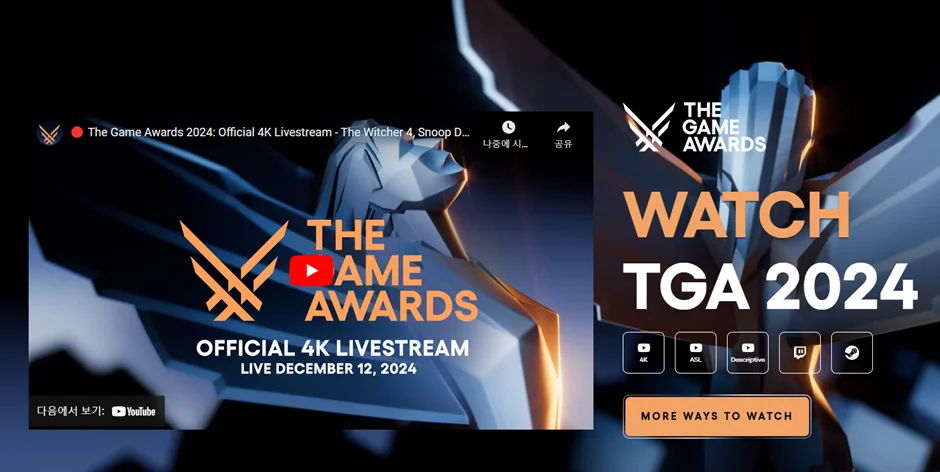
Korea is a global gaming powerhouse: Korea Creative Content Agency's 2023 Korea Game White Paper reports 2022 domestic game industry revenue of approximately 22.2 trillion won (+5.8% YoY); globally, Korea holds 7.8% market share (4th globally, consistently 4th-5th for 10+ years). Yet Korean games remain absent from major global awards. At The Game Awards (TGA, since 2014) through 2024, no Korean game has won GOTY; the only Korean nominees were PUBG (2017) and Stellar Blade (2024). GOTY (Game of the Year) context: The Game Awards 2024 (December 13, Los Angeles) awarded Astro Bot (PlayStation, Japan/UK) as GOTY — praised for innovative use of PlayStation 5's DualSense controller haptics and original platformer design. 2024 nominees: Astro Bot, Black Myth: Wukong, Elden Ring: Shadow of the Erdtree, Balatro, Metaphor: ReFantazio, Silent Hill 2 (remake). Analysis of Korean gaming's GOTY gap: (1) Business model priority — Korean games historically prioritize monetization (gacha, P2W mechanics) over critical acclaim; the systems most profitable in Korean/Asian markets (randomized loot, progression gates) create negative impressions among Western critics; (2) IP vs. originality — Korea excels at live-service sequels and licensed games but rarely creates entirely new IPs with distinctive aesthetic vision; (3) Narrative and worldbuilding — Korean games often lack the environmental storytelling, writing quality, and world coherence that characterize GOTY contenders; (4) Genre distribution — Korean strength in MMO, mobile, and gacha overlaps poorly with GOTY-eligible genres (single-player narrative, indie, action-adventure). Path forward: Shift Up's Stellar Blade GOTY nomination demonstrates Korean studios can create globally acclaimed single-player experiences when given freedom from live-service monetization requirements. The question is whether the Korean industry's commercial success model allows for the creative risk-taking that GOTY recognition requires.
Is There No Korean Game in the 'GOTY' Game of the Year?
[Korean article] 올해의 게임, ‘GOTY’에 한국 게임은 없다?!
Source: META-X metax.kr
Growing Global Game Market, Yet Korean Games Still Unrecognized.
ⓒ META-X metax.kr
All rights reserved.
Free to share with attribution.
All rights reserved.
Free to share with attribution.