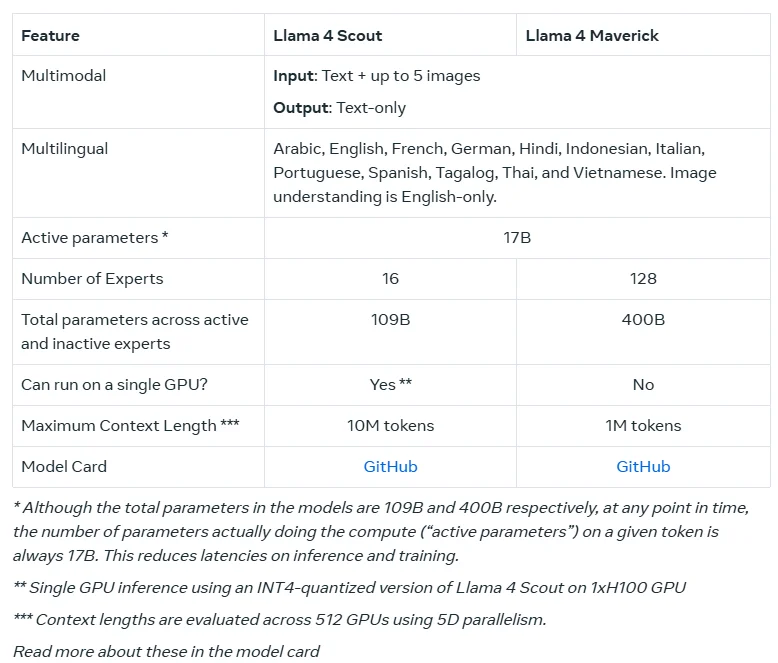
Meta officially announced Llama 4 on April 5, simultaneously introducing two models: a lightweight model optimized for fast text processing (on-device/mobile deployment), and a multimodal model combining text and images for complex queries. Both maintain Meta''s open-source strategy — a direct challenge to closed high-performance models like Google Gemini and OpenAI GPT-4. Technical highlights: lightweight variant enables real-time processing on mobile and edge devices with low computing resources; multimodal variant handles large-scale image+text analysis and complex multi-turn context; architecture improvements enabling competitive performance at lower compute cost than equivalent closed models. Llama 4 was trained with 10x more GPUs than Llama 3.1 (~160,000 GPU cluster). Model architecture: Mixture-of-Experts (MoE) design enabling efficient parameter utilization; extended context windows for long document understanding; improved multilingual capabilities across 100+ languages. Strategic significance: Meta''s open-source commitment forces the industry to compete on merit rather than access restrictions; developers building on Llama can commercially deploy without per-query API costs; the strategy builds ecosystem lock-in through developer familiarity. The open-source vs. proprietary AI competition is entering a new phase: Llama 4 capabilities are genuinely competitive with frontier closed models across most use cases, validating Meta''s thesis that open-source can match proprietary performance. This shifts competitive advantage from model capability (where open-source now competes) to distribution, integration, and enterprise support — areas where Meta''s consumer platform scale and developer ecosystem provide distinct advantages.
Meta Announces 'Llama 4' — Generative AI Leadership Competition Begins in Earnest
Meta announces Llama 4, its next-generation open-source AI model, formally beginning the battle for generative AI leadership.
Source: META-X metax.kr
Meta Announces ''Llama 4''… Full-Scale Competition for Generative AI Leadership
ⓒ META-X metax.kr
All rights reserved.
Free to share with attribution.
All rights reserved.
Free to share with attribution.