Decentralized social platform Mastodon released version 4.6 on June 17, 2026. At first glance, the update may appear to be a routine feature release. A closer look at the underlying design, however, reveals a business model and growth strategy fundamentally different from those of Big Tech platforms.
Mastodon operates across tens of thousands of servers and serves hundreds of thousands of users without venture capital, advertising revenue, or the sale of user data. The direction chosen in this update offers a clearer view of how the platform intends to sustain itself—and compete.

“No Consent, No Visibility”: Collections and the Trust Economy
The centerpiece of the update is Collections, a feature that allows users to curate and share groups of accounts around common interests. Its main purpose is to help newcomers discover more of the fediverse.
On the surface, the feature resembles X’s former Twitter Lists or Instagram’s collections. Its design philosophy, however, is fundamentally different.
The key distinction is that Mastodon users retain control over whether their profiles can appear in collections. Users who have not enabled the “search and discoverability” setting cannot be added to collections. Even users who have opted in receive a notification whenever they are added to a collection and can remove themselves at any time.
Mastodon has also introduced safeguards against what could be described as “bait collections.” If the title or description of a collection is changed after users have been added, all included profiles are notified. The system is designed to prevent curators from quietly changing the purpose or character of a collection after attracting participants.
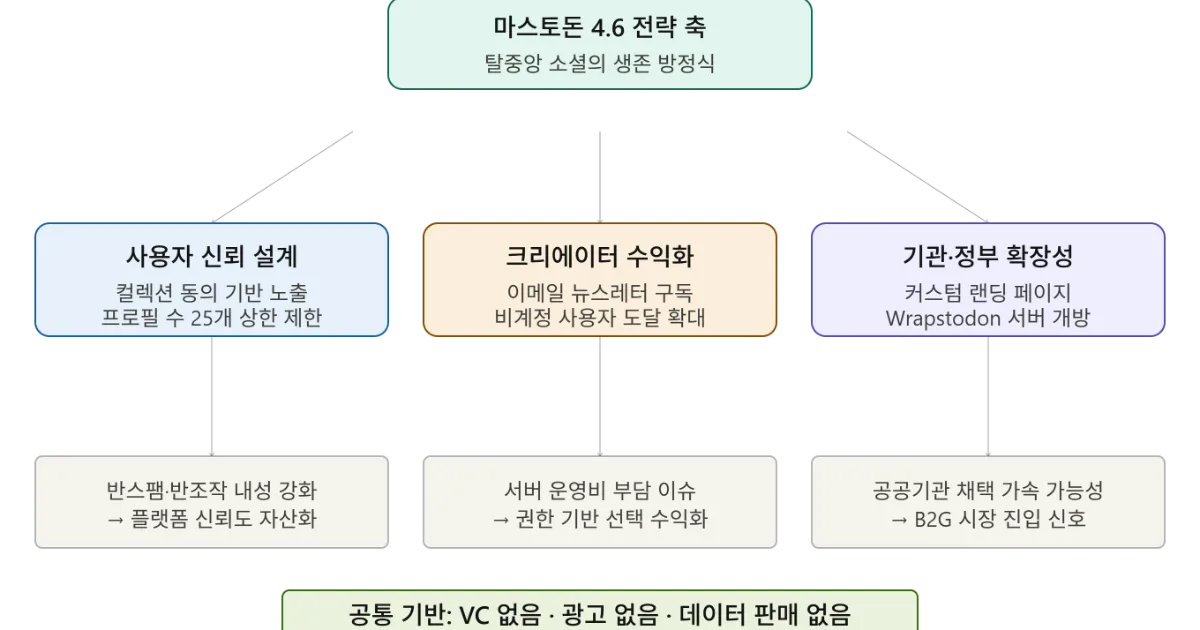
Each collection is limited to 25 profiles, and Mastodon has deliberately chosen not to offer a one-click “follow all” feature. The platform argues that large-scale exposure tools can make it easier for abusive actors to insert spam accounts among legitimate ones. Mastodon said the number may be adjusted in the future, but the strategic direction is clear: it is prioritizing small, trusted recommendations over mass virality.
That design is also meaningful from a business perspective. By treating trust as a core platform asset, Mastodon can potentially build user loyalty with a much longer life cycle than platforms optimized for short-term growth metrics. Advertising-driven platforms have repeatedly pursued rapid expansion through algorithmic recommendations and artificial exposure amplification, only to lose user trust in the process. Mastodon is attempting to block that dynamic at the product-design stage.
For European users and regulators who have become increasingly sensitive to visibility and profiling without consent in the post-GDPR era, this structure represents a platform with substantially lower legal risk. While competing platforms spend heavily on responding to privacy regulation, Mastodon has effectively embedded compliance into its product philosophy.
At present, discovering collections still depends largely on manual methods, such as recommendations from acquaintances. Mastodon has indicated that it plans to introduce features for browsing popular collections in the future. The point at which this discovery infrastructure becomes mature may become the first major test of Mastodon’s ability to enter the mainstream market. The next question will be whether the platform can create meaningful discovery experiences without relying on recommendation algorithms.
Profile Redesign Moves Beyond UX Toward Creator Retention
Mastodon has also overhauled profile pages after using community surveys to identify the information users consider most important when visiting another person’s profile. The move signals that Mastodon is evolving beyond an open-source community project into a more mature product organization capable of making data-informed UX decisions.
Users can now switch between viewing only original posts or viewing posts together with boosts and replies with fewer clicks. That preference is then applied across all profiles visited later.
One of the most notable changes is the upgraded role of hashtags. Previously buried “featured hashtags” are now placed in a much more visible position. The update strengthens one of Mastodon’s core mechanisms for discovering content without advertising and effectively formalizes hashtags as the platform’s substitute for algorithmic recommendation.
The profile editing experience has also been redesigned. Previously, even a simple change such as replacing a profile picture required users to navigate to a separate settings page. Now, entering profile edit mode provides access to all relevant controls. Image cropping can also be completed directly within the platform, without relying on external editing tools.
The change is an onboarding optimization strategy aimed at lowering friction and reducing abandonment among new users.
New customization options have also been added. Users can decide whether to display a media tab on their profile. They can also create a portfolio-style profile view that highlights creative work while excluding everyday reaction content such as GIFs, memes, and media attached to replies. The “Featured” tab can now also be hidden selectively.
These changes position Mastodon as more than a simple communication space. They lay the groundwork for a creator portfolio platform capable of attracting professional users who need career- and work-centered profiles, similar to LinkedIn, Behance, or ArtStation.
For creators, the ability to increase visibility through their own work without paying for exposure or adapting to opaque algorithms represents a quiet alternative to the existing creator economy, where platforms often pressure creators through commissions, monetization rules, and algorithmic incentives.
Newsletter Subscriptions Mark a Cautious Step Into the Creator Economy
Another notable feature in the update is email newsletter subscription. Anonymous visitors who do not have a Mastodon or fediverse account can now subscribe to a specific user’s posts by email.
It is Mastodon’s first meaningful attempt to open its traditionally account-based communication structure to people outside the fediverse.
The feature, however, is not available by default to all users. It must first be enabled by the server, and only accounts granted permission by server administrators can use it. Mastodon said it chose not to make newsletter delivery universally available because sending email newsletters can significantly increase server operating costs.
The design is notable because it addresses cost through product governance rather than centralized restriction. Rather than opening the feature to every user and risking a surge in infrastructure expenses that could overwhelm individual servers, Mastodon has delegated access decisions to server administrators.
It is a defensive design that turns one of the weaknesses of decentralization into a control mechanism.
From a business perspective, the structure opens two possible paths. First, server operators could offer newsletter privileges as a premium account benefit, creating their own subscription-based revenue models. This could become one of the first practical forms of B2C monetization within the Mastodon ecosystem.
Second, the feature could help retain journalists and bloggers who might otherwise leave for independent newsletter platforms such as Substack or Ghost. The fact that readers can subscribe without creating a Mastodon account gives the platform a foundation for competing more directly with existing newsletter services.
The limitations are also clear. Mastodon still lacks many of the monetization tools offered by Substack, including paid subscriptions, revenue-sharing mechanisms, and analytics dashboards. At this stage, the feature primarily expands audience reach. Without stronger links to creator revenue, it may be difficult to fully prevent creators from moving to other platforms.
A Social Network for European Governments: A Signal Toward the B2G Market
Mastodon has introduced a new type of landing page designed for institutional users, including organizations such as the European Commission and the German government, for which a “Trending” tab may not be appropriate.
The simplified interface places the server description and recent posts from local accounts at the center, reducing the likelihood that visitors will be directed away to external content.
The update signals that Mastodon is beginning to design products with public institutions as an explicit target market. In the context of the European Union’s push for digital sovereignty, the feature appears aimed directly at government agencies seeking to avoid placing public communications and data on Big Tech-controlled infrastructure.
The German federal government and the European Commission already operate Mastodon servers. The adoption of decentralized social platforms by public institutions is therefore moving beyond isolated precedent and toward a broader trend.
Another important development is the platform’s changing funding structure. A significant portion of Mastodon’s accessibility improvements was supported by funding from the Dutch government. The fact that public institutions are participating not only as users but also as development sponsors suggests that Mastodon is increasingly being positioned as a form of public-interest social infrastructure.
If this model expands, EU member states could begin investing part of their domestic social infrastructure budgets into Mastodon development. That would create a third potential revenue path alongside donations and sponsorships: public procurement-based support for open-source infrastructure.
The update’s broad accessibility improvements—including keyboard navigation, improved focus management, stronger color contrast, and enhanced screen-reader compatibility—should also be understood in this context. Accessibility compliance is a basic requirement for software adopted by public institutions.
By treating accessibility not as a burden but as an investment, Mastodon is improving its ability to meet public procurement requirements while strengthening trust in its brand.
Wrapstodon Opens Annual Reviews to All Servers
Starting with Mastodon 4.6, the annual review feature known as “#Wrapstodon” will be available to administrators across all servers. Beginning each year on December 10, users can generate an annual review—but only if they explicitly opt in.
Previously, Wrapstodon results could only be shared through screenshots. Users can now share them through public web links.
The move is designed to increase participation and generate year-end social sharing effects, borrowing from the model popularized by Spotify Wrapped. Spotify’s annual recap has become a form of voluntary viral marketing that fills social media feeds around the world every December. Mastodon’s decision to make Wrapstodon shareable by link appears intended to create a similar viral loop within decentralized social media.
More importantly, the feature offers a model for consent-based data use. If users decline, no review is generated. Instead of using personalization data for advertising, Mastodon returns it to users in the form of a personal review.
The feature reaffirms Mastodon’s broader philosophy: user data should function as a tool for user experience, not as a tool for monetization.
How Does Mastodon Survive Without Advertising?
Mastodon does not take venture capital, sell advertisements, or trade in user data. The Mastodon team has acknowledged that maintaining code used by hundreds of thousands of people across tens of thousands of servers is not easy.
The structure may be less favorable for short-term scale, but it creates a distinctive long-term competitive moat. Mastodon is structurally less exposed to user attrition caused by algorithmic addiction, privacy scandals, or data misuse. Its risk of privacy-related regulatory penalties is also significantly lower. The platform is not subject to the same pressure from advertisers that can distort content policies on commercial social networks.
Its revenue structure is also becoming more layered. Donations, sponsorships, and public procurement-based support have become more concrete through this update. Newsletter privileges offered by server operators, as well as demand from companies and institutions for dedicated servers, could become additional revenue sources.
Unlike Big Tech companies that depend heavily on a single advertising model, Mastodon’s diversified revenue structure may strengthen its long-term sustainability.
Mastodon 4.6 is therefore more than a feature update. It represents the accumulation of a design philosophy that consistently chooses trust over growth, users over advertisers, and control over algorithmic optimization.
At a time when regulation and public backlash against advertising-driven platforms are growing around the world, that philosophy could become a competitive advantage. While Big Tech companies fight regulators to protect advertising revenue, Mastodon is building a structure that may become more favorable as regulation becomes stricter.
Mastodon 4.6 was announced through the platform’s official blog on June 17, 2026.