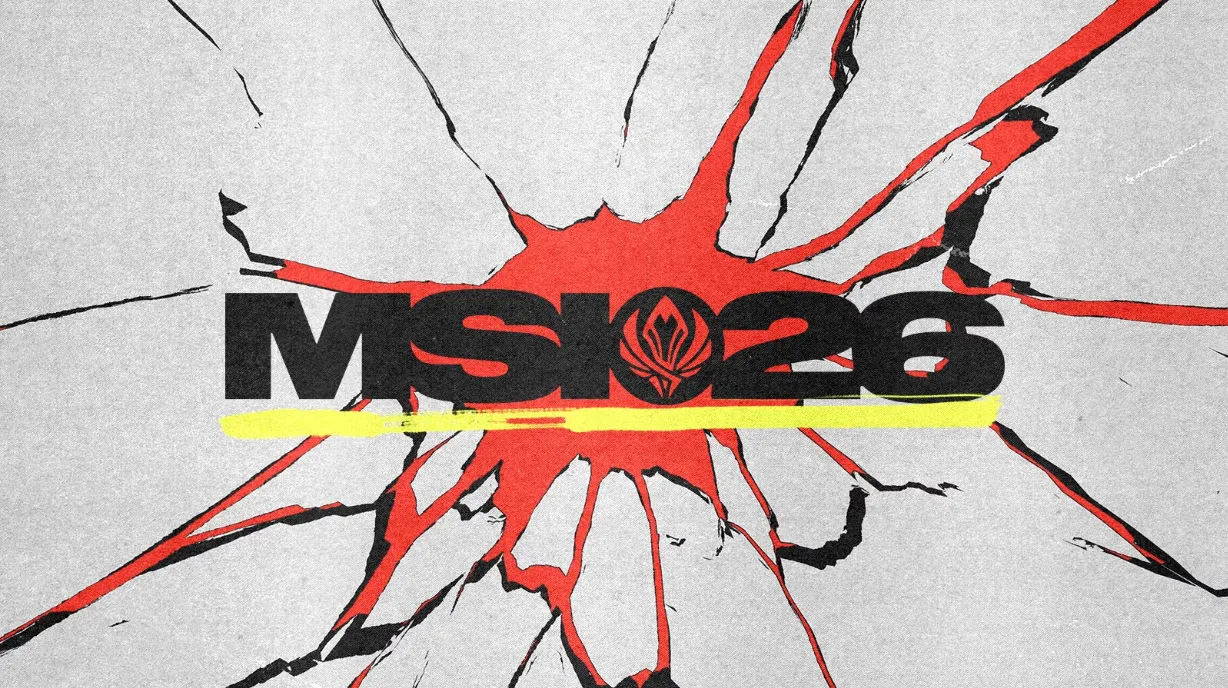
The Mid-Season Invitational 2026, the largest international League of Legends esports tournament in the first half of the year, is now being held at the Daejeon Convention Center. MSI is a stage where top teams from regional leagues around the world compete, and it is considered the biggest international tournament after the World Championship, commonly known as Worlds. From the very beginning, this year’s tournament has repeated a familiar scene.
The tournament began with the Play-In Stage, where teams that did not receive direct entry to the main bracket competed for a place in the next round. There, Korea’s T1 defeated North America’s Team Liquid and Europe’s Karmine Corp one after another, advancing to the main stage without dropping a single game. But it was not only the result that drew attention. T1’s match against Team Liquid surpassed 1.39 million peak concurrent viewers, making it the most-watched match of the day. The following match against Karmine Corp also exceeded 1.2 million viewers, becoming the most-watched match ever involving a European team. What was supposed to be only a preliminary stage became the tournament’s first major draw the moment T1 appeared.
Yet once T1 reached the main stage, an entirely different scene unfolded. The tournament stage known as the Bracket Stage has a slightly unusual format. A team does not get eliminated immediately after one loss. The first defeat sends a team down to the lower bracket, where it receives one more chance. But if it loses there, that is the end. Teams that remain in the upper bracket therefore have room to breathe, while those that fall into the lower bracket must play every match from the edge of a cliff.
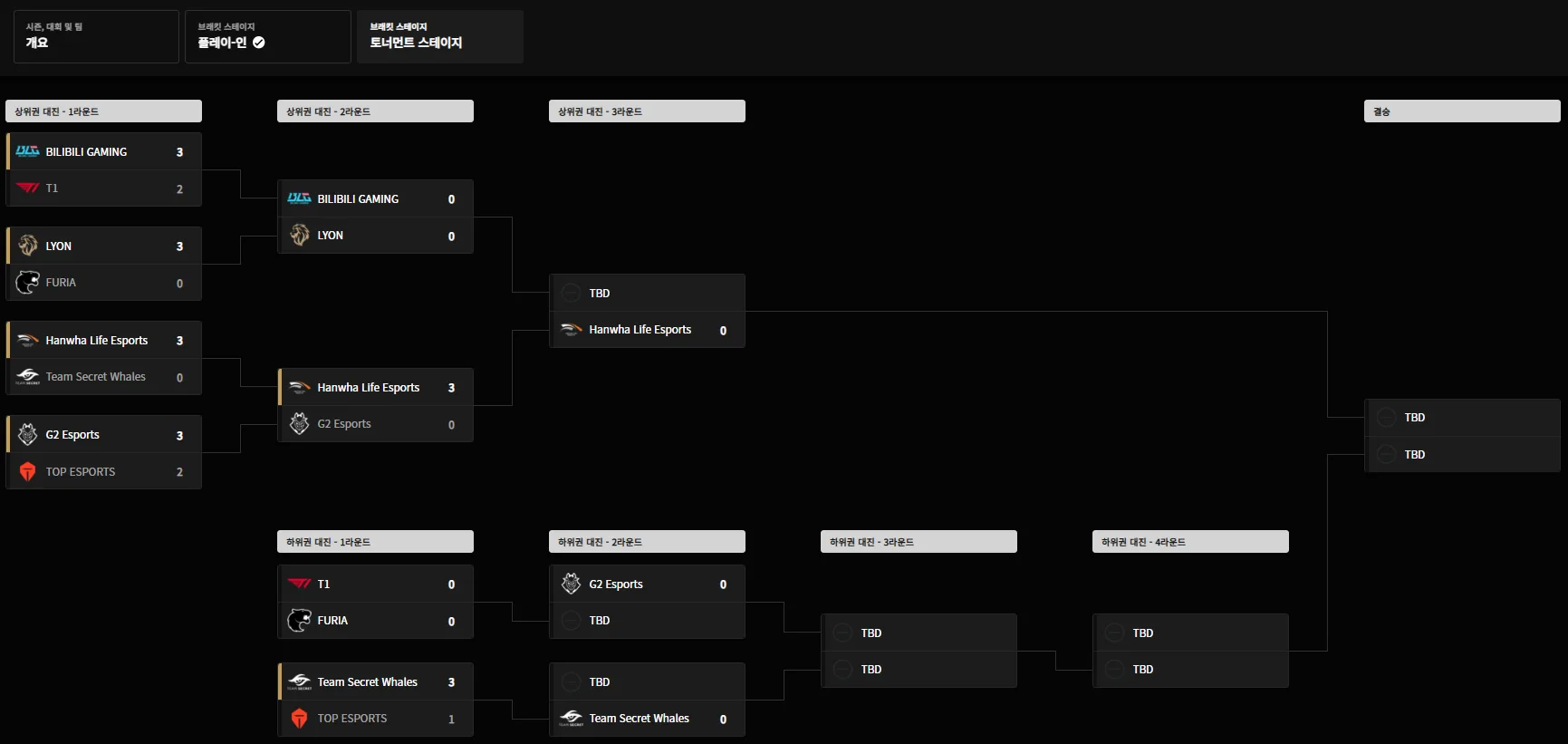
T1’s first opponent in the upper bracket was China’s powerhouse, Bilibili Gaming. In the best-of-five series, T1 went up 2–1. They needed just one more game to stay in the upper bracket. But from that point on, the flow of the series flipped. T1 dropped two games in a row, lost 2–3, and was pushed straight into the lower bracket. A match that seemed almost won slipped out of T1’s hands.
In fact, this kind of scene did not suddenly emerge at this tournament. The road to MSI had already been like this. Just before MSI, the Korean league, the LCK, held the Road to MSI qualifier to decide which teams would advance to the international stage. The final match between T1 and Gen.G recorded 2.27 million peak concurrent viewers, becoming only the third event in LCK history to surpass 2 million viewers. The nature of the match was symbolic as well. After losing the first seed to Hanwha Life Esports, T1 had to defeat Gen.G to reach MSI. It was essentially a one-series, do-or-die situation. At the edge of that cliff, T1 defeated Gen.G 3–2. Pushed to the very end, then surviving at the final moment — this is the kind of scene that repeatedly brings people to T1’s matches.
Here is the interesting part. T1 is clearly a strong team. But T1 is not the only strong team. This year, Hanwha Life Esports secured the LCK’s first MSI seed, and last year’s MSI trophy was lifted not by T1 but by Gen.G. And yet the team people most want to watch, regardless of trophies or seedings, is almost always T1. The team at the top of the standings and the team people wait for in front of their screens are not always the same.
Why is that? Why did T1 become not simply “the team that wins the most,” but “the team people most want to watch”?
A clue lies in the phrase that floods the chat whenever T1 starts a teamfight: “The circus is starting.”
“Another Circus Today”
Anyone who has watched a T1 match with the live chat open, whether at MSI, Worlds, or during the LCK regular season, has probably seen the same scene. The moment T1 tries to start a teamfight and someone dives into enemy territory, the chat almost reflexively fills with the same words. “Here we go again.” “The circus is starting.” “Another performance today.” No one gives the order, yet thousands of people type the same thing at once. It feels almost like the murmur of an audience just before the curtain rises.
What is interesting is that these words are not simply criticism. In ordinary sports, a reaction like “they’re causing trouble again” usually comes with anxiety or irritation. But when fans call T1 a circus, the tone carries more anticipation than annoyance. There is a strange excitement in it, as if they know something is about to happen — and as if they want it to happen. It is less a boo than an opening announcement.
Even more interesting is that the team itself has accepted this image. What once began as a community joke has now become an identity that players and the organization themselves mention. Even Faker has casually referred to the nickname on stream, saying, in effect, “The circus is fun for viewers, right?” After Doran joined in 2025, Oner described his team in an interview by saying, “We’ll make you laugh for half the year and cry for the other half.” It sounds like a joke, but these remarks capture exactly how T1 understands itself: not as a team that simply wins in a stable way, but as a team that puts fans on an emotional roller coaster. By the middle of 2025, T1’s style had become so firmly associated with this “circus” that fans could unite around a single sentence: “Well, if you went in, you must have seen something.” T1 had become a team that seemed to leap first and justify it later.
But the name “circus troupe” was not originally a term of affection. It oscillated for a long time between criticism and love before settling into its current place.
So why did people begin watching a professional sports match, one with real stakes, as if it were a performance? And why did they give T1, of all teams, the name “circus troupe”?
Circus — Acrobatics and the Display of Failure
The virtue of professional sports is usually the reduction of mistakes. Good teams are stable. The stronger the team, the better it controls variables, protects a lead once it has one, and avoids creating unnecessary crises. This is why “not losing” is praised in football and “taking care of the ball” is praised in basketball. In the basic grammar of sports, stability is another name for skill.
But the circus operates by a slightly different principle. Think of a tightrope walker or a trapeze artist. The audience holds its breath not because the performer looks perfectly safe. It is the opposite. The possibility of falling, the feeling that balance could collapse, the tension that a single mistake could change the entire scene — these are what pull the audience toward the stage.
Of course, the circus does not simply sell danger. A scene that is only dangerous is unsettling, and a reckless attempt quickly becomes exhausting. The pleasure of the circus comes from placing the possibility of failure on stage and then passing through that possibility. The audience has not come to watch a fall. It has come to watch the skill of surviving a situation in which a fall is possible. What the circus shows is not stability, but the technique of managing instability.
This is exactly why T1 came to be called a circus troupe. It is not an abstract marketing slogan. T1 is a team that repeatedly makes choices that embrace risk. From the champion select stage, the draft, they bring out cards that others would not easily choose. Even inside the game, in moments when they could proceed safely, they choose to walk along the blade. This is possible because the individual fundamentals and judgment of the players are so strong. And on that blade, they seem as if they might fall, yet somehow they do not, and eventually they create a scene.
That is why fans naturally reach for the word “performance” when talking about T1’s matches. T1 is not a team that draws attention simply by playing dangerously. It is a team that repeatedly shows the spectacle of taking risks and surviving them.
But T1 was not always this kind of team. In fact, there was a time when its image was almost the opposite.
From 2015 to 2017, when the team dominated the world stage under the name SK Telecom T1, or SKT, it was far from a circus. The words used to describe SKT at the time were closer to stability, control, and flawlessness. It was not a team that overwhelmed opponents with extreme speed. It was a team that waited for the opponent’s mistake and punished it with cold precision. Not a dazzling acrobatic act, but a finely tuned machine.
That version of T1 had a different texture from today’s team. SKT was strong not because it kept creating dangerous scenes, but because it refused to create them at all. Once it gained a lead, it rarely let it slip. Before the opponent could create variables, SKT removed those options one by one. The terror of that era’s SKT lay less in explosive force than in stability.
The turning point is relatively clear. In the latter half of 2021, as the team moved through a period of transition, Oner and Gumayusi established themselves as starting players, adding much stronger aggression to T1’s games. Then in 2022, Zeus settled into the starting top lane with both laning strength and teamfight ability, making the team’s color even clearer. Zeus, Oner, Faker, Gumayusi, and Keria — the five players known as “Ze-O-Fa-Gu-Ke” — became a T1 that pressured opponents from the early game and relied on bold engages and coordinated teamfighting to decide matches.
This change came at a cost. The team became undeniably more entertaining to watch, but its games also shook more often. T1 would take one more fight in situations where it could have played safely, step forward again when it could have stopped, and sometimes create danger by trying to win a game even bigger than it already was. If cleanly closing out a match was the symbol of old SKT, today’s T1 is closer to a team that has traded some of that stability for dramatic tension.
In other words, T1 gave up the perfection of the machine and gained the tension of the circus.
This change does not simply mean that one team’s playstyle changed. While T1 moved from stable macro control toward the creation of precarious moments, the expectations of esports viewers were also changing. People now consume not only the result, but the instability of the process. What is remembered longer is not always how cleanly a team won, but how impossible it was to look away.
In that sense, today’s T1 is the team most dramatically aligned with the changing desire of the audience. From a team that wins stably to a team that creates spectacle even in danger. T1’s transformation is also connected to the transformation of how esports is watched.
Why Do People Find These Games Fun?
Why, then, do people find that danger enjoyable? A precarious match makes the viewer anxious. Anxiety is usually an emotion people want to avoid. Yet millions of viewers deliberately seek out and consume that anxiety. People want T1 to win, but they keep watching precisely because T1 does not win easily. Something strange is happening: if anxiety is an emotion people want to avoid, why do they seek it out and enjoy it?
In fact, “why people watch sports” and “what makes sports viewing enjoyable” are questions that communication studies and sports economics have examined for a long time. The accumulated discussion explains the case of T1 quite well.
One. People Watch Longer When the Process, Not Just the Result, Shakes
One of the oldest starting points in sports viewing research is the uncertainty of outcome hypothesis. The idea is simple: the harder it is to predict the result, the more people watch, and the longer they keep watching. It is an academic way of describing something everyone knows from experience — that a close, back-and-forth match is more fun than a one-sided game.
But if this hypothesis is applied directly to T1, it immediately runs into a wall. T1 is generally seen as a team with a high chance of winning. Strong fundamentals, an enormous fandom, the presence of the greatest player of all time. In pre-match predictions, T1 is often placed on the favored side. If so, the explanation that people watch because the result is uncertain should not fit T1 very well. Yet reality says the opposite. Matches featuring T1 repeatedly drive viewership upward.
This contradiction does not mean the hypothesis is wrong. It means we may be understanding “uncertainty” too broadly.
An important clue comes from a study by Tae-Yeon Oh, Seomgyun Lee, and Hayley Jang, published in the Journal of Sports Economics in 2023. The researchers analyzed real-time viewership data from esports leagues on Twitch and divided uncertainty into two types. One is uncertainty before the match begins — the feeling of “I don’t know who will win this match.” The other is uncertainty during the match — the state in which the game is already underway and the flow seems as if it could shift or overturn at any moment.
When the two were measured separately, the result was clear. What increased real-time viewership was not pre-match unpredictability, but in-game instability. People were not necessarily watching only because they did not know who would win. What mattered more was the feeling that something could happen inside the match at any moment.
This distinction solves the puzzle of T1. When judged only by the result, many T1 matches are somewhat predictable. But the process often escapes prediction. A match that seems likely to be won suddenly opens into a risky fight. A moment that could be handled safely becomes one more engage. A game that looked settled begins to shake again. Viewers respond less to the uncertainty of the result than to the uncertainty of the process. T1 is a team that creates that instability in the process by itself.
This matters even more in the environment of online broadcasting. A stadium ticket is usually bought before the match begins. But an online viewer can enter with one click and leave with one click. Because the cost of changing channels is almost zero, streaming demand is far more sensitive to in-game tension than to pre-match expectations. “What is happening right now?” becomes the condition that determines whether people keep watching. This is also why a team like T1, which creates events from moment to moment, is especially good at holding online viewers.
Two. If It Is Too Easy, or Too Painful, the Fun Disappears
The second key is the idea of optimal arousal. Human interest does not increase simply in proportion to the intensity of stimulation. If the stimulation is too weak, it becomes boring. If it is too strong, it becomes exhausting. The most enjoyable point lies somewhere in between: a state where there is tension, but it can be endured; anxiety, but not enough to make one give up.
In sports terms, this is easy to understand. A one-sided slaughter is dull. But watching the team you support collapse without being able to do anything is painful. The most entertaining match lies between those extremes. Crisis and recovery alternate, and tension rises and falls at a level the viewer can withstand. Viewers may dislike anxiety, but they do not stay long in a match where anxiety has disappeared completely.
T1’s circus is close to a device that creates this zone of manageable tension. Its overwhelming skill functions as a kind of safety net. Because there is a belief that “surely they won’t completely collapse,” crisis does not turn into terror. At the same time, T1’s bold choices provide constant stimulation. The sensation of moving between “Can this really work?” and “Is this about to explode?” leaves no room for boredom.
The balance is crucial. If T1 were a weak team, the same play would look less like a circus and more like self-destruction. Conversely, if T1 played every match too safely, the impression of strength might remain, but the current magnetic pull would likely weaken. Strength and danger must coexist. Skill makes the anxiety bearable, and risky decisions make that skill worth watching until the end.
That is why T1’s matches often produce a strange mixture of reassurance and anxiety. They seem likely to win, but not easily. They seem likely to endure, but not without shaking at least once. That feeling is what keeps viewers in front of the screen.
Three. A Team Must Make You Hold Your Breath
The third key is connected to the feeling often called catharsis. More precisely, however, it is suspense — the feeling of holding one’s breath. The two seem similar, but their focus is different. Catharsis refers to the moment when emotion bursts at the end. Suspense refers to the entire process in which anxiety accumulates on the way to that ending. The enjoyment of watching does not come only from the final explosion. There must be time for the pressure to build toward it.
This feeling has a condition. The audience must care about one side. Viewers must want a team to succeed, and when that desired ending is repeatedly delayed, suspense begins to accumulate. A close match between two teams one does not care about can be interesting, but it does not make the palms sweat. There must be an object of support, and that object’s success must be painfully delayed.
Sports viewing research also treats this point as important. Suspense is a core element of enjoyment in sports spectatorship, and viewers in that state become more deeply involved in the result and feel less bored by the match. This effect becomes especially strong when the viewer supports a particular team. The close match itself is not enough. What matters is that the team one cares about is placed inside that close match.
This mechanism has also been observed in esports. A 2020 study by Logan D. Trent and Daniel M. Shafer extended sports viewing theory to esports, and the title examined in the study was League of Legends. The study explains that enjoyment in esports spectatorship works in ways similar to traditional sports spectatorship. Familiarity with the team and the game, affection for the team being supported, and the suspense that arises from that affection all help structure the viewing experience.
Applied to T1, the structure becomes clear. First, T1 receives enormous affection. Faker as a symbol, a roster that has played together for a long time, a global fandom. People already turn on the broadcast wanting T1 to do well. And T1 often delays that desired ending. Even in matches that look as if they could be won safely, the team creates crises. It survives situations that looked lost, then shakes again just when it seemed to have recovered.
Affection and delay. The two ingredients of suspense are present in T1 matches almost every time. This is also why viewership explodes in matches such as the rivalry against Gen.G, where the temperature of support is at its highest. People are not simply coming to watch a good match. They are coming to see what ending the team they care about will reach from inside a crisis.
Where the Three Explanations Meet
The three explanations now converge. T1’s matches create in-game uncertainty, with the state of the game shaking from moment to moment. At the same time, the balance between strength and boldness holds viewers in a tolerable state of tension. And through enormous affection and repeated delay, T1 maximizes suspense.
These are not separate stories. They are different angles on the same phenomenon. In-game instability captures the viewer’s attention. Manageable tension turns that instability into enjoyment. Fandom affection adds emotional weight to that enjoyment. This is why T1’s matches are not simply matches people watch because the team is good. They are matches people want to keep watching.
One thing becomes clear here. The entertainment value of T1’s matches cannot be explained as mere coincidence. It is not just a matter of a great match happening on a particular day. Whether intentionally or not, T1’s playstyle structurally satisfies the conditions of enjoyment that sports viewing research has long described. It places instability on stage, and that instability touches the viewer’s emotions with precision.
How Does a Nickname Become a Brand?
T1 is not the only team that plays dangerously, nor the only team with a massive fandom. The conditions of entertainment are shared, in different degrees, by many teams. So why has the name “circus troupe” attached itself so strongly to T1 in particular? There is a river to cross between playing entertaining games and becoming a brand with a name.
Repetition Creates a Name
The first key to crossing that river is repetition. A single great moment is an event. But when similar moments repeat across seasons and tournaments, they no longer remain isolated events. People give that repetition a name, and named repetition eventually becomes identity.
A look through T1’s match history shows that this repetition clusters around a particular type of scene. Ryze at Worlds 2015, Azir in the semifinals of Worlds 2023, mid-lane Yasuo at match point in the Esports World Cup 2024 final — T1 has repeatedly pulled out cards on important stages that other teams would not easily choose. Of course, not every choice succeeded, and not every moment was called “circus” from the beginning. Over time, however, fans began to understand T1’s bold champion picks and teamfighting style as a pattern.
At some point, the word “circus” began to attach itself naturally to T1’s drafts and teamfights. The team repeatedly brought out choices that looked unreasonable to others, then made those choices work through individual skill and team coordination. What is interesting is that even the opposite situation became part of the language. When T1 drafted a safe, standard composition, fans in online communities would jokingly call it “opera,” “documentary,” or “Pyongyang naengmyeon.” Once circus became the default, not doing the circus became the exception worth naming.
The fact that a nickname begins to carry its own opposites is important. It means the word has moved beyond a simple joke and has become a language for interpreting the team.
The Circus Troupe’s Partner: The Cemetery Team
The second key is that this identity is not completed by a single nickname alone. The circus troupe has a partner. Fans call T1 the “dopamine circus troupe,” but depending on the situation, they also call it the “cemery team.” The expression is rough, but the two names point to two sides of the same structure. When the risky act succeeds, it is the circus troupe. When everyone collapses together, it is the cemetery team. Whether T1 survives or falls apart, its large-scale teamfights are often remembered as all-or-nothing scenes.
This pair matters because it reveals what fans are consuming. If fans wanted only victory, a self-deprecating nickname like “cemetery team” could hardly become an object of affection. Defeat would be nothing but failure, and a collapse would be closer to a dark memory to erase. Yet the T1 fandom uses both names. Even the anxiety of not knowing which ending will arrive becomes part of the emotional vocabulary used to describe T1.
Judged only by the result, the circus troupe and the cemetery team are opposites. One is a successful act; the other is a failed one. But at the level of experience, the two are not fully separate. Both arise from the same tension: “Which one will it be this time?” What fans consume is not simply victory or defeat, but the process by which a scene with everything at stake takes shape.
The Nickname Was Not Affectionate From the Start
The “circus troupe” was not a lovable nickname from the beginning. It went through a period of friction, and that tension has not entirely disappeared even now.
In fan communities, whether the word “circus” should be embraced remains a recurring topic of debate. Those who like the term see in it T1’s particular thrill: matches where anything might happen, performances that drive fans crazy yet keep them glued to the screen. Those who dislike it see instability in the same word. They point to the low floor that accompanies the high ceiling, and the frustration of making games difficult when they could have been won more safely.
The same word can therefore be an affectionate summary of the team’s appeal for some, and a statement of dissatisfaction for others. Its meaning has also shifted over time. In the beginning, “circus” was closer to “a strange pick made possible because they can win with anything.” Later, it expanded into a phrase meaning, “Even if it is not standard, we can make it work.” Inside that meaning are both trust in the players’ individual skill and anxiety over whether the team relies on that skill too much.
It is important not to erase this period of conflict. A nickname becoming a brand is not a smooth accumulation of praise without criticism. It is closer to a process in which affection and dissatisfaction are tangled together for a long time, until a particular meaning remains and hardens. And the direction of that meaning is shaped not only by the fandom, but also by the team’s own attitude.
When a Team Embraces Its Nickname
The decisive moment when a nickname leaps from community joke to brand arrives when the team itself accepts at least part of it as its own. When the subject does not completely reject a name given from the outside, but instead absorbs it into its own narrative, the nickname becomes an identity, and that identity becomes a product.
T1 has been relatively skillful at this kind of acceptance. This does not mean that the organization places the phrase “circus troupe” at the front as an official slogan. The point is broader. T1 does not avoid the image of being a team that creates emotional swings — a team that makes fans laugh, makes them cry, and then calls them back to the screen. The players treat that emotional volatility as a joke, and the organization extends it into content, merchandise, and live experiences.
A symbolic example is the mascot, ATI. After appearing as T1’s official mascot, ATI quickly settled into the fandom through video content and merchandise. The character, which evokes a phoenix, fits well with T1’s long-running narrative. A being that dies and comes back to life, that seems to collapse and then rises again, overlaps with the repeated scenes this team has created.
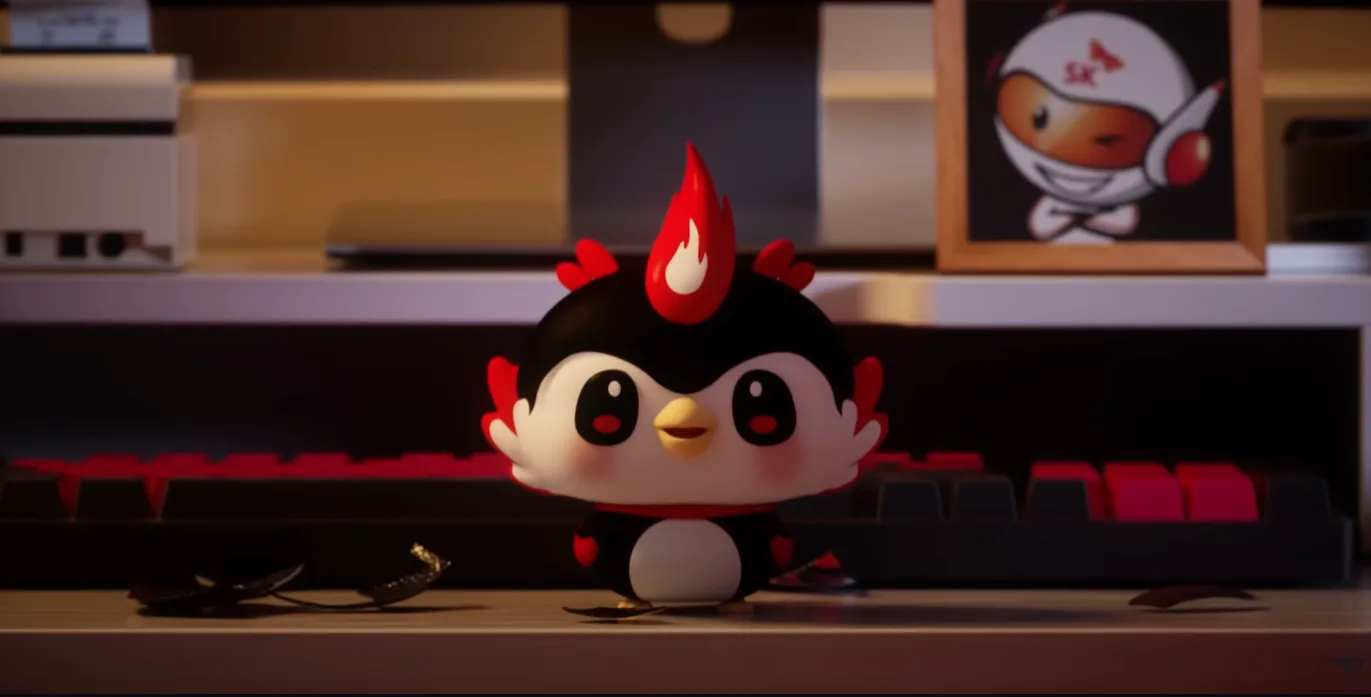
Fans added their own jokes to this. When T1 loses, they say ATI becomes samgyetang or fried chicken. It may sound harsh, but the core of the joke is not mockery. It is the feeling of repeated death and resurrection. A character collapses, gets teased, and then comes back alive for the next match. Through ATI, the fandom translated the emotions of T1’s matches into play once again.
At this point, an interesting cycle appears. Fans turn the team’s playstyle into a nickname. The organization provides symbols and content that fans can interpret. The players then create new scenes inside that structure. A nickname becomes a brand when this cycle is completed. “Circus troupe” is no longer only an external judgment. It becomes close to the name of an experience that fans and the team create together.
Not “What It Sells,” but “What It Makes People Expect”
In sports marketing, a brand is not defined only by what it sells. What matters more is what kind of experience people expect when they hear the name. By this standard, T1’s brand is difficult to define simply as “winning.” Other strong teams also win trophies. A team’s magnetism is not determined only by seedings or recent titles.
What T1 has come close to monopolizing is the expectation that “something will happen today.” The phrase “the circus is starting” in the chat condenses this expectation. The audience is not entering to reserve a result, but to anticipate an unpredictable performance. On some days, the act is spectacular. On other days, everyone collapses together. But either way, an event occurs.
At this point, the story of T1 as a single team meets a question about the esports industry as a whole. If fans are buying not victory but experience, and if teams are selling not victory but experience, what exactly is esports selling?
From the Age of Results to the Age of Experience
The product of traditional professional sports has long been close to the result: trophies, standings, records. The reason fans follow a season is ultimately to watch their team win, and the name most clearly recorded in history is that of the champion. Runners-up are usually remembered briefly, and a losing team’s season quickly turns into an assignment for the next one.
Of course, traditional sports have always had great moments and narratives. But esports grew from the beginning under slightly different conditions. As discussed earlier, online viewers are highly sensitive to real-time tension during a match. They enter with one click and leave with one click. In this environment, the unit fans consume is not only the final result of a season. The scene happening right now, the fight breaking out right now, the teamfight shaking the chat right now — that becomes the content.
Championships come only a few times a year. Viewing happens every day. What sustains those daily acts of viewing is not the trophy itself, but the expectation of “what will happen today?” Fans do not remember only championships. They remember that match, that one scene, that nickname. This is why a star team in esports becomes not merely a team that wins, but a team that continually produces scenes worth remembering.
Here, the meaning of T1 widens to the level of the industry. T1 was once a machine-like, stable team. Today, however, T1 is closer to a team balancing on a tightrope. This transition was not simply a matter of one team’s taste changing. It was one of the clearest examples of esports enjoyment moving from result-centered consumption toward experience-centered consumption.
Numbers Prove “Experience Consumption”
The fact that this is not merely a sentimental interpretation is also visible in the numbers. Whenever T1 plays in an important match, it drives viewership rankings upward. This is why fans joke that T1 is a “viewership demon.” The fact that T1 is playing becomes a viewing motive in itself.
The crucial point is that this viewership does not always move in parallel with the team’s position on the standings. Consider the final match between T1 and Gen.G at the 2026 LCK Road to MSI. That match, which recorded 2.27 million peak concurrent viewers, was not a stage where T1 could secure a championship. T1 had already lost the first seed, and if it lost that match, its path to MSI would be blocked. What was at stake was not a trophy, but survival.
Yet more than 2 million people gathered to watch. What they wanted to see was not simply confirmation of victory. They wanted to see whether T1, standing at the edge of a cliff, could come back to life again; whether this team could once again create an absurd scene. The way standings and viewership diverge here shows that fans are not consuming victory alone. People do not come only to watch the team most likely to win. They come to watch the team that might make anything happen tonight.
Experience Economy and Esports
This phenomenon already has an old name. In their 1998 Harvard Business Review article “Welcome to the Experience Economy,” management scholars B. Joseph Pine II and James H. Gilmore explained that economic value moves from commodities and goods to services, and then beyond services to experiences. As services become commonplace, companies must offer customers memorable scenes, and those scenes themselves become a new form of value.
Esports shows the logic of the experience economy with unusual clarity. Fans do not turn on a broadcast simply to check a result. They expect to see what kind of scene will unfold, what kind of emotion they will go through, and what kind of phrase will remain in the chat and community afterward. The arena is a space of competition, but also a stage that produces memory.
T1 is one of the teams that best demonstrates this kind of stagecraft. If a mascot like ATI translates fandom emotion into a character, the experiential exhibition “A Secret Journey Through the Stars,” presented by SK Telecom and T1 at T Factory Seongsu in July 2026, expands that experience beyond the arena. The exhibition interpreted T1’s championship history and the symbols of its players through displays and interactive programs, allowing fans to remain inside the T1 experience even on days without a match.
Ultimately, esports does not sell only the result of competition. It sells the total experience that viewers go through on the way to that result: tension, affection, jokes, and memory. T1 is close to the team that has shown this fact first and most clearly.
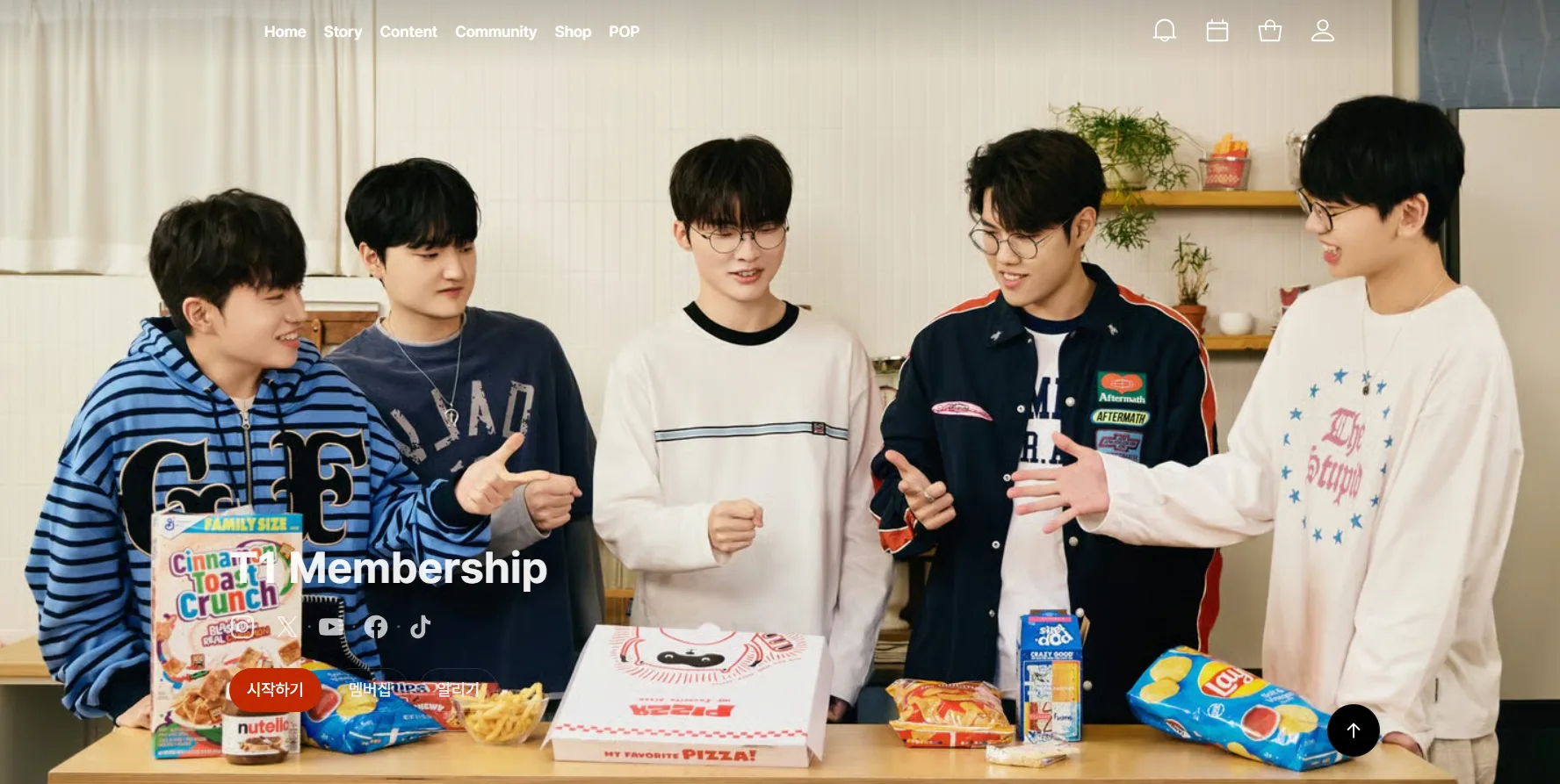
T1 is not loved because it is perfect. Fans keep buying tickets because, within the tension that it might collapse at any moment, T1 somehow creates a scene in the end. In years when it lifted trophies, in years when it missed them, and even on nights when it stood at the edge of a cliff, the seats were full. In the world of competition, T1 sometimes wins and sometimes loses. In the world of experience, T1 almost always wins.
That is why the phrase “the circus is starting” in the chat may in fact condense the nature of this entire industry. People do not come merely to confirm the result of a match. They come to watch another performance unfold. The invitation Pine and Gilmore issued more than a quarter century ago may now be taking shape most clearly in an arena in Daejeon.
“Welcome. T1’s circus performance is about to begin again.”