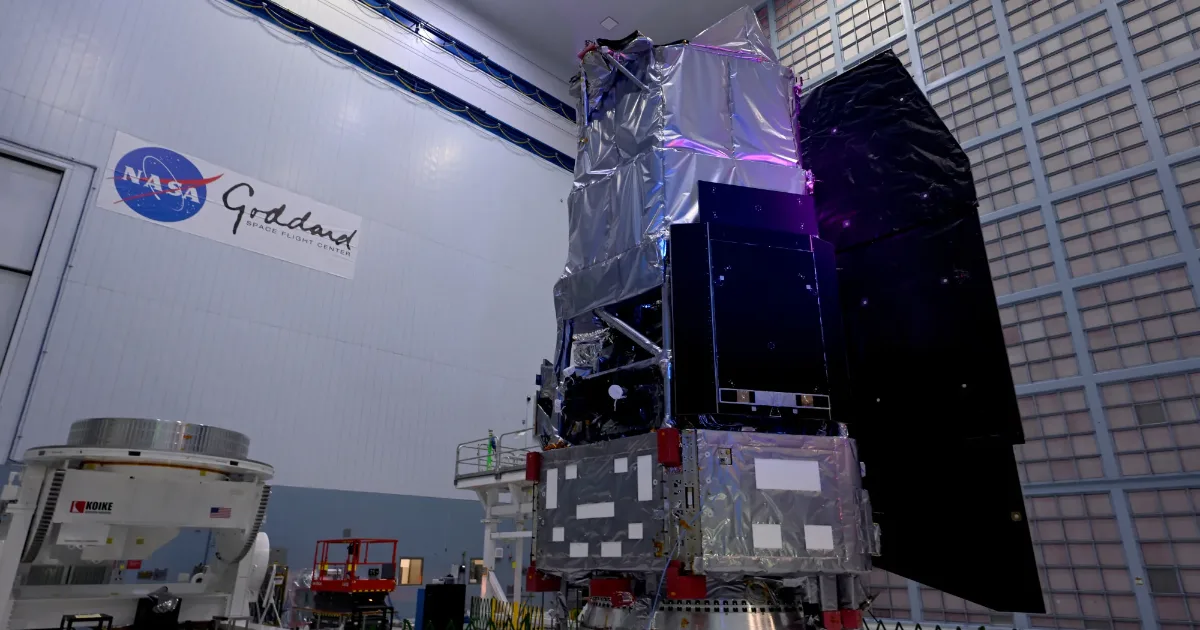
NASA’s next-generation space telescope, the Nancy Grace Roman Space Telescope, has entered the final stage of preparations for a targeted launch on August 30, 2026. NASA lists August 30, 2026, as the launch date on Roman’s official mission page, a schedule that is significantly earlier than the agency’s original commitment to launch the telescope no later than May 2027. NASA had previously announced in April 2026 that Roman’s launch target had been moved up to “early September 2026.”
Roman is not simply another space telescope. If the Hubble Space Telescope gave humanity sharp, detailed views of the cosmos, and the James Webb Space Telescope opened a deeper infrared window into the early universe and exoplanet atmospheres, Roman is designed to scan much larger areas of the sky at high speed and create a vast map of the universe. NASA says Roman will have a field of view at least 100 times wider than Hubble’s and will be able to measure light from one billion galaxies over the course of its mission.
What Is the Roman Space Telescope?
The Nancy Grace Roman Space Telescope is an infrared space observatory named after NASA’s first chief astronomer, Nancy Grace Roman. Roman played a central role in advancing the Hubble Space Telescope and is often called the “Mother of Hubble.” NASA’s decision to name its next-generation wide-field space telescope after her is symbolic. If Hubble opened humanity’s eye to the universe, Roman is intended to expand that view into a far broader cosmic map.
Roman’s core mission is to address fundamental questions about dark energy, dark matter, exoplanets, and infrared astrophysics. Dark energy is the concept introduced to explain the accelerating expansion of the universe, but its true nature remains unknown. Dark matter is essential for explaining the gravitational structure of galaxies and galaxy clusters, yet it has not been directly observed. By repeatedly surveying large regions of the sky, Roman will trace the expansion history and large-scale structure of the universe through galaxy distributions, supernovae, and gravitational lensing.
Another major objective is exoplanet discovery. Roman will observe the center of the Milky Way for long periods to detect gravitational microlensing events. Gravitational microlensing occurs when a star or planet bends the light of a more distant background star, producing a temporary change in brightness. This method is especially powerful for finding planets far from their host stars, planets close to Earth’s mass, and even free-floating planets that do not orbit any star.
NASA expects Roman’s five-year primary mission to create a data archive of roughly 20,000 terabytes, enabling research into 100,000 exoplanets, hundreds of millions of galaxies, billions of stars, and rare cosmic objects and phenomena that may never have been observed before.
Final Mirror Inspection Clears a Key Launch-Readiness Milestone
Roman recently passed an important milestone before launch. Engineers at NASA’s Goddard Space Flight Center completed the final inspection of the telescope’s primary mirror. Roman’s primary mirror is 7.9 feet, or about 2.4 meters, in diameter. It is the core optical component that collects and focuses light from distant cosmic objects. In many ways, it is the heart of the telescope’s scientific performance.
The inspection had two main purposes. The first was to confirm that no dust or foreign particles had entered the mirror surface or optical path during testing. The second was to check whether the mirror alignment remained stable after vibration testing that simulated the launch environment. During launch, a telescope must withstand intense vibration and noise. If the optical system shifts out of alignment, the telescope’s ability to observe the universe could be affected. NASA said Roman’s final primary mirror inspection was completed successfully and that the telescope is moving toward launch preparation.
Roman is now preparing to travel from NASA’s Goddard Space Flight Center in Greenbelt, Maryland, to the Kennedy Space Center in Florida. NASA previously said Kennedy’s Payload Hazardous Servicing Facility was being prepared for Roman’s arrival. Once Roman arrives at Kennedy, it will undergo detailed inspections to confirm that it was not damaged during transport, followed by fueling, launch rehearsals, fairing encapsulation, and integration with the launch vehicle.
Why Roman Matters Differently From James Webb
The James Webb Space Telescope has exceptionally powerful infrared observing capabilities, but it is optimized for looking deeply and precisely at relatively narrow regions of space. Roman, by contrast, is designed to survey large areas of the sky quickly. As NASA explains, Roman’s field of view is at least 100 times wider than Hubble’s. That means Roman can capture far more galaxies, stars, supernovae, and exoplanet candidates in the same amount of observing time.
This difference could change the way astronomy is done. If Hubble and Webb provide high-resolution portraits of specific cosmic scenes, Roman will build large-scale statistical maps of the universe. For dark energy research, the distribution and evolution of vast numbers of galaxies matter more than the study of a few individual galaxies. In exoplanet science, the key question is not only whether individual planets exist, but how common planets are and what types of masses and orbits dominate planetary systems.
Roman is not a rival to Webb. It is a complement. Roman can identify large numbers of interesting objects and phenomena across wide regions of the sky, while Webb and large ground-based telescopes can conduct deeper follow-up observations of the most important targets. Roman is therefore closer to a cosmic search engine, while Webb functions as a deep-analysis instrument for selected targets.
Another Observatory Bound for L2
After launch, Roman is expected to travel to the Sun-Earth L2 Lagrange point. L2 is located about 1.5 million kilometers from Earth in the direction opposite the Sun. It is a region where the gravitational forces of the Sun and Earth create a stable environment for space observatories. The James Webb Space Telescope also operates from this location.
The advantage of L2 is observational stability. Because the Sun, Earth, and Moon remain generally in the same direction from the telescope’s perspective, an observatory can use a sunshield to reduce the effects of heat and light. Temperature stability is especially important for infrared observations. For Roman to repeatedly observe large regions of the sky over long periods in search of dark energy signals and exoplanets, a stable location and thermal environment are essential.
Roman is scheduled to launch aboard a SpaceX Falcon Heavy rocket from Launch Complex 39A at Kennedy Space Center. NASA has said Roman will undergo launch preparations at Kennedy before being integrated with the Falcon Heavy.
The Data Era Roman Will Create
Roman’s real impact will come from the data it produces after launch. NASA expects the telescope to generate a 20,000-terabyte data archive over its five-year primary mission. That archive will support not only dark energy and exoplanet research, but also studies of galaxy evolution, star formation, supernovae, galaxy clusters, the structure of the Milky Way, and rare astronomical objects.
The important point is that Roman is not a telescope for only a narrow group of researchers. NASA has emphasized that Roman’s observing power will allow astronomers to explore a wide range of cosmic questions beyond the mission’s core objectives. The wide-field data Roman creates is likely to become the foundation for numerous follow-up studies. In that sense, Roman’s value is not limited to the observing power of a single telescope. It may become a massive data infrastructure for the entire astronomical research ecosystem.
Roman also symbolizes the direction of modern science. Earlier space telescopes were often associated with the most beautiful and precise images of the universe. Roman will be associated with one of the widest and richest astronomical databases ever created. In an era when AI and large-scale data analysis are becoming central tools of scientific discovery, Roman’s astronomical data could become a source of new findings for decades.
An Accelerated Launch Schedule and a Symbolic Achievement for NASA Science
The accelerated launch schedule is also significant. Large space science missions are often delayed and frequently face cost pressures. Complex optical systems, cryogenic conditions, vibration and radiation environments, launch vehicle integration, international cooperation, and budget changes all create risk. Against that backdrop, targeting a launch in late August 2026 — earlier than the original commitment to launch no later than May 2027 — is a meaningful achievement for NASA’s science mission management. NASA announced in April 2026 that Roman was targeting an “early September 2026” launch, and the official mission page later listed August 30, 2026, as the launch date.
Still, launch schedules remain fluid until the final stage. A space telescope may face schedule adjustments if issues are found during transport, inspection, fueling, launch vehicle integration, or final rehearsals. For a large scientific instrument such as Roman, safe launch preparation is more important than the launch date itself. August 30 should therefore be understood as the current target date, not an unchangeable guarantee.
Conclusion: Roman Opens the Era of Seeing the Universe Wide
The arrival of the Nancy Grace Roman Space Telescope signals the next chapter of NASA astronomy. Hubble showed the depth of the universe. Webb opened the early universe and the infrared sky. Roman will extend that vision into large-scale cosmic statistics and mapping. With a field of view 100 times wider than Hubble’s, a 20,000-terabyte data archive, the possibility of detecting 100,000 exoplanets, and observations of hundreds of millions of galaxies, Roman could change the kinds of questions astronomers are able to ask.
Roman’s importance is not simply that it will see farther. It will see wider, compare more objects, and read the patterns of the universe with greater statistical power. The nature of dark energy, the evolution of galaxies, the distribution of exoplanets, and the structure of the Milky Way may all become clearer within the enormous datasets Roman will create.
If the August 30, 2026, launch proceeds as planned, Roman will join Webb at L2 and expand humanity’s ability to observe the universe. The way we study space is moving from single deep images toward vast cosmic maps. The Roman Space Telescope stands at the center of that transition.